Your Complete Guide to CNA Classes and Training in San Diego
Compare accredited CNA programs in San Diego with details on costs, durations, and clinical hours.
By Bryce HallReviewed by Editorial staffUpdated August 10, 202614 min read
Key Points
San Diego metro employs 9,790 CNAs, median wage $46,600.
California's first-time CNA exam pass rate is just 59.13%.
Free CNA classes exist via employer sponsorships and grants.
Public community colleges versus private vocational schools: that choice shapes nearly every decision a prospective CNA in San Diego will make, from tuition and financial aid to evening availability and clinical partnerships. San Diego's healthcare sector employed 9,790 nursing assistants in 2023, with a median wage of $46,600, and growth projections point to steady hiring through the end of the decade.
This guide covers free training options through workforce boards and Medi-Cal-funded employers, evening and hybrid schedules for working adults, state certification steps, and salary benchmarks across the metro. You will also find an admissions checklist, financial-aid breakdowns, and a ranked list of programs evaluated on cost, graduate earnings, and student outcomes.
Most CNA programs in California can be completed in four to twelve weeks, but the state's first-time exam pass rate in 2023-2024 sat at 59.13 percent. That gap makes clinical prep and instructor experience critical variables in your program search.
CNA Job Market in San Diego: Employers, Demand, and Placement Rates
A Certified Nursing Assistant in San Diego is a frontline caregiver who handles bedside tasks like bathing, feeding, vital signs, and mobility support under the direction of licensed nurses. In this region, that role operates within one of California's busiest healthcare economies, where hospitals, children's facilities, skilled nursing homes, and county-run clinics all compete for trained staff.
Where CNAs Work in San Diego
Five employer names come up again and again in local job listings:
Scripps Health: A large nonprofit system with hospitals in La Jolla, Hillcrest, Encinitas, and Chula Vista, plus a network of outpatient sites that hire nursing assistants for inpatient units and same-day surgery.
UC San Diego Health: The region's academic medical center, with CNA hourly pay reported in the $24.08 to $29.91 range in 20246.
Sharp HealthCare: San Diego's largest private employer, running Sharp Memorial, Sharp Grossmont, and Sharp Chula Vista, with steady openings across medical-surgical and telemetry floors.
Kaiser Permanente: Reported CNA pay of roughly $28.08 to $30.45 per hour in San Diego in 20247, among the highest posted rates in the metro.
Rady Children's Hospital: The area's dedicated pediatric hospital, paying CNAs in the $22.00 to $30.27 range4 and often hiring for patient care assistant roles that build on CNA training.
The County of San Diego also hires nursing assistants for public health facilities and detention health services, with annual salaries reported around $45,000 to $50,000 in 20242.
Demand and What It Means for New CNAs
California employed about 100,000 CNAs statewide in 20241, and San Diego alone showed 221 active job postings that year2. Nationally, the Bureau of Labor Statistics projects 4% job growth for nursing assistants from 2023 to 2033, with roughly 216,000 openings each year1, most driven by turnover.
For new graduates, this mix matters. Starting hourly wages in San Diego sit around $203, ranging from $19 to $234; top earners at experienced hospital systems can clear $305. Program-level placement rates are not consistently published by California CNA schools, but the volume of hospital and long-term care openings means most graduates who pass the state exam and hold a clean background check land a CNA job within weeks, especially if they are open to skilled nursing facilities before moving into a hospital role.
The healthcare sector in San Diego is projected to keep expanding, which means steady demand for certified nursing assistants. Many local CNA programs have direct ties to leading hospitals and skilled nursing facilities, so you can gain clinical experience with employers who often hire graduates right away. This gives you a real advantage in landing a job after certification.
CNA Salary and Job Outlook in San Diego Metro
The San Diego metro area employed 9,790 nursing assistants, with a median annual wage of $46,600. Wages range from $45,300 at the 25th percentile to $49,010 at the 75th percentile, placing San Diego near the middle among major California metros. By comparison, the nearby Riverside area reports a median wage of $44,950, while San Francisco and San Jose offer significantly higher pay due to cost of living differences.
Metro Area
Total Employment
Median Annual Wage
25th Percentile Wage
75th Percentile Wage
San Diego-Chula Vista-Carlsbad, CA
9,790
$46,600
$45,300
$49,010
Los Angeles-Long Beach-Anaheim, CA
39,910
$46,140
$44,870
$48,460
Riverside-San Bernardino-Ontario, CA
9,040
$44,950
$40,640
$47,050
San Francisco-Oakland-Fremont, CA
10,750
$53,990
$49,460
$58,810
San Jose-Sunnyvale-Santa Clara, CA
4,910
$56,220
$50,900
$65,950
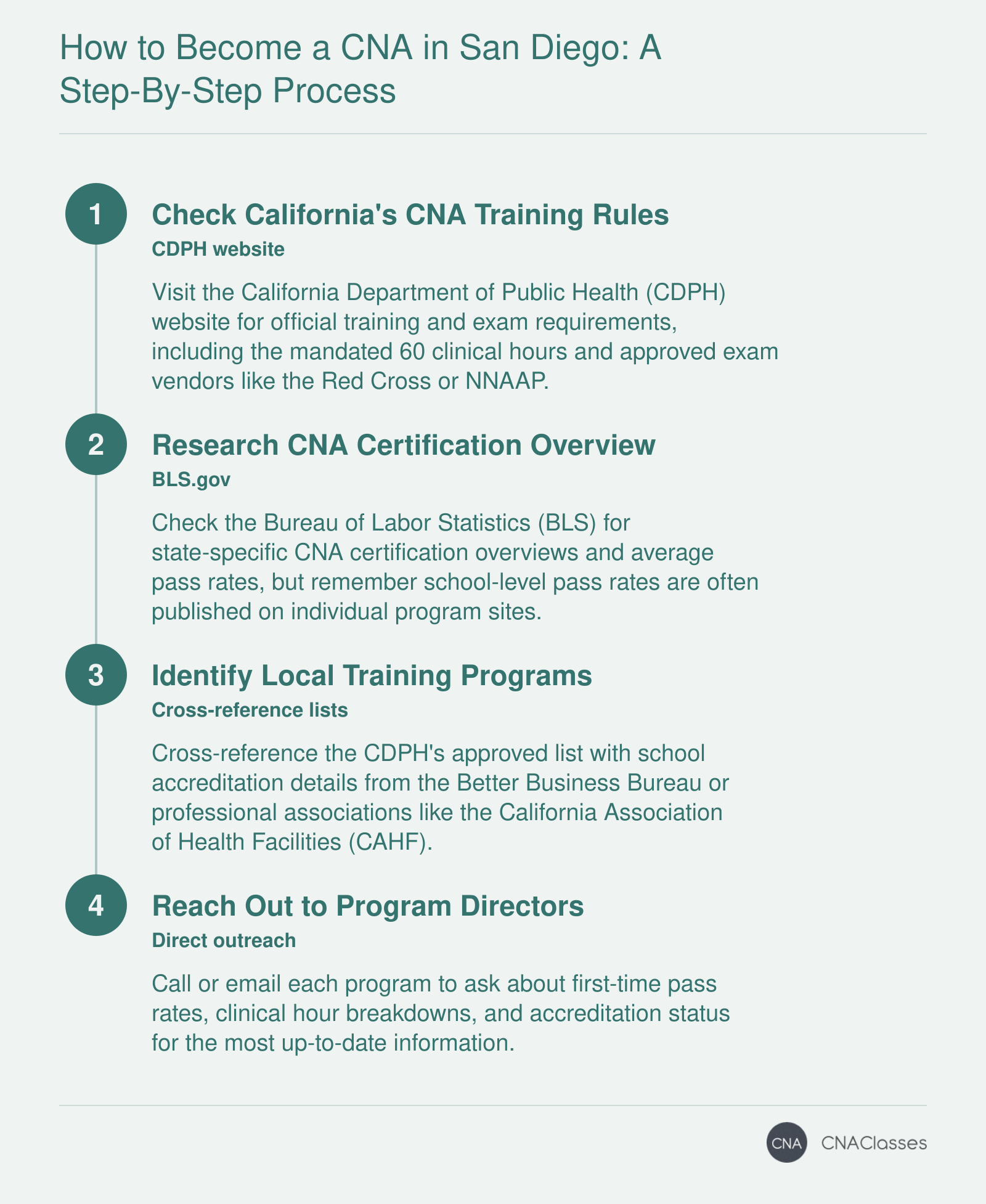
How to Become a CNA in San Diego: A Step-By-Step Process
Becoming a Certified Nursing Assistant in San Diego requires following a clear sequence of steps, from understanding state mandates to selecting an approved training program. Use reliable sources and direct communication to gather the most current information on pass rates and program quality.
Here's a stat that surprises most aspiring CNAs: California's first-time pass rate on the state CNA exam was just 59.13% in 2023-2024, according to data reported by Ventura College. That means choosing a program with strong clinical prep and exam coaching can seriously improve your odds of certifying on the first try.
CNA Program Admission Requirements in San Diego
Before you apply, review these typical requirements for CNA programs in the San Diego area. While specifics vary by school, this checklist covers the essentials.
Age and Education
Be at least 16 years old (some programs require 18). A high school diploma or GED is usually required; if you don’t have one, some schools accept a passing score on the Wonderlic assessment.
Background Check and Drug Screening
All programs require a criminal background check. Some, like Southwestern College, also mandate a drug screening. Live-scan fingerprinting is common.
Health Requirements
Immunizations typically include MMR, Hepatitis B, Varicella, Tdap, COVID-19, and flu shot. A physical exam and TB test are often required before clinical rotations.
Entrance Exams
Most programs have no academic prerequisites, but Poway Adult School requires a CTE Readiness Assessment (score 235+), and Dalrada may use the Wonderlic for some applicants.
Application Materials
Prepare your photo ID, Social Security card, high school diploma/GED, and CPR certification (required by some schools). Check application deadlines, they vary throughout the year.
Questions to Ask Yourself
Does the program offer job placement assistance or connections with San Diego healthcare employers?
Many San Diego programs partner with hospitals, skilled nursing facilities, and home health agencies to help graduates secure interviews. Schools with strong employer networks can significantly shorten your job search and give you access to openings before they are publicly posted.
Do you need a fast-track program to start earning income quickly, or can you spread training over several months?
Accelerated programs (3 to 6 weeks) let you enter the workforce faster but demand full-time availability and intensive study. Part-time evening or weekend schedules take longer but fit around existing work or family commitments.
Have you asked local hospitals, nursing homes, or home health agencies if they sponsor CNA tuition in exchange for a work commitment?
Employer-sponsored tuition programs cover your training costs in full or in part, often requiring you to work for the sponsoring facility for six months to a year after certification. This arrangement eliminates upfront cost and guarantees a job upon completion.
What days and times can you realistically commit to attending class and clinical rotations?
CNA programs require both classroom hours and hands-on clinical shifts, which may fall on weekdays, evenings, or weekends. Matching your schedule to a program's calendar prevents dropped classes and keeps you on track to complete training and sit for the state exam.
CNA Program Costs and Financial Aid in San Diego
Training for CNA classes in California, including right here in San Diego, does not have to break the bank. Costs vary widely depending on where you enroll, and there are genuine pathways to free or heavily subsidized training if you know where to look.
Understanding the Cost Range
At the low end, San Diego Continuing Education (SDCE) charges no tuition for its CNA program.3 You will still need to budget roughly $400 for additional costs such as uniforms, textbooks, and exam-related fees, but the instructional cost itself is zero.4 That makes SDCE one of the most accessible entry points in the region.
Adult school programs sit in the next tier. Poway Adult School, for example, prices its program at $1,195 for students starting in August 2026, with a manageable payment plan: a $300 down payment followed by four installments of $223.75.3 Private training centers typically range from $750 to $1,500 in tuition, often requiring a $300 deposit to hold your seat.3 The average cost across San Diego programs lands around $1,500 when all fees are factored in.4
Financial Aid and Funding Options
Several funding sources can reduce or eliminate your out-of-pocket costs.
Pell Grants: Federal Pell Grants are available to eligible students at accredited institutions, including some community college CNA pathways. Completing the FAFSA is the first step.
WIOA Funding: The Workforce Innovation and Opportunity Act covers tuition, books, required materials, and exam fees for qualifying individuals. Eligibility is aimed at people who are unemployed or underemployed, low income, or dislocated workers. Contact the San Diego Workforce Partnership or a local America's Job Center to start an application.6
Medicaid Reimbursement: If you are hired within 12 months of completing your program at a Medicaid-funded long-term care facility in California, the facility may reimburse your training costs. Ask potential employers about this before you enroll.4
Scholarships: International Health Group Career College offers scholarships through its IHG Education Foundation for eligible applicants.6
Employer Tuition Assistance: Large healthcare systems in San Diego sometimes sponsor CNA training for candidates who commit to working for them after graduation. Ask during the hiring or interview process.6
What You Will Need to Apply for Aid
Gather these documents before you start any application:
Government-issued photo ID and Social Security card
Proof of income or unemployment status (pay stubs, termination letter, tax returns)
Completed FAFSA if applying for federal aid
Proof of California residency for WIOA or state-funded programs
Reaching out to the financial aid office at your chosen program early, before the semester start date, gives you the best chance of securing funds before seats fill up.
Top-Ranked CNA Programs for San Diego Students
Below are two leading CNA programs in the San Diego area, each offering distinct advantages for aspiring nursing assistants. These schools combine quality instruction with practical experience to help you launch a healthcare career.
NCES-IPEDS federal institutional data — nces.ed.gov
Independent program research
Southwestern College
#1
Chula Vista, CA · $13,000/yr
Best for: Budget-conscious students needing flexible schedules
Southwestern College, a community college in Chula Vista, offers an affordable CNA program with flexible 9-week or 18-week sessions. The curriculum includes classroom instruction and hands-on clinical training at local nursing facilities. Graduates are eligible for state certification and benefit from the college's strong ties to the San Diego healthcare community.
Certified Nursing Assistant — On-Campus
8.5-unit course structure with lecture and lab components
9-week or 18-week sessions available each semester
Best for: Career changers seeking rapid certification
Pima Medical Institute-Chula Vista provides a fast-track CNA certificate program that can be completed in about six weeks. The on-campus training emphasizes hands-on skills, including infection control and patient care, with clinical externships for real-world experience. The school offers career services and financial aid options to support students from enrollment through job placement.
Nursing Assistant / Nurse Aide Certificate Program — On-Campus
Six-week accelerated program
On-campus instruction with hands-on training
Clinical externships included for practical experience
Covers infection control and patient care skills
Financial aid options available to those who qualify
Frequently Asked Questions About CNA Training in San Diego
Have questions about becoming a CNA in San Diego? We've compiled answers to the most common queries from prospective students. From training duration and costs to certification requirements and job placement, get the facts you need to start your healthcare career.
How long does it take to become a CNA in San Diego?
Most programs take 4-12 weeks. California requires at least 60 hours of theory and 100 hours of clinical training. Full-time students can finish in about 4-6 weeks; part-time or evening programs may extend to 12 weeks. After training, you'll schedule the state exam, which may add a few weeks for testing and processing.
How much does CNA training cost in San Diego?
Costs vary widely, from about $500 to $2,500. Community colleges and adult schools often charge on the lower end, while private vocational schools may be higher. Some facilities, like nursing homes, offer free training in exchange for a work commitment. Additional expenses include textbooks, uniforms, background checks, and exam fees (around $100).
Are there free CNA classes in San Diego?
Yes, some healthcare facilities sponsor free training if you agree to work for them after certification. Local workforce development programs and grants may also cover costs for eligible students. Check with nursing homes, hospitals, and organizations like the San Diego Workforce Partnership for free or subsidized options.
What are the requirements for CNA certification in California?
You must complete a state-approved training program, pass a criminal background check, and pass the California CNA competency exam (written and skills). You also need to provide proof of immunizations, a TB test, and be at least 16 years old. No high school diploma is required, but most programs expect one or a GED.
Can I take CNA classes online in San Diego?
Partially online programs exist, but clinical hours must be completed in person. Some schools offer hybrid formats where theory is online and labs/clinicals are on-site. Ensure the program is approved by the California Department of Public Health (CDPH) so you're eligible for the state exam upon completion.
Do CNA programs in San Diego help with job placement?
Many schools help with landing your first CNA job, offering resume reviews, interview prep, and direct connections to local employers. Some have partnerships with hospitals and nursing homes that hire graduates. Always ask about placement rates and career support services when evaluating a program.
What is the typical exam pass rate for CNA graduates in San Diego?
Pass rates vary by program, but better schools generally report rates above 80%. California has a state competency exam; some programs publish their pass rates. High-quality training with hands-on practice tends to yield better results. You can ask schools directly for their latest exam pass rate data.
What's the difference between a CNA and a Home Health Aide (HHA)?
CNAs work in facilities like nursing homes and hospitals, providing basic nursing care under an RN. HHAs often work in clients' homes, assisting with daily living activities. Some tasks overlap, but CNAs typically have more medical responsibilities (vital signs, repositioning). In California, CNAs can become HHAs with additional training.