Key Points
- Virginia Peninsula Community College charges just $815 for its CNA program.
- The state projects 28.6 percent job growth for CNAs.
- CNAs in Richmond and Charlottesville earn median wages near $38,890.
Compare Virginia's top CNA programs: costs, schedules, and career outcomes to find your best fit.
Virginia is projected to add certified nursing assistants at a 28.6 percent growth rate in the coming years. For most prospective students, the biggest practical question is not whether jobs exist, but how to get licensed without overpaying or choosing a program with a weak pass record.
Tuition across Virginia's approved programs ranges from under $1,000 at some community colleges to nearly $3,500 at private training centers. That spread matters because a higher price tag does not reliably predict better preparation for the state competency exam. A program's first-attempt pass rate is often a sharper indicator of quality than its cost or location.
For many applicants, the real constraint is schedule. Working adults, parents, and career changers often need evening, weekend, or hybrid options, and not every program offers them. Demand for CNAs in Virginia is strong enough that employers are actively competing for newly certified aides, which means the credential itself holds real labor-market value once you have it.
Which CNA training programs in Virginia actually prepare students to pass their certification exam and land a job?
That is the question worth centering before you enroll anywhere. Virginia has a broad range of approved nursing assistant programs, from community colleges to vocational schools to employer-sponsored training sites. Not all of them publish clear outcome data, which means a little detective work on your part goes a long way.
The eight programs highlighted in this section were selected with value in mind: accessible tuition, strong completion support, and a track record of producing graduates who are ready to work. Because program approval status and exam pass rates can shift from year to year, we strongly recommend verifying the details below through the primary sources described throughout this section.
Every legitimate CNA program in Virginia must be approved by the Virginia Board of Nursing. Before paying a deposit or signing an enrollment agreement, visit the Board of Nursing website directly and confirm the program is listed in good standing. Approval status can change, and a school that was compliant last year may have had its standing updated since then.
While you are on the Board of Nursing site, look for published exam pass rate data. This information sometimes appears in board meeting minutes or annual reports. A program with a consistently high first-attempt pass rate is one of the clearest signals that instruction quality is solid.
Public databases tell part of the story. School websites, alumni groups, and local healthcare networks fill in the rest. When researching any program on this list, check the school's own site for published pass rates, job placement figures, and student testimonials. These sources are often updated more frequently than state reports and can give you a ground-level view of what graduates experienced.
The Bureau of Labor Statistics at BLS.gov is another practical resource. It publishes local area wage data and employment projections that let you compare what CNAs are earning in different parts of Virginia and how demand is expected to grow in your region. That context helps you weigh whether a program's location lines up with where the job market is strongest.
Some of the most useful program intelligence does not appear online at all. The Virginia Healthcare Association connects employers and training programs across the state, and reaching out to their staff can surface candid perspectives on which schools produce work-ready graduates. Local nursing home administrators and hospital hiring coordinators are similarly well-positioned to tell you which programs they recruit from most actively.
A quick phone call to two or three local employers asking which programs they trust can be more informative than hours of online searching. These conversations cost nothing and can prevent a costly enrollment mistake.
The programs profiled below represent a cross-section of training options across Virginia, including community college pathways, standalone vocational programs, and formats suited to working adults. Use each profile as a starting point, then apply the verification steps above before making a final decision. The right program for you will depend on your schedule, budget, commute, and career goals, and no single list can substitute for your own due diligence.
Every program on our list earned its spot through measurable outcomes, not opinions. We built our selection process around publicly available federal data and state nursing board records so you can verify the numbers yourself.
The centerpiece of our evaluation is a return-on-investment calculation that weighs two critical data points together: what graduates typically earn a decade after starting their program, and how much federal debt completers carry at graduation. A program that leads to strong long-term earnings while keeping student debt low scores well on this metric. Both figures come directly from federal postsecondary datasets, giving you an apples-to-apples comparison across schools regardless of their marketing claims.
Beyond the ROI metric, we factored in several other indicators that affect your experience and outcomes as a student:
State competency exam results are one of the most telling indicators of training quality, so we independently cross-referenced each program's pass rates using Virginia Board of Nursing records. This step ensures the numbers you see reflect actual testing outcomes rather than self-reported or outdated figures. Programs with consistently high pass rates demonstrate that their curriculum, clinical hours, and instruction genuinely prepare students for certification.
Rankings built on subjective criteria or anonymous reviews can steer you toward programs that look impressive on the surface but fall short where it counts. By grounding every selection in verifiable data from federal datasets and state regulatory records, we give you the information you need to make a confident, well-informed decision about where to train. If a program appears on our list, it is because the numbers back it up.
Sticker price is only part of the story when you budget for CNA training in Virginia. Programs across the state advertise tuition ranging from about $815 at Virginia Peninsula Community College to roughly $3,495 at schools like Virginia Western Community College and Danville Community College, but several line items rarely show up in the headline number.
Tuition across Virginia's CNA programs generally falls between $800 and $3,500, yet total out-of-pocket costs climb higher once you account for extras:
Put it all together and most students should plan for a total investment between roughly $1,050 and $3,840.
Virginia offers several pathways that can cut your costs dramatically or eliminate them entirely.
The G3 Program, available at community colleges statewide, covers tuition and fees for Virginia residents whose household income falls below 400 percent of the federal poverty level. If you qualify, your tuition drops to zero6. Virginia's FastForward workforce credentials program is another strong option, bringing total program costs down to around $1,163 to $1,165 through state subsidies4.
WIOA grants, administered through local Virginia Workforce Centers, can cover tuition, textbooks, and testing fees. Eligibility is generally based on income guidelines and employment status. To apply, visit your nearest Workforce Center, where a counselor will walk you through documentation requirements and help you determine whether you qualify.
Employer-sponsored training is perhaps the most straightforward route. Many Medicare- and Medicaid-certified nursing facilities in Virginia will pay the full cost of your training and testing if you agree to work for them during or after the program. You typically need to be employed by the facility or have a job offer in hand before training begins.
Before you enroll, ask the admissions office for an itemized cost sheet that includes every fee, not just tuition. Compare at least two or three programs side by side so you can see where the real value lies. A program with higher tuition but fewer add-on fees may end up costing the same as a cheaper option that nickel-and-dimes you along the way.
In Virginia, the median annual wage for nursing assistants is $37,150, or about $17.86 per hour, according to the latest data. Pay varies significantly by location, with Richmond and Charlottesville offering median salaries near $38,890, while areas like Blacksburg and Staunton hover closer to $37,150. Northern Virginia, part of the Washington D.C. metro area, typically pays above the state average, with experienced CNAs earning up to $24.90 per hour in Fairfax. Entry-level workers can expect around $27,000 annually, while seasoned professionals with 5+ years of experience earn roughly $39,000. Top-paying employers include the U.S. Department of Veterans Affairs and hospital systems, where hourly rates can reach $25.50. The table below breaks down median wages across Virginia's metro areas to help you gauge earning potential where you plan to work.
| Metro Area | Median Annual Wage | Median Hourly Wage |
|---|---|---|
| Virginia (statewide) | $37,150 | $17.86 |
| Richmond, VA | $38,890 | $18.70 |
| Charlottesville, VA | $38,870 | $18.69 |
| Winchester, VA-WV | $38,790 | $18.65 |
| Roanoke, VA | $38,260 | $18.39 |
| Harrisonburg, VA | $37,720 | $18.13 |
| Lynchburg, VA | $37,540 | $18.05 |
| Virginia Beach-Chesapeake-Norfolk, VA-NC | $37,400 | $17.98 |
| Staunton-Stuarts Draft, VA | $37,340 | $17.95 |
| Blacksburg-Christiansburg-Radford, VA | $37,150 | $17.86 |
According to the 2026 Jobs Outlook for Virginia, certified nursing assistants are projected to grow by 28.6 percent, a rate that outpaces many other healthcare support roles in the state. That kind of demand translates into strong, consistent hiring opportunities for newly certified CNAs entering the workforce.
Getting your CNA certification in Virginia is straightforward, but you likely have questions about timelines, costs, and what to expect. Below we answer the most common questions from future nursing assistants across the Commonwealth.
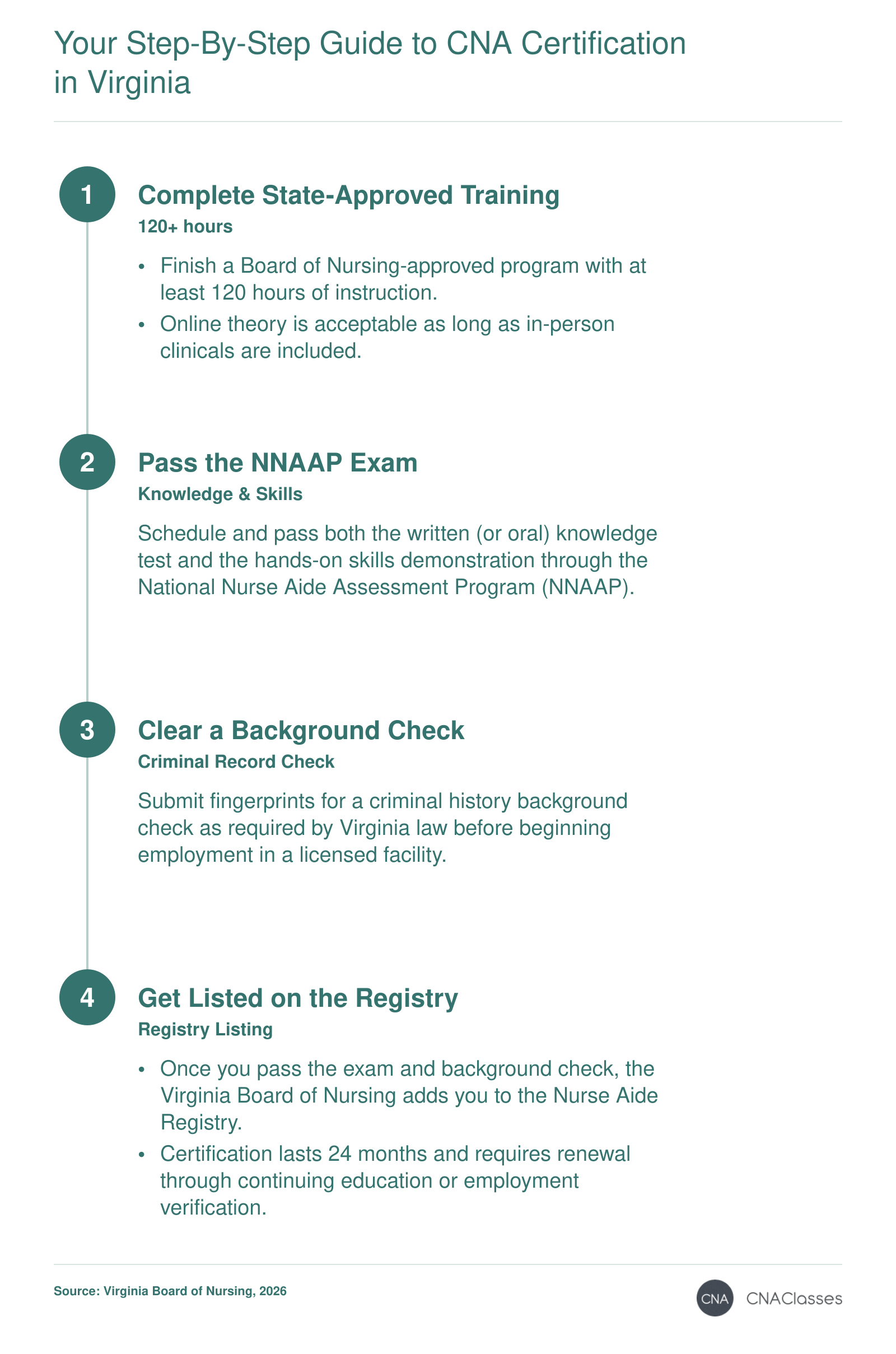
Most programs take 4 to 12 weeks to complete, depending on whether you study full-time or part-time. Virginia requires at least 120 hours of training, including 40 hours of clinical practice.1 Intensive full-time courses can get you ready in about a month, while evening or weekend classes may extend the timeframe to 12 weeks.
Virginia does not require a high school diploma or GED for CNA training; you only need to be at least 16 years old. However, many training programs have their own admission criteria, so it's wise to check with the specific school before you apply.
In Virginia, a Certified Nursing Assistant (CNA) has state-approved training, passes the NNAAP exam, and provides medical care under nurse supervision. A Personal Care Aide (PCA) helps with daily living tasks but typically does not require certification or provide medical care. Licensed Nursing Assistant (LNA) is the same as a CNA in other states, but Virginia consistently uses the CNA credential.
Yes, Virginia allows you to work as a nursing assistant for up to 120 days while enrolled in an approved training program. You must complete your training and pass the CNA exam within that period to continue working. This is a great way to earn income and gain hands-on experience simultaneously.
The NNAAP exam in Virginia costs between $140 and $180.4 The written portion is $45, and the skills evaluation is $95.5 Some testing providers bundle the fees, so the total may vary slightly. Retakes are allowed up to three times within two years of completing your training, with additional fees for each attempt.
No, CNA training in Virginia cannot be completed fully online. State regulations require in-person clinical hours (40 hours minimum) to ensure you gain hands-on skills. While some programs may offer hybrid models with online coursework for theory, the clinical component must be done at an approved healthcare facility.
Virginia CNA certification is valid for two years. To renew, you must have worked at least eight hours in a nursing-related role during that period1 and have no convictions of abuse or neglect. The Virginia Board of Nursing sends renewal notices about 60 days before expiration, and you can renew online or by mail.
Absolutely, Virginia hospitals frequently hire CNAs directly. With the state's growing healthcare demand, many acute care facilities and rehabilitation centers actively recruit nursing assistants. Completing your CNA certification opens doors to hospital-based roles; learn how to get a CNA job.
Becoming a CNA in Virginia follows a clear, regulated path. You'll need to complete state-approved training, pass a competency exam, and meet background requirements before your name appears on the Nurse Aide Registry.
Virginia's CNA programs offer a variety of schedules to accommodate working adults, full-time students, and career changers, though the specific days and times change each term. Because program schedules shift frequently with enrollment demand and instructor availability, the most reliable way to confirm current class formats is to contact schools directly or check their websites regularly.
Start with the Virginia Board of Nursing's official list of approved CNA programs. This registry ensures every program meets state clinical and instructional hour requirements. Once you identify programs in your area, visit each school's admissions page or call their enrollment office to request a current semester schedule. Many community colleges and vocational schools publish course catalogs online showing section numbers, meeting days, and times (for example, a morning section running Monday, Wednesday, and Friday or an evening cohort meeting Tuesday and Thursday). High-demand locations may offer multiple sections per term, while smaller schools might run one cohort at a time.
Traditional daytime programs typically meet on weekdays during business hours and can be completed in a condensed timeframe if you are available full-time. Evening programs are designed for students who work during the day, with classroom and lab sessions beginning in the late afternoon or early evening. Weekend formats condense instruction into Saturdays, Sundays, or both, though clinical rotations may still require some weekday availability depending on facility partnerships. Ask each program how clinical hours are scheduled, since those placements often follow healthcare facility shifts rather than academic calendars.
Some Virginia programs offer hybrid formats that deliver lecture content online while requiring in-person attendance for lab skills and clinical rotations. Fully online CNA programs are rare because state regulations mandate a minimum number of supervised clinical hours in healthcare settings. If you are considering a hybrid course, verify that the program appears on the Virginia Board of Nursing's approved list and that the clinical component meets the state's hour requirements. Review the program's accreditation details on the Board of Nursing website to confirm it will qualify you to sit for the Virginia certification exam. Cross-reference community colleges and technical centers in your region, as they frequently update their online course offerings and publish clear hybrid-format descriptions in their catalogs.
Beyond the top-rated programs, Virginia offers many other state-approved CNA training options. These additional providers meet the Virginia Board of Nursing's standards and offer flexible schedules to fit your needs. Explore the full directory below to find a program near you.