Key Points
- Michigan's CNA demand is growing 11.5 percent, adding 11,700 jobs by 2032.
- Accelerated CNA programs in Michigan can be completed in just 2 weeks.
- Michigan Works! funding can cover the total cost of CNA classes.
Compare Michigan's best CNA programs by cost, schedule, and clinical hours to find an affordable, flexible option near you.
Michigan’s healthcare support workforce is projected to grow by 11,700 jobs between 2022 and 2032, with nursing assistants accounting for a large portion as the state’s senior population expands.
While that demand makes certification a reliable career move, training quality and total cost are far from standardized. Some programs advertise low tuition but tack on hundreds in fees; others promise fast completion while skimping on the clinical hours employers actually require. Discerning which programs deliver is not a matter of preference but of due diligence.
Identifying the strongest CNA programs in Michigan begins with verifying state approval, not promotional materials or third-party rankings.
Every program legally authorized to train CNAs in Michigan appears on the Michigan Department of Licensing and Regulatory Affairs (LARA) website. This registry is your first checkpoint. Programs without current approval cannot prepare you for the state certification exam. The LARA list updates regularly as schools gain, renew, or lose their authorization, so checking approval status directly prevents you from enrolling in a program that cannot legally credential you. While the state approval list confirms legal standing, it does not differentiate between programs on quality, outcomes, or cost.
Once you have confirmed a program holds current state approval, investigate its performance metrics. Strong programs publish certification exam pass rates and job placement statistics, usually on their own websites or in materials provided during information sessions. Programs that consistently graduate students who pass the state exam on their first attempt and secure employment within weeks of certification deliver measurable value. If a school hesitates to share these numbers or provides vague answers, consider that a warning sign. Accreditation matters as well. While state approval covers legal training standards, institutional accreditation from bodies recognized by the U.S. Department of Education signals that the school meets broader educational quality benchmarks. This distinction becomes important if you plan to pursue federal financial aid or transfer credits later.
The Michigan Health & Hospital Association and LeadingAge Michigan maintain connections with healthcare employers across the state and often know which programs produce job-ready graduates. Contacting these organizations for recommendations adds a layer of validation beyond what appears on official lists. Employers who hire CNAs regularly notice patterns in which programs consistently prepare students for the realities of the role. These insights are harder to quantify than pass rates, but they matter when you are competing for your first position.
Tuition for state-approved CNA training programs in Michigan varies widely. Some community colleges and vocational schools offer training at a fraction of the cost charged by private career institutes. Cost alone does not determine value. A less expensive program with poor pass rates or weak employer relationships may cost you more in delayed earnings than a moderately priced program with strong placement support. Review the U.S. Bureau of Labor Statistics wage data for CNAs in your target region to estimate your return on investment, then weigh that against each program's total cost, including fees, textbooks, uniforms, background checks, and certification exam expenses.
Becoming a Certified Nursing Assistant in Michigan follows a clear, regulated path. Here’s how to navigate each stage, from training to the state registry.
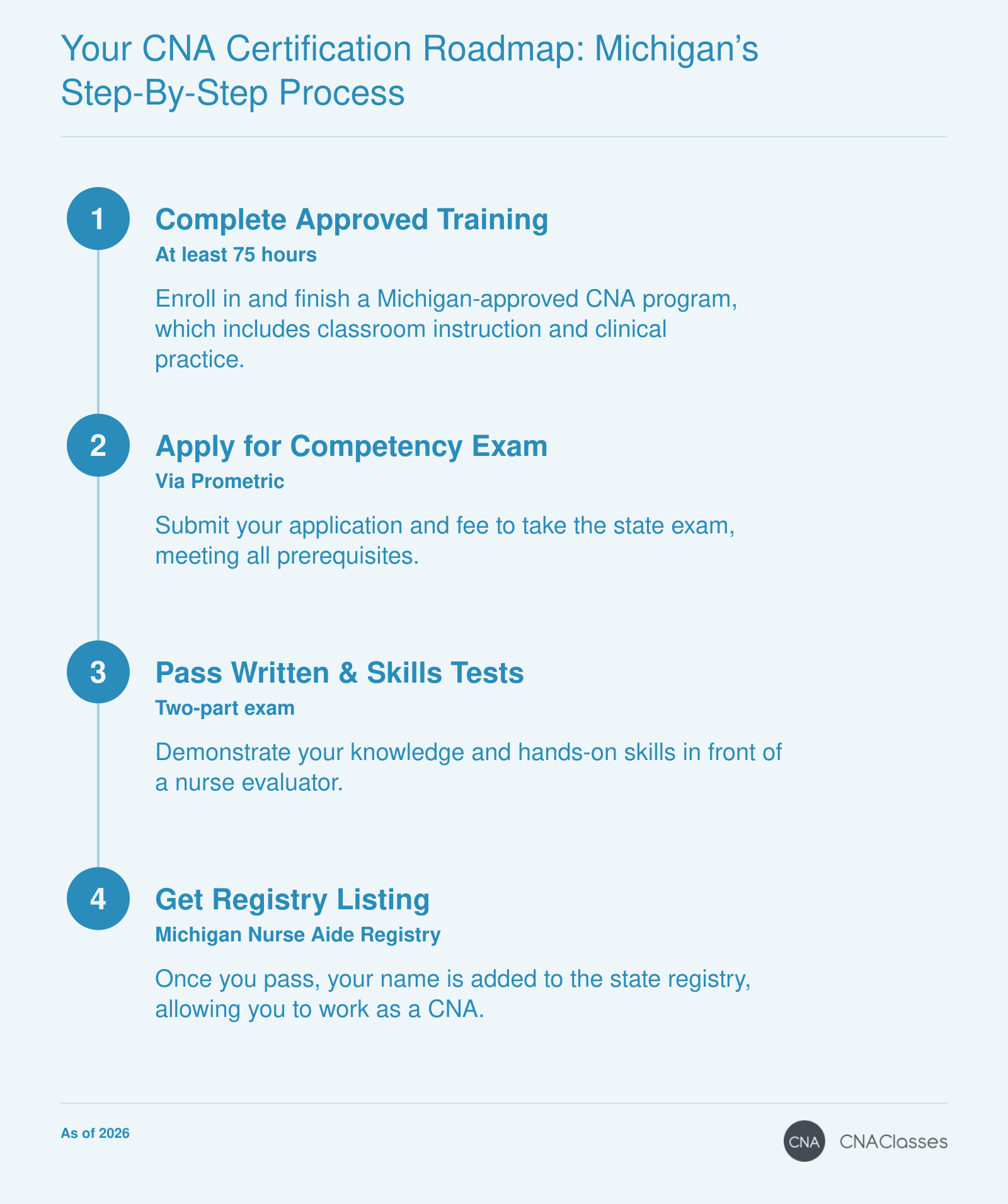
Licensing as a CNA in Michigan means completing a state-approved training program, passing a two-part certification exam, and registering with the state's nurse aide registry. Each piece has specific requirements set by LARA (the Michigan Department of Licensing and Regulatory Affairs), and knowing them upfront helps you plan your timeline, budget, and study strategy.
Michigan requires a minimum of 75 hours of training through a LARA-approved Nurse Aide Training and Competency Evaluation Program (NATCEP). Within those 75 hours, at least 16 must be spent in a clinical setting where you practice hands-on skills with real patients under supervision, and at least 16 must be classroom instruction. The remaining hours cover topics like infection control, patient safety, communication, and basic nursing skills.
If you already have experience working as a nurse aide but lack formal certification, Michigan does offer a competency evaluation pathway. This option lets qualified individuals demonstrate their skills and knowledge without completing the full training program, though eligibility criteria are strict.
Once you finish your approved training, the next step is the state certification exam, which is administered by Headmaster/TMU. The test has two components:
You must pass both parts to earn your certification. Total exam fees come to $195 ($175 exam fee plus a $20 application fee). If you don't pass on your first try, you have up to three attempts within a 24-month window. After three unsuccessful attempts, you would need to retake an approved training program before testing again.
After passing both exam components, your name is added to the Michigan Nurse Aide Registry (MI-NATES). This registry is what employers check to verify your active certification status, so keeping it current is essential.
To maintain your certification, you must renew every 24 months. Renewal requires that you have performed paid nursing aide work during the renewal period, and the fee is $40. If your certification lapses, you may need to retest or retrain depending on how long it has been inactive.
Most people complete the entire process in 4 to 12 weeks from start to finish. Accelerated programs can get you through the 75 training hours in as little as two to three weeks, while part-time or evening programs may stretch across two to three months. After training, you will need to schedule your exam date and allow time for your registry listing to process. If you choose a fast-track program and pass the exam on your first attempt, it is realistic to go from enrollment to job-ready in under six weeks.
Planning ahead helps: register for your exam before you finish training so there is minimal downtime between your last class day and your test date. Programs on cnaclasses.org include scheduling details that can help you map out your personal timeline.
How much does CNA training in Michigan actually cost once you add up every fee, supply, and exam charge beyond the sticker price?
Tuition across Michigan's CNA programs ranges from roughly $600 to over $2,0001, but that number rarely tells the full story. Most programs list a base tuition figure that excludes several required expenses you will need to budget for before your first day of clinical rotations. Understanding the complete picture helps you avoid surprises and compare programs on a true apples-to-apples basis.
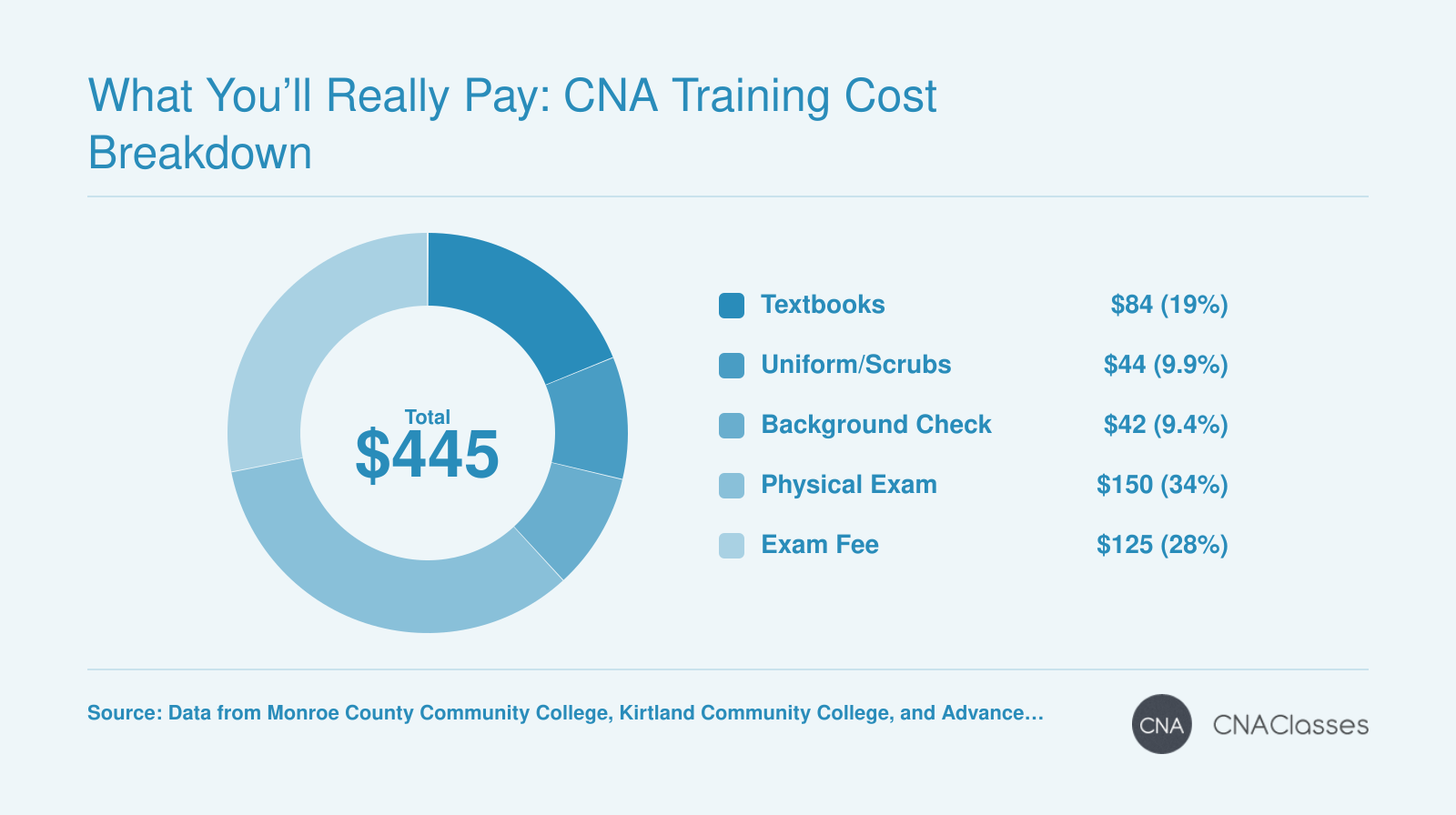
Beyond tuition, you should plan for ancillary expenses that typically total between $300 and $7001. Here are the line items for 2026:
When you combine tuition with every ancillary cost, a private-pay student in Michigan can expect to spend somewhere between $910 and $2,4351 from enrollment through certification. Students who choose a lower-cost community program and already have up-to-date immunizations and CPR certification will land closer to the lower end. Those selecting a premium program or starting from scratch on health requirements will trend higher.
Keep in mind that net-price figures, which factor in any financial aid or employer sponsorship, can look very different from the published totals. If you qualify for workforce development grants or enroll through an employer-sponsored pathway, your out-of-pocket cost could drop significantly. We cover those options in the financial aid section below.
Some Michigan programs roll several of these extras into a single fee, which simplifies your budgeting. Michigan Healthcare Academy, for example, charges $1,499 in tuition plus a $99 lab fee, but that package includes the textbook, background check, BLS/CPR certification, and TB testing. When you see a higher tuition number from a program like this, the real cost difference may be smaller than it appears once you subtract items you would otherwise purchase separately.
Before you enroll, ask each program for an itemized cost sheet. Check whether textbooks, CPR training, background checks, and clinical supplies are included or billed separately. You can find program-specific tuition details and what each school bundles in the ranking section earlier in this article, which will help you compare your true investment side by side.
Beyond any tuition, CNA students in Michigan face a range of additional costs. Here is a breakdown of what to budget for, based on typical prices from multiple programs.
For Michigan residents, starting a career as a certified nursing assistant doesn't have to mean putting your life on hold. Many training programs across the state are designed with busy adults in mind, offering scheduling options that accommodate work, family, and other obligations. Whether you need night classes, weekend-only tracks, or hybrid online formats, you can find a CNA program that aligns with your reality.
A key advantage of today's CNA training landscape is the availability of part-time and self-paced study. Instead of a rigid 4-6 week full-time schedule, some Michigan schools allow students to stretch the required 75 hours of training over several months. This approach reduces the weekly time commitment and lets you progress as your schedule allows, ideal for parents or those with fluctuating work hours.
Hybrid programs, which blend online coursework with in-person clinical labs, have become increasingly popular. You can complete theoretical modules from home at your convenience, then attend scheduled sessions for hands-on skills practice. This model is offered by providers in many Michigan cities. For example, cna classes in grand rapids mi frequently include this format, along with evening and weekend in-person options. Similarly, students near the capital can explore cna programs in lansing that combine online learning with on-site labs, giving you the flexibility to manage your study time around other commitments.
On the eastern side of the state, cna classes in flint mi also prioritize accessibility, with some programs allowing you to begin clinical rotations after finishing a self-paced online portion. These flexible structures help ensure that a temporary personal or professional obstacle doesn't derail your career goals.
Beyond formal scheduling options, many training centers offer rolling admissions, so you can start soon after enrollment rather than waiting for a traditional semester. This is particularly beneficial if you need to complete your certification quickly to take advantage of a job opening. Be sure to verify that any program you consider is approved by the Michigan Department of Licensing and Regulatory Affairs and prepares you for the state competency exam. Even the most flexible program must meet the same quality standards.
When evaluating flexible CNA classes, also consider the support services provided: Does the school offer tutoring, career counseling, or job placement partnerships with local healthcare facilities? These resources can make your transition into the workforce smoother and more efficient.
Ultimately, the best CNA program is one that fits your life while delivering a solid foundation in patient care. By choosing a flexible option, you can earn your certification without sacrificing your current responsibilities, opening the door to a stable and rewarding healthcare career in Michigan.
Michigan's healthcare support sector is set to add 11,700 new positions between 2022 and 2032, an 11.5% increase driven by an aging population and expanding care facilities. That translates to steady demand for CNAs across the state, making certification a smart investment in job security.
Two numbers tell you more about a CNA program than any brochure ever will: the percentage of graduates who pass the state competency exam on the first try, and the percentage who land a healthcare job within six months of finishing. Everything else, class size, facility photos, marketing language, is secondary to these two data points.
Michigan requires every CNA candidate to pass the Headmaster/TMU competency exam, which covers both written knowledge and hands-on skills. A program with a strong first-time pass rate means the curriculum, the instructors, and the 75 hours of required clinical practice are actually preparing students for what the state will test them on. A weak pass rate means you may end up paying to retake the exam, or worse, retaking the training.
Job placement is the other half of the return-on-investment equation. Michigan has a real CNA shortage, but that does not automatically mean every graduate gets hired at a good facility. Programs with formal employer relationships shorten the gap between finishing class and starting a paycheck, but a guide to landing your first CNA job can help you navigate the market.
Here is what the top programs are reporting:
If a program does not publish its outcome data on its website, ask for it in writing before you pay a deposit. Specifically, request the first-time pass rate for the most recent cohort, the six-month job placement rate, and the names of clinical partner facilities that actively hire graduates. Any reputable program will hand these numbers over without hesitation. Hesitation is itself an answer.
Programs with strong employer partnerships consistently place graduates in jobs within weeks of passing the state exam, not months. Checking a program's verified placement rate before you enroll is one of the most practical steps you can take.
CNA salaries in Michigan reflect the cost of living and demand across different metro areas. The highest median annual wages are found in Traverse City ($40,710) and Ann Arbor ($39,830), while Detroit, which employs the most CNAs, offers a median of $39,080. Hourly wages typically range from $17 to over $20, with experienced workers on desirable shifts often earning more than these medians.
| Metro Area | Total Employment | Median Annual Wage | Median Hourly Wage |
|---|---|---|---|
| Detroit-Warren-Dearborn, MI | 16040 | $39,080 | $18.79 |
| Grand Rapids-Wyoming-Kentwood, MI | 5420 | $37,270 | $17.92 |
| Ann Arbor, MI | 3120 | $39,830 | $19.15 |
| Lansing-East Lansing, MI | 1370 | $39,130 | $18.81 |
| Flint, MI | 1280 | $39,120 | $18.81 |
| Saginaw, MI | 1280 | $38,280 | $18.40 |
| Kalamazoo-Portage, MI | 1180 | $39,570 | $19.02 |
| Battle Creek, MI | 950 | $38,900 | $18.70 |
| Jackson, MI | 660 | $38,610 | $18.56 |
| Niles, MI | 640 | $37,750 | $18.15 |
| Traverse City, MI | 610 | $40,710 | $19.57 |
| Midland, MI | 570 | $38,220 | $18.38 |
| Muskegon-Norton Shores, MI | 570 | $37,650 | $18.10 |
| Bay City, MI | 500 | $36,850 | $17.72 |
| Monroe, MI | 410 | $37,550 | $18.05 |
Michigan has more pathways to free or heavily subsidized CNA training than most states, and knowing which programs exist can mean the difference between waiting another year and enrolling next month.
The most powerful tool for many prospective CNAs is Michigan Works!, the state's network of workforce development agencies. Through federal Workforce Innovation and Opportunity Act (WIOA) funding, Michigan Works! can cover up to 100% of CNA training costs for eligible residents. To qualify, you generally need to be a Michigan resident registered with your local Michigan Works! office, and you will need to meet income or employment criteria, such as being recently laid off, underemployed, or receiving certain public benefits. The application process starts with a one-on-one appointment at a Michigan Works! service center, where a career counselor reviews your situation and identifies approved training programs in your area.
West Michigan Works! goes a step further, covering not just tuition but also the certification exam and supplies. A similar arrangement exists through programs like the NACD Kalamazoo CNA Training initiative, which packages training, exam fees, and uniforms together at no cost to the participant.
If you graduated from high school or earned a GED in 2023 or later, the Michigan Achievement Skills Scholarship may apply to you. The award is up to $2,000 for Michigan residents enrolled in an approved CNA program2, and the application is handled through the state's student aid portal. Separately, the Michigan Reconnect program offers up to $1,500 for adults returning to education, which can offset costs at community colleges offering CNA training.
Community college CNA programs in Michigan typically run between $800 and $1,800 in tuition, plus $150 to $300 in fees, so a combination of these awards can bring your out-of-pocket cost close to zero.
Some of the most accessible no-cost options come directly from healthcare employers. Long-term care facilities that accept Medicaid can be reimbursed up to $1,100 per trainee, which is why many nursing homes offer free in-house CNA training in exchange for a work commitment of six to twelve months after certification.
City-level programs exist as well. Detroit at Work has offered CNA training in Detroit at no cost to Detroit residents3, connecting graduates directly with local healthcare employers. Goodwill of Greater Grand Rapids runs a CNA program with reduced or free tuition depending on financial need.4
The fastest route to funding is usually a visit or phone call to your local Michigan Works! office. Bring documentation of residency, income, and any prior education. From there, a career counselor can match you with approved programs and confirm which grants you qualify for before you commit to anything. Cnaclasses.org also maintains a school-matching tool that can help you identify programs near you that accept workforce funding, so you can narrow the list before making calls.
This list includes additional state-approved CNA programs across Michigan that were not featured in the top 10 ranking. Organized by region, these programs offer campus-based training with diverse schedule options and costs.