Key Points
- CNAs provide 80 to 90 percent of direct hands-on care in long-term facilities.
- Median annual pay for CNAs reached $39,530 in 2024, about $19 hourly.
- Over 211,800 CNA job openings are projected each year through 2034.
Explore CNA salary data by state, job growth projections, step-by-step certification requirements, and how to find paid training programs near you.
Certified Nursing Assistants provide roughly 80 to 90 percent of the direct, hands-on care that residents receive in long-term care facilities, making the role one of the most essential in healthcare. The Bureau of Labor Statistics projects about 211,800 job openings each year through 2034, and the median CNA salary stood at $39,530 in 2024. Entry requires no prior degree, but navigating state-specific training mandates, identifying low-cost or employer-paid programs, and understanding where the role can lead will determine both your upfront investment and your long-term earning potential.
CNA certification is set state by state, with training ranging from four to twelve weeks and costs that swing from under $500 to over $2,000 depending on whether you secure employer sponsorship or enroll independently. Once certified, advancement to LPN or RN is common, and experience in acute-care or specialty units can push hourly wages well above the national median.
Certified Nursing Assistants provide roughly 80 to 90 percent of the direct, hands-on care that residents receive in long-term care facilities. That frontline role makes CNAs essential to everyday patient well-being and comfort across a range of healthcare settings.
A CNA's shift is built around helping patients with the activities they cannot safely perform on their own. Typical daily tasks include:
Nursing homes and skilled nursing facilities employ the largest share of CNAs, but the role extends well beyond those walls. Hospitals rely on CNAs for bedside patient care on medical, surgical, and rehabilitation units. Assisted living communities use CNAs to support residents who need moderate help with daily routines. Home health agencies send CNAs into private residences, where they often work one-on-one with clients who prefer to age in place.
This is not a desk job. CNAs spend most of their shifts on their feet, lifting and repositioning patients, and moving quickly between rooms. The physical demands are real, and proper body mechanics training is a key part of every CNA training program for that reason.
Just as significant is the emotional side of the work. CNAs build close relationships with the people they care for, especially in long-term settings where they may see the same residents every day for months or years. That personal connection is one of the most rewarding parts of the job, but it also requires resilience. Patients may be dealing with chronic illness, cognitive decline, or end-of-life transitions, and CNAs are often the caregivers who know them best.
For people who find purpose in direct, meaningful patient contact, the CNA role offers a level of human connection that few other entry-level healthcare careers can match.
According to the Bureau of Labor Statistics (BLS), the median annual wage for nursing assistants was $39,530 in 2024, which translates to approximately $19.00 per hour. The lowest 25 percent earned less than $36,260, and the highest 25 percent earned more than $46,070. Employment of nursing assistants is projected to grow 2 percent from 2024 to 2034, adding about 211,800 openings each year, on average, over the decade. An aging population and staffing shortages in long-term care facilities are key drivers of demand, ensuring steady job availability.
| Occupation | 25th Percentile | Median | 75th Percentile |
|---|---|---|---|
| Nursing Assistants | $36,260 | $39,530 | $46,070 |
| Nursing Assistants, Orderlies, and Psychiatric Aides | $36,200 | $39,470 | $46,070 |
According to the Bureau of Labor Statistics, about 211,800 job openings for nursing assistants are projected each year, on average, from 2024 to 2034.
The highest salaries for nursing assistants are often found in major metropolitan areas, where demand is strong and the cost of living tends to be higher. The table below highlights the top 10 paying metro areas based on the most recent data from the Bureau of Labor Statistics (2024).
| Metro Area | Median Annual Salary | Employment |
|---|---|---|
| Seattle-Tacoma-Bellevue, WA | $50,690 | 14,910 |
| New York-Newark-Jersey City, NY-NJ | $47,810 | 77,360 |
| Minneapolis-St. Paul-Bloomington, MN-WI | $46,910 | 13,830 |
| Los Angeles-Long Beach-Anaheim, CA | $46,140 | 39,910 |
| Boston-Cambridge-Newton, MA-NH | $46,110 | 25,870 |
| Chicago-Naperville-Elgin, IL-IN | $46,050 | 42,800 |
| Washington-Arlington-Alexandria, DC-VA-MD-WV | $43,330 | 24,080 |
| Philadelphia-Camden-Wilmington, PA-NJ-DE-MD | $43,000 | 30,390 |
| Detroit-Warren-Dearborn, MI | $39,080 | 16,040 |
| St. Louis, MO-IL | $38,820 | 14,360 |
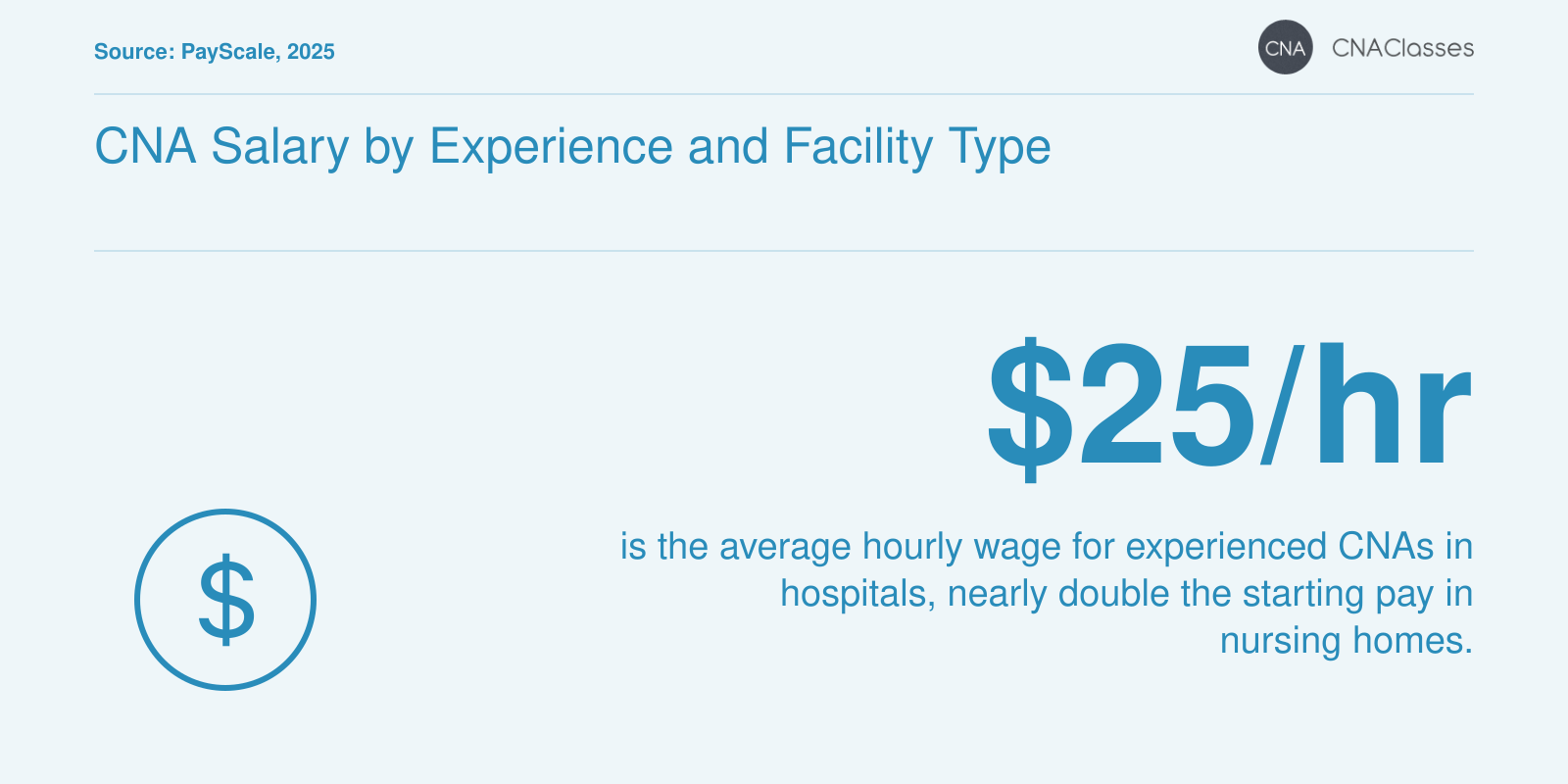
If you're evaluating CNA career paths, it's important to understand how pay scales with both your years on the job and your workplace setting. According to 2025 data from PayScale, entry-level CNAs in nursing homes can expect $14 to $18 per hour. With 1-4 years of experience, that range shifts to $16-$20. Hospital positions command a premium from day one, at $21-$24 per hour, and senior CNAs in hospitals may earn $23-$25. Home health agencies offer $18.50-$22, while assisted living facilities typically pay $16-$18. Across all settings, the national mean hourly wage is $17.46, but strategic facility choice and accumulated experience can push your income significantly higher. The chart below illustrates these gaps, helping you target the roles that best fit your financial goals.
The path to becoming a CNA is one of the fastest entry points in healthcare, but understanding the exact sequence of steps can save you time, money, and frustration. From meeting basic prerequisites to landing on your state's nurse aide registry, here is what the process looks like from start to finish.
Before you can enroll in a training program, you will need to satisfy a few baseline CNA requirements that are fairly consistent across the country:
These prerequisites are straightforward, and most applicants clear them without difficulty.4
CNA training programs generally run four to twelve weeks and include a mix of classroom instruction and hands-on clinical practice. Federal regulations require a minimum of 75 hours of training, including at least 16 hours of clinical experience, but many states set higher thresholds. Depending on your state, you may need anywhere from 75 to 120 hours total.4
During classroom sessions, you will study topics such as infection control, vital sign measurement, patient communication, and basic anatomy. Clinical rotations take place in settings like nursing homes or hospitals, where you practice skills under the supervision of a licensed nurse. These real-world hours are essential because they prepare you for both the certification exam and day-one job responsibilities.
Programs are offered through community colleges, vocational schools, the Red Cross, and even some employers (more on paid training options in the next section).
After completing your training, you must pass a state competency exam, often called the CNA exam, to earn your certification. Most states use the National Nurse Aide Assessment Program (NNAAP) exam, though some states administer their own version.
The NNAAP has two parts:
First-time pass rates on the knowledge section typically fall between 70 and 85 percent1, so solid preparation matters. If you do not pass on your first attempt, you are allowed up to three attempts within a 12-month window. After that, most states require you to retake an approved training program before trying again.
States that do not use the NNAAP administer their own exams, which generally include 50 to 100 written questions and a demonstration of three to five clinical skills.4 Check with your state's testing vendor for specific details.
Once you pass both portions of the exam, your name is added to your state's nurse aide registry. This listing is not optional. It is a legal requirement, and employers will verify your registry status before extending a job offer. The registry confirms that you have met all training and testing standards and that you are in good standing.
Most states require you to renew your registry listing every two years, and renewal typically involves proof that you have worked a minimum number of hours as a CNA during that period. Some states also require continuing education credits.
From start to finish, many people move from enrollment to registry listing in as little as four to eight weeks. That speed is one of the biggest advantages of the CNA credential: it gets you into the workforce quickly while still providing a solid clinical foundation to build on.
CNA training is an affordable first step into healthcare, but costs vary widely depending on the program type and location. Understanding your options for financial aid and employer-sponsored training can dramatically reduce your out-of-pocket expenses.
Most CNA programs cost between $500 and $2,000, with the national average falling closer to $1,200. Community colleges typically charge $500 to $1,200, while private training centers may range from $500 to $1,500. The American Red Cross, known for its comprehensive curriculum, usually costs $1,000 to $1,600.4 These figures often cover tuition only; you should budget separately for:5
Training is short, most programs can be completed in 4 to 8 weeks, with total classroom and clinical hours ranging from 75 to 160.6 This quick turnaround means you can start earning quickly, even if you pay upfront.
Several funding sources can slash or even eliminate your training costs:7
Always ask the program’s financial aid office about these options before enrolling.
One of the most attractive pathways is employer-paid training. Many nursing homes, assisted living facilities, and hospitals will cover your entire tuition, and sometimes pay you an hourly wage while you learn, in exchange for a work commitment after certification.
Typical arrangement: you receive free training (often valued at $0 to $200 out-of-pocket after reimbursement)6 and agree to work for the employer for 6 to 12 months.8 Some employers even pay $14 to $17 per hour during your training period.6
Major employers known to offer paid CNA training or tuition reimbursement include:8
Additionally, Medicare and Medicaid-certified nursing facilities are required to reimburse training costs on a pro-rata basis if they hire you as a CNA within 12 months of completing a program, effectively making training free if you get a CNA job at such a facility.7
To locate paid programs:
By leveraging financial aid or employer sponsorship, you can launch your CNA career with minimal debt and immediate income.
CNA rules are set state by state, which means the training hours, background check policies, and renewal timelines that apply to you depend entirely on where you plan to work, not on any national standard. Federal law sets a floor (a minimum of 75 training hours under the Omnibus Budget Reconciliation Act), but many states require more, and a handful require substantially more. That patchwork is why one applicant across a state line can face a very different path than a neighbor next door.
Rather than trying to memorize 50 different rulebooks, the fastest way to get accurate, current information is to go directly to your state's official source.
Every state maintains a nurse aide registry, typically run by the state Board of Nursing or the Department of Health. This is the authoritative source for training requirements, testing procedures, and certification status. Try these searches:
The official page will spell out the minimum classroom and clinical hours, the approved testing vendor, fees, and whether fingerprinting or a criminal background check is part of the process. Most states do require a background check, but the scope and cost vary.
If you are still deciding where to train or where to relocate, a few national sources give you a useful overview before you drill into state specifics:
Renewal cycles typically run every one to two years, and most states require proof of paid nurse aide work within that window to stay active on the registry. Some states also require continuing education hours. For the current renewal form, fee, and any CE requirement, call or email your state nurse aide registry directly. Local CNA training schools are another practical resource, since they update their state summaries regularly to advise their own graduates on landing your first CNA job.
Two paths, two destinations: CNA to LPN versus CNA to RN. Both build on your experience and can lead to higher pay and greater responsibility, but the time commitment and career scope differ significantly.
CNA to LPN bridge programs recognize the skills you already have, often cutting the training time to 6-12 months. Most require 6 months to a year of CNA work experience,2 a minimum 2.5 GPA, and a passing score on the TEAS or HESI A2 entrance exam. You will likely need to complete Anatomy and Physiology as a prerequisite. These accelerated programs typically cost between $5,000 and $20,000. For example, the Community College of Rhode Island offers a CNA-to-LPN bridge option at $210 per credit, while Miami Lakes Educational Center’s 15-month LPN program costs around $5,961 total. Howard Community College’s LPN certificate lasts 11 months, and New England Institute of Technology’s CNA-to-LPN pathway program runs 15 months. These programs give you credit for your CNA training and clinical hours, so you graduate ready to sit for the NCLEX-PN.
If your goal is to become an RN, you can enter an Associate Degree in Nursing (ADN) program directly. These typically take about 24 months to complete. Alternatively, many pursue the LPN step first and then enroll in an LPN-to-RN bridge, which can take 12-24 months. The bridge route lets you work as an LPN while studying, providing income and real-world experience. Your CNA background often helps with admission, as programs value hands-on patient care skills. Many community colleges offer flexible, lower-cost ADN options, making the RN pathway accessible even if you start as a CNA.
You can also expand your scope without returning to a degree program. A medication aide certification requires 60-120 clinical hours and allows you to administer routine medications under nurse supervision. Patient care technician programs, lasting 4-9 months, add skills like phlebotomy and EKG monitoring. Restorative aides focus on rehabilitation exercises and mobility, often learning on the job. These roles can boost your hourly pay and give you a clearer picture of advanced healthcare careers before committing to a nursing program.
Many healthcare employers actively support CNA career advancement. Hospitals, nursing homes, and assisted living facilities often provide tuition reimbursement or scholarship programs for staff pursuing LPN or RN degrees. Some offer paid study time or flexible schedules around class hours. Because retention is a constant challenge, organizations invest in employees who want to grow. Check your employee handbook or talk to HR to see what benefits are available, you might find the financial help you need to take the next step.
Nursing assistants are projected to see hundreds of thousands of job openings each year through the decade, making this one of the most in-demand entry points in healthcare.
Your certification and clinical hours are only half the story: you also need to show employers that you're reliable, compassionate, and ready to step onto the floor on day one. A strong resume and a thoughtful interview performance can set you apart, even from candidates with similar training.
Prepare for questions that test both your clinical judgment and your interpersonal skills. Common examples include:
Find quick answers to the most common questions about becoming a CNA. From pay and training time to certification requirements and career pathways, we cover what you need to know.