Key Points
- Tennessee CNAs now test through Credentia after a June 2026 change.
- Nashville CNAs earn a median $38,780, close to the national figure.
- You can finish training and start working in under eight weeks.
Compare the top-rated CNA programs across Tennessee with cost, schedule, and certification details to jumpstart your healthcare career.

A 75-hour training requirement and a certification exam you can schedule within weeks of finishing class: that is the gap between starting CNA classes in Tennessee and landing a healthcare job. With the state's aging population driving consistent demand, employers across Nashville, Memphis, Knoxville (home to multiple CNA training programs in Knoxville), and smaller communities are competing for certified aides, pushing entry-level hourly wages near $18 statewide.
The real tension for prospective students is not whether jobs exist but how to pick the right program. Tuition ranges from roughly $650 to $3,000, some facilities offer free training in exchange for a work commitment, and first-time exam pass rates vary widely between schools. Tennessee's recent switch to Credentia as its testing vendor adds another layer worth understanding before you enroll.
Our ranking of Tennessee CNA programs goes beyond simple price tags to evaluate real graduate outcomes, affordability, and completion success. The eight schools below stand out for preparing students for registry exams and connecting them to local healthcare employers. Each profile highlights the unique strengths that help you launch a stable, rewarding career as a certified nursing assistant.
Huntsville, TN · $16,000/yr
Best for: Affordability-focused students in east Tennessee
Tennessee College of Applied Technology-Oneida-Huntsville offers a streamlined Nursing Aide certificate that emphasizes affordability and hands-on clinical training. With a total tuition of just $576 and no entrance exam, it is one of the most accessible paths to CNA certification in the state. Graduates leave prepared for immediate employment in long-term care, home health, and hospital settings.
Harriman, TN · $10,000 – $15,000/yr
Best for: Working adults needing part-time evening training
Tennessee College of Applied Technology-Harriman provides a part-time evening CNA program tailored for working students who need flexibility. The 120-hour certificate can be completed in about two months, with clinical rotations in both long-term and acute care facilities. Admission is open to students as young as 16, though rigorous health and background screenings apply.
Knoxville, TN · $20,000 – $25,000/yr
Best for: Knoxville learners seeking multiple campus options
Tennessee College of Applied Technology-Knoxville delivers a convenient and low-cost CNA program with courses at both Knoxville and Maryville campuses. Priced at around $850 all-in, the training includes clinical hours and prepares students for the state exam in just two months. Multiple schedule options make it a practical choice for busy learners.
Harriman, TN · $4,000/yr (net price)
Roane State Community College offers a Clinical Nurse Aide program with Tennessee State Licensure built into the curriculum. Students benefit from instructors with real-world healthcare experience and a program that has been refining its approach for over two decades. It is an efficient on-ramp for career changers seeking rapid entry into direct patient care.
Dyersburg, TN · ~$5,000/yr (est.)
Dyersburg State Community College provides a focused, 3-credit CNA course that balances classroom instruction with practical skills in patient care and documentation. The program emphasizes professionalism, patient rights, and foundational anatomy, making it a solid starting point for a healthcare career. Military-friendly and open to all learners without an entrance exam.
Collegedale, TN · $20,000 – $25,000/yr
Southern Adventist University offers a distinctive Clinical Nurse Aide program that combines 100% online instruction with hands-on clinical rotations. The 4-6 month timeline prepares students for national certifications (NRSA or CCMA) and includes exam fees in the total tuition around $2,000. Its flexible, self-paced model is ideal for those balancing other commitments.
Morristown, TN · $5,000/yr
Walters State Community College runs several CNA training tracks, all designed to meet Tennessee's 75-hour requirement and deliver job-ready skills quickly. With a program fee of $899 and built-in clinical hours, it is an affordable gateway to licensure. Strong ties to area healthcare employers help graduates transition directly into the workforce.
Chattanooga, TN · $24,000/yr (net price)
Miller-Motte College-Chattanooga offers an intensive, 5-week CNA program that uses rolling admissions to let students start quickly. The 120-hour campus-based training emphasizes patient safety, medical terminology, and ethical care, with career services and financial aid available to support students from enrollment through job placement.
A major shift took effect in June 2026 when Tennessee transitioned to a new testing vendor, Credentia, for the nurse aide competency exam. This update streamlines the certification journey, but the core roadmap remains straightforward: meet eligibility requirements, complete a state-approved program, pass the two-part exam, and get listed on the official registry. Here’s how each step works.
Before enrolling, you must satisfy a few common prerequisites. While specific rules can vary by program, most require you to be at least 16 or 18 years old, hold a high school diploma or GED, and pass a criminal background check and drug screening. You’ll also need up-to-date immunizations and a negative tuberculosis test. Some training providers may assess basic reading and math skills through an entrance exam. Once cleared, you can begin searching for a state-approved training program.
Tennessee mandates a minimum of 75 hours of training1, including at least 16 hours of hands-on clinical practice in a healthcare setting under supervision. Most students finish in 4 to 6 weeks when attending full-time, though part-time schedules can extend the timeline. Programs are offered by community colleges, vocational schools, and some healthcare facilities. The curriculum blends classroom instruction on topics like infection control, vital signs, and patient rights with real-world clinical rotations. Choosing a program that exceeds the minimum hours can give you added confidence for the state exam.
Since June 1, 2026, the Tennessee Department of Health has contracted with Credentia to administer the nurse aide competency evaluation. The exam has two parts: a knowledge test and a skills demonstration.
You have up to 24 months from the start of your training program to pass both sections1. Failing one part means you can retake that section, but time limits apply, so avoid delaying.
After passing both exam components, your program or testing site sends the results to the Tennessee Department of Health. Within a few business days, your name appears on the Tennessee Nurse Aide Registry, which is maintained by the department. Employers use this public database to verify your active status before hiring. No additional application is needed. Once listed, you’re eligible to work as a certified nursing assistant in any state-licensed facility, and our guide to landing your first CNA job can help you launch your career. Remember to renew your certification every two years by meeting continuing education and work requirements, keeping your registry status current.
Training to become a CNA in Tennessee costs far less than most healthcare credentials, and with the right funding strategy, you might pay little to nothing at all. Program prices across the state currently range from $650 to around $3,0001 depending on the school type, location, and what is included in the fee.
Public technical colleges tend to offer the sharpest prices, while private career schools run higher. Here is a snapshot of five of the most affordable options available in 2026:
| School | Location | Program Cost | |
|---|---|---|---|
| TCAT Oneida-Huntsville | Huntsville, TN | $576 (tuition) + $179 books | |
| TCAT Harriman | Harriman, TN | $1,249 (tuition) + $324 books | |
| TCAT Knoxville | Knoxville, TN | $1,023.50 (Spring 2026) | |
| Career Academy Memphis | Memphis, TN | $1,350 | |
| [[LINK:3 | Walters State Community College | Morristown, TN]] | $899 (tuition) + additional fees |
Remember that sticker price rarely tells the whole story. Background checks, CPR certification, scrubs, and state exam fees can add $150 to $300 on top of tuition, so budget for those from the start.
Several funding sources can bring your out-of-pocket cost down dramatically.
One of the most practical ways to pay is to let your future employer foot the bill. Many Tennessee hospitals, nursing homes, and home health agencies offer tuition reimbursement of $600 to $1,5001 for employees who complete a CNA program and commit to working with them for a set period.
Ballad Health, the large health system serving Northeast Tennessee and Southwest Virginia, goes even further: the organization runs its own CNA training program at no cost to participants, pairing 100 clinical hours with classroom instruction. UTC's CNA program in Chattanooga is another example, with local healthcare facilities paying course tuition in full for qualified students.
If you are open to working for a specific employer after certification, asking about sponsored training before you enroll is often the single best move you can make for your budget.
CNA training in Tennessee runs about $700 to $1,600, less than 10% of a typical Associate Degree in Nursing. With a median wage near $18 an hour, graduates can finish class in roughly 6 weeks and recoup tuition within just a few paychecks on the job.
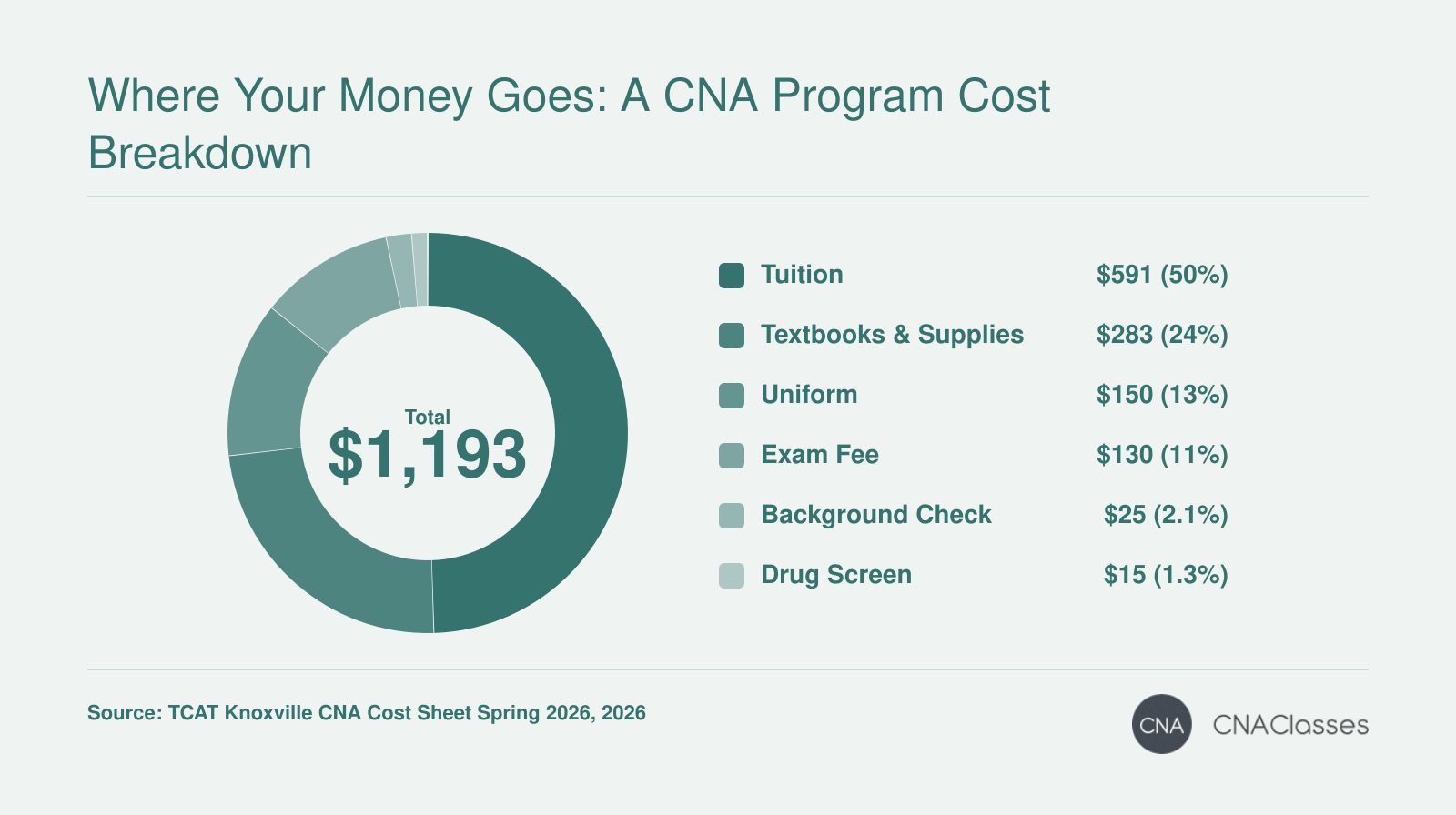
At TCAT Knoxville, the program fee covers tuition, textbooks, supplies, and a uniform, $1,023.50. The state exam and background screening add approximately $169.50, bringing the full investment to $1,193. Costs vary by school, with some bundling fees and others keeping them separate.
Free and low-cost CNA training in Tennessee has expanded dramatically in 2026, driven by acute staffing shortages that have turned nursing homes, hospitals, and health systems into direct training providers. Rather than wait for graduates to apply, employers now recruit students first and cover every dollar of tuition, testing, and materials in exchange for a post-certification work commitment. The result is a growing menu of zero-cost pathways for Tennessee residents willing to commit six months to a year of full-time employment after licensure.
Several major healthcare employers in Tennessee offer CNA training at no charge to candidates who agree to work for the organization after certification. Ballad Health, which operates hospitals and clinics across northeast Tennessee, runs a free CNA program at its Blountville campus (110 Ayers Pl, Blountville, TN 37617; 423-431-2622; [email protected]). The program covers all training and testing costs with no upfront tuition. In Nashville, CareRite Centers operates the Nashville Health Career Center CNA Program, a CNA training program in Nashville that is fully funded and requires participants to commit to one year of full-time employment after certification; the next class begins April 6, 2026. NHC Pulaski runs a two-week accelerated student CNA class for candidates who agree to join its nursing staff. Memphis Jewish Home & Rehab offers a free four-week CNA training program in Memphis for students willing to work at the facility after licensure.1
Tennessee law reinforces this employer-training model. Any nursing home-based CNA program must provide training and testing at no charge for candidates employed by a skilled nursing facility. Additionally, Medicare and Medicaid-certified nursing facilities must reimburse exam fees and training costs if they hire the candidate within 12 months of certification. This legal framework ensures that every nursing home in the state can serve as a tuition-free training site for its prospective workforce.
The University of Tennessee at Chattanooga hosts an employer-sponsored CNA training program in Chattanooga open to candidates with a full-time job offer from a participating healthcare organization; those students pay nothing and commit to working up to one year post-certification.2
The Workforce Innovation and Opportunity Act provides Individual Training Accounts that cover tuition, fees, books, and supplies for eligible Tennessee residents pursuing CNA certification. WIOA funds can be applied at Tennessee Colleges of Applied Technology, community colleges, and select private training schools approved by the state. To access WIOA funding, candidates contact their local American Job Center, complete an eligibility assessment, and work with a career counselor to select an approved training provider. Priority goes to low-income adults, dislocated workers, and individuals receiving public assistance. Career Academy Memphis, which charges $1,350 for its CNA program, accepts WIOA vouchers, SNAP Employment and Training funds, and direct employer sponsorships, making it effectively free for students who qualify for any of those funding streams.3
Tennessee high school students can earn CNA certification before graduation at no cost through dual-enrollment programs. Wilson Central High School offers a free CNA certification program for currently enrolled students, covering tuition, materials, and testing fees.1 Similar programs operate at career and technical education centers across the state, allowing juniors and seniors to graduate with both a diploma and a Tennessee Nurse Aide Registry credential.
Employer-sponsored CNA programs create a win-win: facilities gain trained, loyal staff while students earn their certification without paying tuition out of pocket.
Employer-sponsored CNA training at a long-term care facility and a standalone private school may both prepare you for the same exam, but their track records can look very different on paper. Before you enroll in CNA classes, checking a program's first-time pass rate on the CNA competency evaluation is one of the most practical ways to gauge how well its graduates are actually prepared.
As of May 2026, the overall first-time pass rate across CNA programs in Tennessee is about 63.5 percent. That number combines results from both parts of the test: the written (knowledge) component, where candidates pass at roughly 67.3 percent, and the clinical skills component, where the rate is considerably higher at about 82.4 percent. Skills performance tends to be stronger statewide, which tells you that the written portion is where most candidates stumble.
Not every training setting produces the same outcomes. Here is how the major program categories stack up on first-time pass rates:
High school CNA programs post some of the strongest combined numbers in the state, likely because students receive consistent classroom instruction over a full semester or longer. University programs also stand out, particularly on the skills side, though their smaller candidate pools can amplify percentages. Community college and TCAT programs, despite their affordability and accessibility, currently trail the state average on the written exam, something prospective students should ask admissions counselors about before signing up.
A high pass rate signals that a program's curriculum, instructors, and practice hours are doing their job. A lower rate does not automatically mean the training is poor, but it is a yellow flag worth investigating. Ask the school directly about its most recent results and what kind of exam prep resources it offers.
That said, pass rates should never be the only factor driving your decision. Weigh them alongside tuition cost, program length, clinical site quality, and schedule flexibility. A program with an 80 percent pass rate and a price tag you can afford will serve you better than a 95 percent program that leaves you buried in debt.
These figures come from the Tennessee Department of Health's most recent reporting period. If a program you are considering is not listed above or falls into a broad category, contact the school and ask for its specific pass-rate data. Reputable programs are happy to share it.
Can you complete CNA training online in Tennessee, or do you have to attend class in person every day? It is one of the most common questions prospective students ask, and the answer is more nuanced than a simple yes or no.
Tennessee does allow a hybrid format for CNA training, meaning a program can deliver its theory coursework online while requiring students to complete clinical hours at an approved facility in person. The state does not allow fully remote CNA programs. Clinical hands-on training must happen face to face, and Tennessee typically requires at least 40 clinical hours to be completed on-site. No amount of video lessons or virtual simulations can substitute for that floor time.
If you are searching for hybrid online CNA classes, start with the Tennessee Department of Health's list of approved nurse aide training programs. That list will indicate the format each program uses, and it is the most reliable place to confirm whether a school's online theory component meets state standards.
Not every approved school advertises its format clearly on the first page of its website. When you visit individual school sites, look for terms like "hybrid" or "blended learning" in the program description. If the language is vague, call the program coordinator directly. Some schools that appear purely in-person will allow students to complete theory work remotely on a case-by-case basis, especially for students with scheduling conflicts.
For a broader understanding of how states regulate CNA training formats, the Bureau of Labor Statistics and professional groups like the National Association of Health Care Assistants publish guidance that explains why clinical requirements vary and what students should verify before enrolling.
The best choice depends on your life circumstances.
Whichever format you choose, confirm approval status with the Tennessee Department of Health before you register. A program that is not state-approved will not qualify you to sit for the certification exam, regardless of how it delivers its curriculum.
Choosing a CNA training path brings up many practical questions. Below, we address some of the most common queries Tennessee students ask, along with guidance on where to locate the most up-to-date and reliable information.
While the national median annual wage for nursing assistants sits at $39,530, CNAs in Tennessee earn wages that vary by location, with the Nashville metro area coming closest to the national figure at $38,780. Statewide, the job outlook is exceptionally strong: projections indicate CNA employment growth between 13% and 35% over the decade, far outpacing the national average of just 2%. Tennessee expects between 1,895 and 2,219 annual openings for CNAs through 2030. The table below lists current median wages and employment levels for Tennessee's major metropolitan areas, based on 2024 data. Keep in mind that actual earnings can exceed these medians with experience, specialized certifications, or employment in higher-paying settings like hospitals.
| Metro Area | Employment | Median Hourly Wage | Median Annual Wage |
|---|---|---|---|
| Nashville-Davidson--Murfreesboro--Franklin | 6,630 | $18.64 | $38,780 |
| Johnson City | 1,170 | $17.85 | $37,130 |
| Knoxville | 3,100 | $17.75 | $36,920 |
| Memphis | 4,000 | $17.71 | $36,830 |
| Kingsport-Bristol | 1,280 | $17.62 | $36,640 |
| Clarksville | 670 | $17.59 | $36,580 |
| Morristown | 280 | $17.39 | $36,170 |
| Chattanooga | 1,930 | $17.33 | $36,050 |
| Cleveland | 310 | $17.11 | $35,580 |
| Jackson | 940 | $16.79 | $34,930 |
You can go from zero healthcare experience to a paying job as a certified nursing assistant (CNA) in Tennessee in under two months if you start this week. That is the practical timeline for becoming a CNA: a state-approved program of 75+ hours, the Headmaster written and skills exams, and a name on the Tennessee CNA Registry. Every step is well-worn, and Tennessee employers are hiring aggressively enough that most graduates have offers before their certification card even arrives.
Here is the sequence to move through, in order:
Online research only gets you so far. Call or email the admissions office of two or three programs on your shortlist this week. Ask about the next start date, current class size, tuition breakdown, and whether they have hiring partnerships with local employers. Many Tennessee programs run rolling admissions, meaning you could be in a classroom seat within days of your first phone call.
The healthcare workforce in Tennessee needs you. Pick up the phone, pick a start date, and get moving.