Key Points
- Many South Dakota CNA programs can be completed in 4 to 6 weeks.
- About 60% of CNA trainees in South Dakota get free or low-cost training.
- South Dakota projects 745 CNA job openings annually with 7.8% growth.
Compare top CNA programs in South Dakota by cost, schedule, and student success. Start your healthcare career today!
South Dakota projects 745 annual openings for nursing assistants, fueled by an aging population and a 7.8% growth rate over the next decade. High demand does not guarantee a smooth start: choosing an accredited program that fits your budget and schedule is the real gatekeeper. CNA classes range from free, employer-sponsored options to programs costing over $1,000. The certification path is fixed: 85 hours of training, a competency exam, and placement on the state registry, but how you get there determines time and cost. A poor match between program format and personal constraints remains the most common reason candidates delay or drop out.
Section content unavailable.
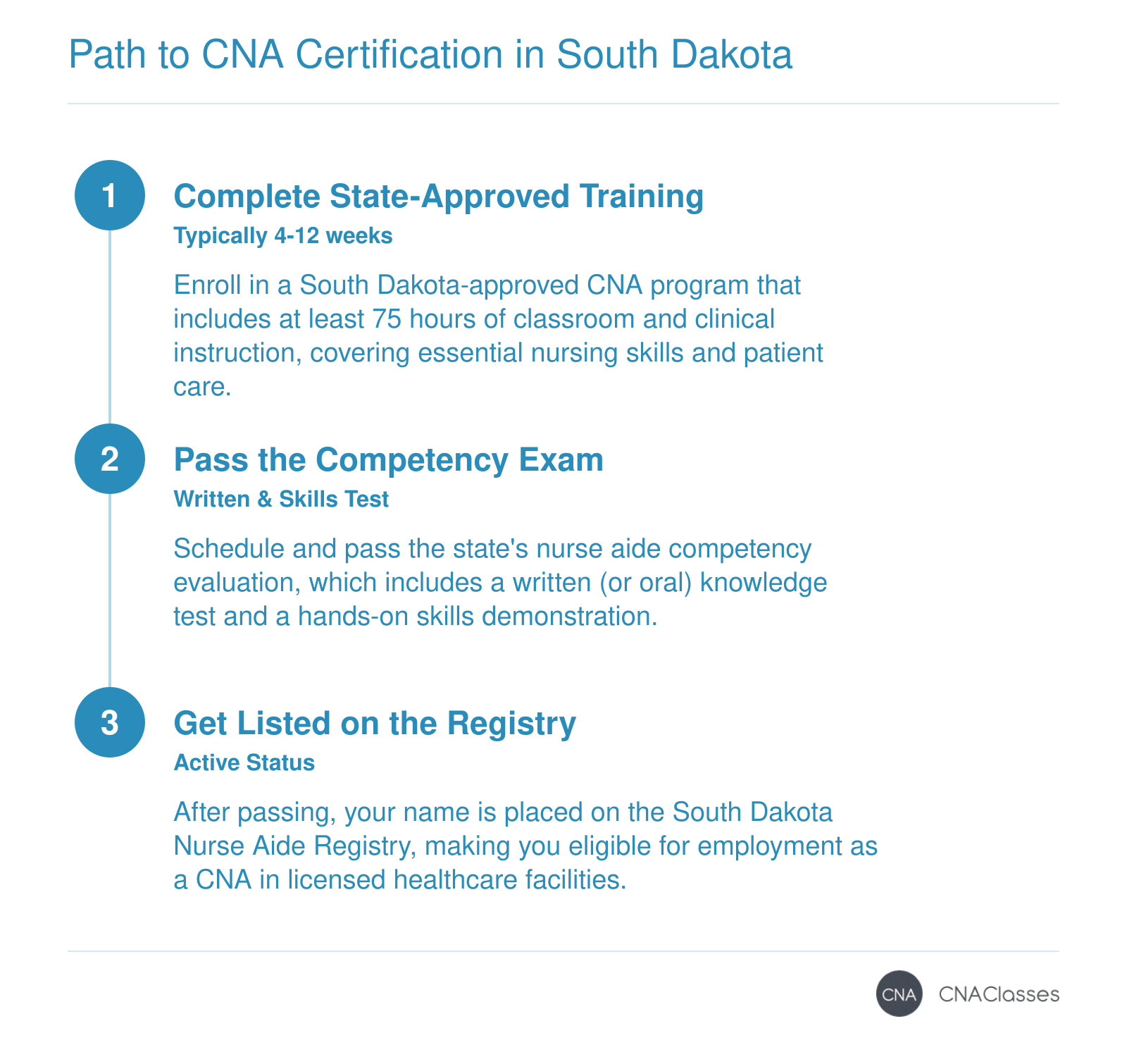
CNA Training in South Dakota is one of the fastest routes into healthcare, but knowing the exact sequence of steps can save you from delays and surprises along the way. The entire process, from enrollment to registry listing, can take as little as a few weeks if you plan ahead.
South Dakota requires a minimum of 75 hours of training through a state-approved program.1 Of those hours, at least 16 must be dedicated to supervised clinical practice in a healthcare facility such as a nursing home or hospital.1 During clinicals, you will practice hands-on skills like taking vital signs, assisting with mobility, and performing personal care under the guidance of a licensed nurse. Make sure the program you choose is approved by the South Dakota Board of Nursing, as unapproved coursework will not qualify you for the certification exam.
It is worth noting that nursing students who have completed a Fundamentals of Nursing course may also be eligible to sit for the exam without completing a separate CNA program.2
Before you can work in a clinical setting or sit for the competency exam, you will need to pass a background check.1 South Dakota requires this step to protect vulnerable populations in care facilities. Many training programs also require current CPR certification (typically BLS or CPR for Healthcare Providers) before clinicals begin. Plan to complete both early in your training so they do not hold up your progress.
Once you finish your training, the next milestone is the two-part competency exam administered by D&S/Headmaster.1 The exam includes:
You must pass both portions to move forward. If you do not pass on your first attempt, retesting is available.
After passing both parts of the exam, your name is added to the South Dakota Nurse Aide Registry.1 This listing is what employers verify when they hire CNAs, so it is your official green light to begin working. Keep your registry status current by meeting any renewal requirements, and you are set to start your career in one of the state's most in-demand healthcare roles.
The biggest cost variable in South Dakota CNA training is not the quality of instruction but where you choose to train: some programs charge nothing at all, while others run over a thousand dollars once you add books and testing fees. Understanding the full price tag and what help is available puts you in control.
The summary below gives you a snapshot of tuition at four well-known programs in the state. Keep in mind that additional expenses like textbooks, scrubs, a stethoscope, background checks, and the state competency exam fee can add roughly $100 to $300 on top of listed tuition.
Exam fees for the South Dakota nurse aide competency test are set separately by the testing vendor and are not always included in the tuition figures above. Budget an additional amount for that step.
Beyond tuition, plan for a handful of smaller costs that nearly every program requires:
These extras typically total between $100 and $300, though the exact amount varies by program and by what you already own.
South Dakota students have several paths to reduce out-of-pocket spending. Healthcare employers like Sanford Health and Prairie Heights Healthcare offer free tuition programs, often requiring graduates to work at the facility for a set period after earning certification. This arrangement benefits both sides: you train at no cost, and the employer gains a qualified team member.
If you prefer a college-based program, Southeast Technical College accepts federal financial aid applications through FAFSA. Eligible students may receive grants that cover tuition partially or entirely. Monument Health's employer reimbursement model works differently: you may pay upfront and receive reimbursement once you fulfill specific employment terms.
Before enrolling anywhere, ask the admissions office for an itemized cost sheet that includes every required expense. Comparing those totals, not just tuition, gives you the clearest picture of what you will actually spend on the road to CNA certification in South Dakota.
Free or nearly free CNA training is more accessible in South Dakota than many prospective students expect, especially if you're willing to commit to an employer afterward or meet income-eligibility requirements for workforce grants.
Approximately 60 percent of CNA training programs across South Dakota are operated directly by nursing homes and hospitals, and many of these facilities shoulder the full cost of training in exchange for a service commitment. The challenge is discovering which facilities are currently recruiting trainees and confirming the terms before you enroll.
Several major healthcare systems in South Dakota offer fully funded or reimbursable CNA training:
Start by contacting the human resources or training departments of facilities near you. Good Samaritan Society, Avera Health, and Sanford Health all maintain multiple campuses across the state. Ask whether they currently have open training cohorts, what the work commitment entails, and whether reimbursement is paid as a lump sum or incrementally.
You can also check the South Dakota Department of Health's list of approved nurse aide training programs to identify facility-based programs, then call each one to ask about sponsorship. Finally, visit your regional workforce development office or South Dakota Department of Labor website; occasional state grants fund training for income-eligible residents, particularly in rural counties with healthcare staffing shortages.
Most employer-sponsored programs require you to be at least 16 years old3, pass a criminal background check, and demonstrate the ability to lift at least 40 pounds.4 If you meet those baseline criteria, free training is within reach.
Starting your journey to become a Certified Nursing Assistant comes with many questions. Whether you're concerned about cost, time, or flexibility, the answers below will help you plan your next move.
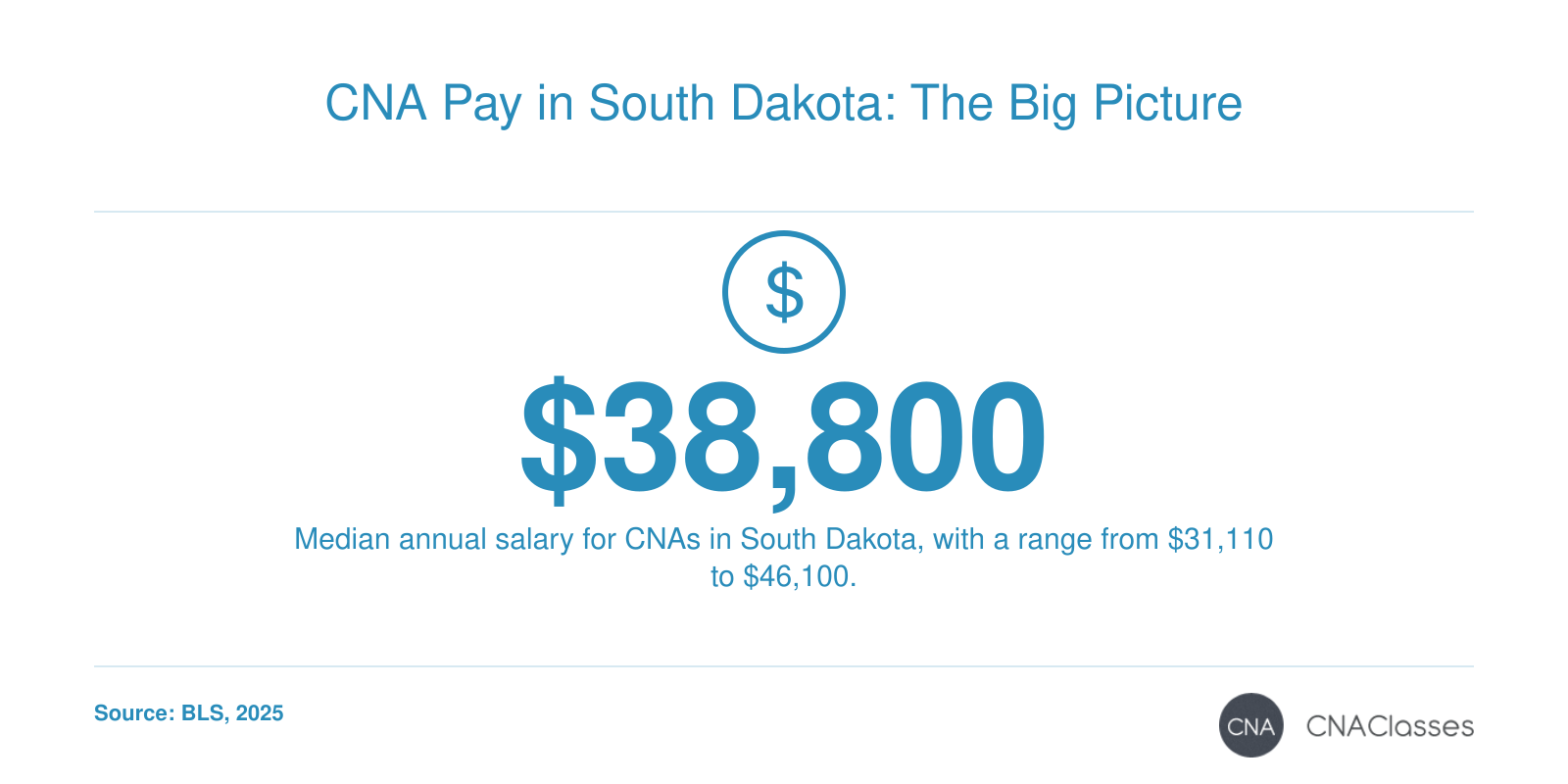
What can you expect to earn as a CNA in South Dakota? The median annual wage sits at $38,800, but pay varies with experience and location. Entry-level CNAs earn around $31,110, while top earners bring in over $46,000. Nationally, nursing assistant jobs are projected to grow 2% over the next decade, reflecting stable healthcare demand.
Nursing assistants in Sioux Falls earn a median annual wage of $38,070, slightly ahead of Rapid City at $37,250. With 2,900 jobs, the Sioux Falls metro area also offers far more employment opportunities. The table below shows the latest available data for South Dakota's major cities.
| Metro Area | Employment | Median Annual Wage |
|---|---|---|
| Sioux Falls, SD-MN | 2,900 | $38,070 |
| Rapid City, SD | 910 | $37,250 |
Fully online CNA programs and hybrid options with in-person clinicals serve very different learners, so understanding what South Dakota actually allows is essential before you commit to either format.
CNA training everywhere includes a hands-on clinical component, and South Dakota is no exception. The state requires supervised clinical hours completed in a real healthcare setting under the guidance of a licensed nurse. That means a completely online CNA program, with zero in-person time, will not meet the state's requirements. Some programs, however, do offer a hybrid model where you complete classroom lectures and written coursework online, then report to a local facility for your clinical rotations.
Before enrolling in any program that advertises online delivery, visit the South Dakota Board of Nursing website. The Board maintains a list of approved CNA training programs and publishes policies on distance education. If a program is not on that approved list, the hours you complete may not count toward your certification exam eligibility. This is the single most important step you can take to protect your time and money.
Community colleges, technical institutes, and healthcare facilities across the state each structure their CNA courses a little differently. Some may offer lecture modules through a learning management system while scheduling clinical days on weekends or during evening shifts. Others require full in-person attendance. When you contact a program, ask these questions:
The Bureau of Labor Statistics provides a reliable overview of CNA training expectations at the national level, which can help you set a baseline for what any legitimate program should include. The National Association of Health Care Assistants is another useful resource for understanding industry standards and finding links to state-specific guidelines.
You can also reach out to the South Dakota Health Care Association or similar professional organizations in the state. These groups often maintain relationships with training providers and can point you toward reputable hybrid options that balance flexibility with the hands-on preparation you will need on the job.
If your schedule or location makes a traditional in-person class difficult, a hybrid program can be a practical solution. Just verify state approval before you enroll, confirm the clinical arrangement works with your schedule, and make sure the program prepares you for the competency evaluation that follows. Taking those steps upfront keeps your path to certification smooth and avoids costly detours.
Here's something worth noting: CNA jobs in South Dakota are projected to grow 7.8% through the next decade, according to the South Dakota Department of Labor and Regulation. With around 6,510 CNAs currently employed statewide and roughly 745 openings each year, demand for trained caregivers shows no sign of slowing.