Key Points
- Many CNA programs require BLS before clinical shifts begin.
- Albany High's 27 health science students completed free BLS training.
- In 2026, online-only CPR won't clear you for clinicals.

BLS vs. Heartsaver, free CPR classes, and why high school CNA programs add it early.

Do CNA programs include CPR certification, or do you have to get it on your own? At Albany High School in New York, CNA training for high school students built CPR into the coursework: 27 Health Science 3 students earned free Basic Life Support (BLS) cards in September 2026, taught by Albany Medical Center nurses and educators.
Most CNA students do not get that setup. Many programs admit students without a CPR card, but clinical sites will not schedule shifts until one is on file.
A BLS card stays valid for two years, so the real constraints are timing and card type. Certify too late and clinicals stall. Pick a course outside healthcare certifications for CNAs and you may pay twice.
Many CNA students run into the same timing pressure: a program will admit you without a CPR card, but the hospital or long-term care facility will not let you begin your CNA clinical rotation until you have one. That gap is why CPR often becomes the first clinical skill you actually hold before you ever take vital signs.
CPR is rarely a single rule. It usually comes from three places.
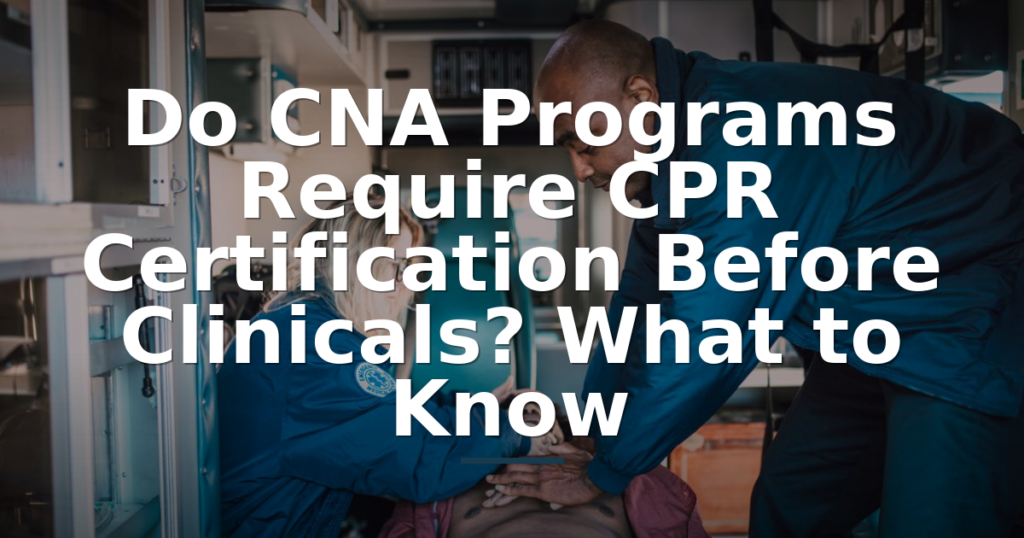
During clinicals you are in real care settings. A resident or patient can experience cardiac arrest or a blocked airway while you are assisting with care. The certification confirms you have practiced chest compressions, rescue breathing, and AED use on adults and children, and that you know how to activate emergency response.
Accrediting bodies often expect CNA programs to align with healthcare provider BLS standards. That is one reason a generic community CPR course may not meet the requirement. Most programs do not require CPR certification for CNA before enrollment, but they do set a hard deadline before your first clinical shift. Treat that date as the real due date. State-level differences are the first place to check, so the next section walks through what to expect where you live.
In many states, CPR or Basic Life Support (BLS) certification is not written into the state nurse aide training rules themselves. The requirement often comes from the individual CNA program, a clinical site, or a health science pathway. That means two students in the same state can encounter different CPR expectations depending on where they enroll. The table below lists the states with evidence gathered for this guide. States marked Not established do not have a state-level mandate in the sources reviewed; that does not prove no requirement exists. Check with your specific CNA program, clinical site, and state board of nursing before enrolling to confirm the current rule and whether an online-only course is accepted.
| State | CPR Requirement | Requirement Source | Online Acceptance |
|---|---|---|---|
| Alabama | Not established (2026) | Not established | Not established |
| Alaska | Not established (2025) | Not established | Not established |
| Arizona | Required (2026) | CNA program (2026) | Not established |
| California | Not established (2026) | Not established | Not established |
| Connecticut | Not established (2026) | Not established | Not established |
| Florida | Not established (2026) | Not established | Not established |
| Georgia | Not established (2026) | Not established | Not established |
| Illinois | Not established (2026) | Not established | Not established |
| Indiana | Not established (2026) | Not established | Not established |
| Iowa | Not established (2026) | Not established | Not established |
| Kentucky | Not established (2026) | Not established | Not established |
| Maryland | Required (2026) | Workforce program (2026) | Not established |
| Massachusetts | Not established (2026) | Not established | Not established |
| Michigan | Not established (2026) | Not established | Not established |
| Missouri | Not established (2026) | Not established | Not established |
| New Jersey | Not established (2026) | Not established | Not established |
| New York | Not established (2026) | Not established | Not established |
| North Carolina | Not established (2026) | Not established | Not established |
| Ohio | Not established (2026) | Not established | Not established |
| Oregon | Not established (2026) | Not established | Not established |
| Pennsylvania | Not established (2026) | Not established | Not established |
| Tennessee | Required (2023) | Nursing education standards (2023) | Not established |
| Texas | Not established (2026) | Not established | Not established |
| Virginia | Not established (2026) | Not established | Not established |
| Washington | Not established (2026) | Not established | Not established |
Short answer: most CNA programs and clinical sites want a healthcare-provider card, which means Basic Life Support (BLS) from the American Heart Association (AHA) or the Red Cross. Heartsaver CPR/AED is built for the general public and workplace responders, and it is usually turned down when a program asks for healthcare-provider BLS. That is the same BLS card the Albany High students earned, valid for two years.
Generally, no. AHA BLS and Red Cross BLS both require you to demonstrate compressions and breaths in person with an instructor, so a self-paced online certificate alone will probably be rejected. Heartsaver acceptance of online-only formats varies, but that rarely matters, because the card itself usually will not meet a healthcare requirement. Some virtual skills sessions exist, yet whether one satisfies your program is the receiving organization's call.
There is no single national rule, so wording matters. Ask your program coordinator and your clinical site these questions:
Get the answers in writing, then book the course. Paying for the wrong card is the most common, and most avoidable, CPR mistake CNA students make.
A fully online CPR course with no in-person skills check will not clear you for CNA clinicals in 2026. Clinical sites and CNA training programs need to see that you can actually perform chest compressions, operate an AED, and respond correctly under pressure, and none of that can be verified through a video and a quiz alone.
There is an important difference between a certificate you earn entirely online and a blended (hybrid) course that most healthcare programs do accept.
The American Heart Association BLS for Healthcare Providers and the American Red Cross BLS for Healthcare Providers are both offered in this blended format, which is what nursing programs usually mean when they ask for "CPR certification."
Acceptance is not uniform. Some community colleges and non-hospital settings may be more flexible, while most hospitals and many clinical sites require a current healthcare-provider card issued after a skills evaluation. Aurora University's CNA program, for example, requires an AHA BLS card earned through online training followed by an in-person skills test and states that any other type of CPR card will not be accepted. Several California hospitals reportedly require AHA-issued BLS, ACLS, or PALS and may reject online-only credentials.
State Boards of Nursing set their own rules, so requirements vary by state.
Because policies range from strict to flexible, check with your program coordinator before paying for any online course. Ask specifically whether a blended BLS card is required, whether a particular issuer is mandated, and whether your assigned clinical site has stricter rules than the program minimum.
High school CNA programs now treat CPR as a first-semester clinical credential rather than an afterthought. That shift was on display at Albany High School this fall, when 27 students in the CTE Health Science pathway completed hands-on training and earned a two-year Basic Life Support card. According to Albany High School's CPR training, seven instructors from Albany Medical Center led the session, which covered adult and pediatric CPR, and students completed the certification at no cost.1
Albany Medical Center's Center for Learning and Development brought nurse educators, nurse clinicians, education specialists, and bedside nurses into the classroom. Students practiced using video segments, live demonstrations, guided skills, and question and answer sessions before taking the exam. A passing score produced a two-year BLS card. Senior Akira Snype described the confidence: "It feels good. Because now if anything ever happens, I can say Here I am!"
The same CNA training partnership model appears in other high school health science pathways. Union Public Schools' Medical Academy partners with Saint Francis Health System to offer CPR, BLS, AED, and Stop the Bleed certification at no cost to students, with Saint Francis committing $100,000 over two years. In California, Grossmont Union High School District reported more than 305 students earned BLS certification and a 69 percent increase in CPR training. Hollister High School introduces CPR/AED certification to freshmen and plans BLS for the following year. Arthur A. Benjamin Health Professions High School places BLS in junior year before students move deeper into CNA skills.
Students who arrive at a CNA program with a current two-year BLS card skip one common admission and clinical-readiness step. They save the cost of a separate CPR class, avoid last-minute scheduling stress, and carry a portable credential onto resumes and college applications. For hospitals, nursing homes, and home health employers, a new hire who already holds BLS can often begin onboarding sooner. Funding varies by school and partner, so students should confirm whether free CNA training includes the CPR or BLS card before enrolling. Even when CPR is not free, completing it in high school can reduce total CNA training costs by avoiding a separate community course.
It feels good. Because now if anything ever happens, I can say Here I am!
A standalone BLS card runs roughly $55 to $150 nationally in 2026, but plenty of CNA students in affordable CNA programs pay nothing at all. The spread between those two outcomes usually comes down to one question nobody thinks to ask: is CPR already bundled into your program's CNA certification requirements?
Before you pay a cent, email your program coordinator and ask whether CPR certification is included in tuition. Several programs already fold it in. Harford Community College in Maryland includes Healthcare Provider BLS CPR with its nursing assistant program, alongside fingerprinting, the state competency exam, and registry application. Life Vest Training Academy also builds CPR into tuition. Career Academy in Memphis charges $1,350 for its CNA program with CPR included, and notes that WIOA funding through an American Job Center or SNAP Employment and Training through Tennessee's human services department may cover that tuition entirely for students who qualify for free CNA training programs.
Not every program works this way. Prestige Health and CPR in Greenfield runs its CNA course at $900 and prices CPR separately at $75. Williams Healthcare includes a CPR/AED course valued at $60, but lets students decline it for a $60 deduction if they already hold a current card. Read the fee sheet line by line.
Hospital-affiliated training centers are often the cheapest route, and sometimes free. At Albany High School, Albany Medical Center's Center for Learning and Development sent nurse educators and bedside nurses to deliver CPR training at Albany High onsite at no cost to students in the CNA pathway. If you already work in healthcare, even part time, ask HR or your unit educator whether students and new hires qualify for in-house BLS sessions. Large systems frequently employ AHA instructors who can run skills checks for staff.
Community colleges are worth a call too. Kansas City Kansas Community College lists AHA BLS at $50 for healthcare and prehospital personnel in 2026. Arizona Western offers both a full CPR-BLS course and a skills-check-only option.
AHA's HeartCode BLS splits the coursework into a self-directed online portion and a required in-person skills session. The online module is listed at $38, with vouchers commonly sold in the $32 to $45 range. Add the skills check and blended totals typically land between $75 and $110, though prices vary by training center: Code One CPR charges $125 for the full course or $95 for skills only, while Show Me CPR lists $70 for a skills evaluation. American Red Cross BLS for Healthcare Providers generally runs $80 to $110 with a roughly 60-minute skills session.
One deadline matters: complete your hands-on skills check within 60 days of finishing the online portion, or that credit expires and you pay twice.
Timing matters more than most students expect. A CPR card that arrives late can keep you out of clinicals, even if you have passed every written test.
If your program does not include CPR in tuition, finish your certification two to four weeks before clinicals begin. That window covers card processing, and it leaves room to retake a skills check if something goes wrong. Some providers issue a digital card the same day, but others take several days. Do not assume yours will be instant.
Students in embedded pathways have it easier. The Albany High School Health Science students who worked toward CNA certification completed a free, hospital-taught BLS course, and passing the exam earned them a card valid for two years. If your program bundles training like this, ask for the class date in writing so you can plan around it.
Programs differ on this point:
Read your enrollment packet closely, because the deadline is often tucked into the checklist rather than the program overview.
Your state board may have its own training requirements, and clinical sites can add policies on top of them. A nursing home or hospital partner may require a specific card type, such as BLS, or ask to see it before your first shift. Confirm these details with your program coordinator rather than relying on a general rule.
If your current card will expire during the program, schedule a renewal before it lapses. An expired card on clinical day can mean sitting out until you are recertified. Count forward from your start date through your final clinical week, then renew early if the dates are close.
CPR timing matters as much as the certification itself. Use this sequence to stay ahead of clinical deadlines and avoid last-minute gaps.

Before your first clinical rotation, most state-approved CNA programs ask for a short stack of documents. CPR/BLS is one of them, so schedule it early enough to stay valid through your entire clinical period.
Renewing a BLS card while it is still current is a quick formality for many CNA students, but trying to renew after the card has lapsed can become a scheduling problem. The two paths lead to very different clinical consequences, so timing matters as much as the credential itself.
CPR and Basic Life Support cards are typically valid for two years. The American Heart Association's Basic Life Support (BLS) Training shows course cards run through the end of the issue month, and successful completion produces a two-year eCard. Many CNA programs require the card to remain valid through the entire clinical rotation, not just through the first day of class. A clinical site may also impose its own stricter rule, so the controlling deadline is the shorter of the card's expiration date and the school or clinical site policy.
An expired card is no longer current proof of training, and a clinical instructor or employer may pull a student from the floor until renewal is complete. Some employers require at least 90 days of remaining validity or run annual BLS checks1, while others offer no grace period. There is no single universal CNA-school rule, so students should confirm the exact policy before the clinical rotation starts. The American Red Cross BLS renewal path is built for people whose certification is current or expired by no more than 30 days; beyond that window, a full course may be required.
Renewal formats include in-person, blended online plus skills check, self-directed review, and abbreviated challenge courses.2 Renewal sessions are usually shorter than the initial class, and some listings show a BLS recertification running about 1 to 2 hours. Cost is provider-specific: one online recertification listing from CPR Care's BLS Recertification Course shows $36.95, but American Heart Association and Red Cross pricing varies by location and format. High school pathways and some employers occasionally cover the fee as a free refresher, so students should ask before paying out of pocket.
Schedule renewal at least a few weeks before the card issue month ends, especially if the clinical site wants 90 days of remaining validity. That buffer keeps the card current through the rest of clinicals and avoids a last-minute gap in eligibility.