Key Points
- Free online courses cannot replace state-approved clinical hours.
- CNA jobs will grow 2%, adding nearly 30,000 positions through 2034.
- Median salaries top $40,000 in Alaska and New York.
Find free practice tests, state-approved online programs, and study guides to ace the CNA exam and start your career.
Demand for nursing assistants remains steady, with nearly 30,000 new positions projected by 2034, and the availability of hybrid training has reshaped how students enter the field. Online coursework now handles the theory and exam prep, while in-person clinicals remain non-negotiable for certification. Prospective CNAs in 2026 can access state-approved programs, free practice tests, and employer-sponsored tuition that were scattered or hard to verify even a few years ago. The real challenge is not finding materials: it is filtering out unapproved courses that cannot lead to a license.
The line between online and in-person CNA training has never been sharper in 2026, as state boards refine what must be learned hands-on. Before you dive into study materials or compare program formats, it pays to understand the steps to become a CNA that every aspiring nursing assistant must walk.
A certified nursing assistant earns their credential by completing a state-approved CNA training program and passing a competency exam. The program itself typically includes at least 75 hours of instruction, though many states require 100 to 180 hours. That time divides into two clear buckets: classroom learning (theory, anatomy, infection control, patient rights) and clinical practice (hands-on skills performed on real patients under supervision). At the end, you sit for a state exam that has a written or oral knowledge test and a skills demonstration where you perform tasks like taking blood pressure or positioning a resident.
Even in 2026, a fully online CNA program that produces a job-ready graduate doesn't exist. The clinical hours demand in-person attendance at a healthcare facility; no virtual simulation can replace the tactile feedback of a real patient. What the market offers instead is a spectrum: - In-person: All theory and clinical hours happen on campus or at a partner site. This remains the most common format. - Hybrid: The theory portion is delivered through live or recorded online lectures, while labs and clinicals are held in person. This model, common in hybrid online CNA classes, grew quickly during the pandemic and is now widely accepted. - Online theory with arranged clinicals: Some providers let you complete the didactic piece online, then contract with a local nursing home for the hands-on hours. You'll need to verify that the combination is approved by your state board.
CNA certification is regulated state by state. A program might be beautifully designed and even accredited by a national body, but if it isn't on your state's official list of approved CNA training programs, completing it won't qualify you to test or work in that state. Before you enroll, visit your state's nursing board or department of health website and search for the program name. Reputable schools display their state approval code openly; if you don't see it, ask.
Most students finish a CNA program in 4 to 12 weeks. Full-time day cohorts often wrap in a month, while evening or weekend tracks stretch longer. Costs range broadly, from free employer-sponsored programs to around $2,000 at private schools. Community colleges and vocational centers tend to sit in the $500, $1,500 zone, often including textbooks, scrubs, and the exam fee. Employers such as nursing homes sometimes pay for training in exchange for a work commitment, making the final price tag $0 for many students.
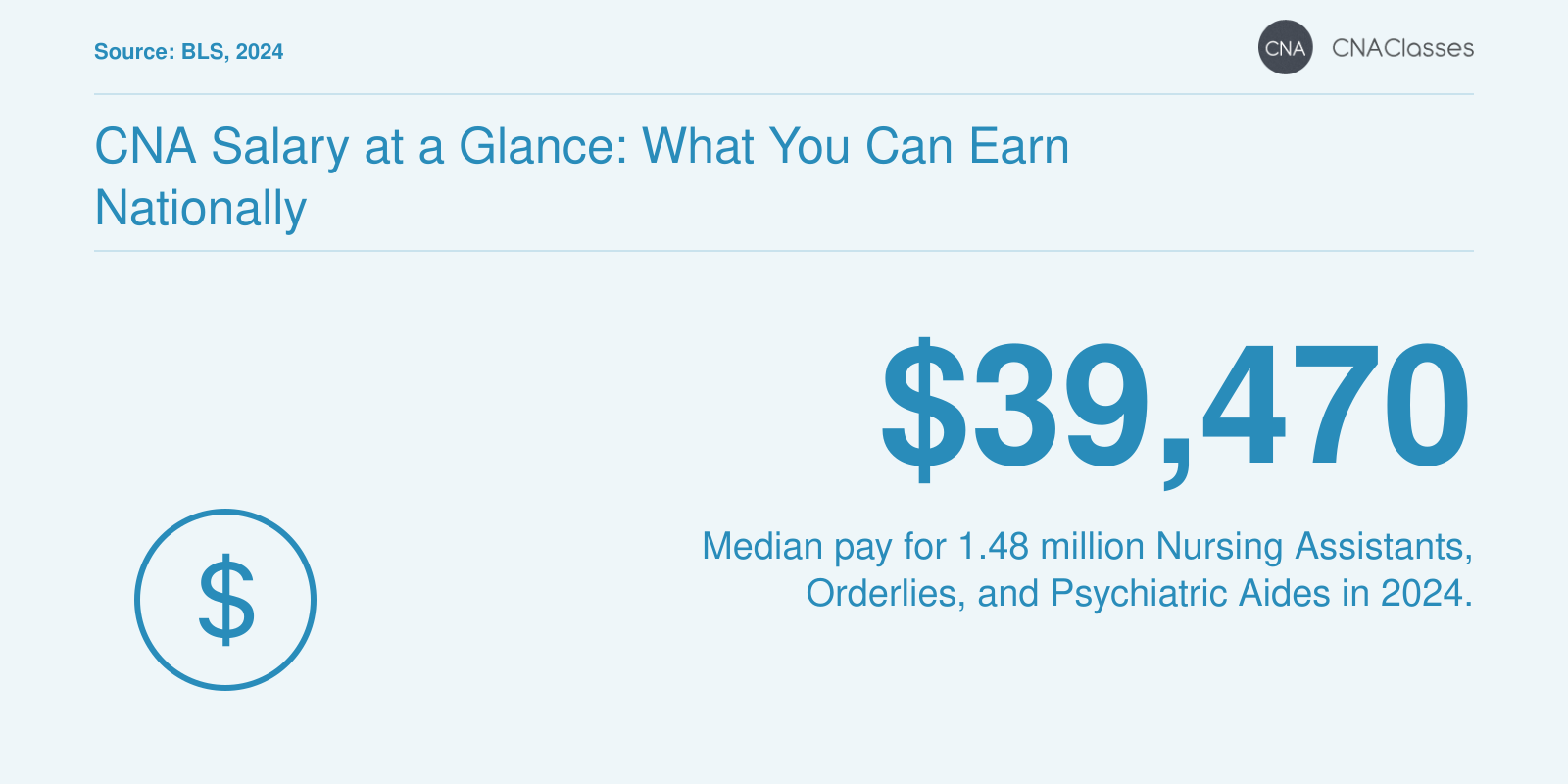
Nursing Assistants play a vital role in healthcare, and their compensation reflects the demand. According to the latest BLS data, here is a snapshot of what CNAs earn across the country.
How do you locate online CNA programs that carry your state's official stamp of approval? Finding CNA training and certification programs that blend online coursework with in-person clinicals and meet certification standards requires checking multiple authoritative sources. The following steps can guide you to state-approved options without guessing.
Your state's board of nursing (or equivalent regulatory body, sometimes called the department of health) publishes a list of approved CNA training programs. These lists often indicate which programs offer online or hybrid delivery. Visit the board's website, look for a "CNA" or "Nurse Aide" section, and download the current directory. Pay attention to expiration dates: approvals can lapse, and the board removes programs that no longer meet standards. If the online listing is outdated, call the board's office directly to confirm a program's status. Review the program's total hours, which usually break down into classroom instruction and supervised clinical practice. Online programs still require you to complete clinical hours in person at an approved facility, so confirm that the program arranges those placements or that you can complete them locally.
State approval is essential, but national programmatic accreditation adds another layer of quality assurance. Two respected accreditors are the Accreditation Commission for Education in Nursing (ACEN) and the Commission on Collegiate Nursing Education (CCNE), which accredit nursing programs at various levels; some CNA programs fall under larger nursing departments that hold these credentials. Ask the program for its accreditation letter, then cross-check it against the accreditor's online directory. To verify a program's claim, follow these steps: - Search the accreditor's website for the program name. - Compare the program's listed credential level (e.g., certificate, diploma) and location. - Contact the accreditor directly if you see discrepancies. Be wary of programs that claim accreditation from unrecognized bodies without providing verifiable documentation.
Organizations like the National Association of Health Care Assistants (NAHCA) maintain relationships with reputable training providers. NAHCA can refer you to programs that have a track record of preparing students for certification exams. Also reach out to local hospitals, nursing homes, and assisted living facilities; many partner with state-approved online CNA programs to provide clinical sites and sometimes sponsor training. These employers often know which local programs produce graduates who know how to get a CNA job.
The U.S. Bureau of Labor Statistics (BLS.gov) offers an overview of CNA training requirements by state through its Occupational Outlook Handbook. While the BLS does not list specific programs, it provides links to each state's board and clarifies the mandated hours and skills competencies. This can help you verify that any program you consider aligns with what your state demands, all at no cost.
While most free platforms focus exclusively on the written portion of the CNA exam, a few go beyond by pairing practice questions with clinical skills demonstrations, the combination that often makes the difference between passing and retaking. In 2026, several free resources have updated their content to align with the latest NNAAP and state-specific exams, giving you solid prep without a price tag. Below we evaluate five of the most popular free CNA practice test platforms on question quality, exam alignment, and skills coverage.
If you want a test that mirrors your specific state’s licensing provider with the most current question set, OpenExamPrep is the best overall free platform for 2026. It covers all 51 jurisdictions, aligns with the dominant testing companies, and was updated as recently as mid-July 2026. No signup barrier means you can jump straight into realistic written prep, making it the top pick for focused, jurisdiction-correct practice.
For the hands-on portion of the CNA exam, no free test alone replaces a proctored skills demonstration, but 4YourCNA4 comes closest with its extensive collection of free skills videos. These walk you through each procedure step by step, which you can reference while practicing with a peer or during lab time. If your study style leans visual and you need to build confidence in patient handling, use 4YourCNA’s videos alongside any written test platform to round out your preparation.
Free and low-cost online CNA courses are self-paced web classes that teach the classroom side of nursing assistant work: infection control, patient rights, communication, basic care concepts, and safety. They are useful as background reading, prerequisite study, or a way to test whether the career fits before you enroll in a state-approved CNA program. What they are not: a substitute for the hands-on clinical hours (typically 16 to 100+ depending on your state) that every state requires before you can sit for the CNA competency exam.
Here is a straight comparison of the most commonly cited platforms in 2026.
Treat these courses as supplements, not shortcuts. They work well before you enroll (to preview the material), alongside a state-approved program (to reinforce weak spots), or after certification (for continuing education on topics like HIPAA and infection control). To actually become a CNA, you still need a state-approved program with supervised clinical hours followed by the state competency exam.
What are the best CNA study guides, videos, and apps to actually pass the certification exam?
With hundreds of resources floating around online, it helps to zero in on the ones that consistently deliver results. A smart combination of a solid textbook, visual skill demonstrations, and mobile review tools can make your study time far more effective than relying on any single source.
Two titles stand out as go-to references for CNA students in 2026:
Using both together gives you broad clinical knowledge from Mosby's and targeted exam strategy from CNA Exam Secrets.
The clinical skills portion of the CNA exam requires you to perform specific procedures in front of an evaluator, so watching CNA training videos repeatedly is one of the best ways to prepare.
Watch each skill video at least twice, then practice with a partner or even a pillow stand-in before your skills check-off.
Scattering your study sessions across random resources leads to gaps. Instead, try a structured weekly plan:
This layered approach, combining reading, watching, practicing, and quizzing, reinforces material through multiple learning pathways. Most successful candidates pursuing a CNA career report that consistency over four to six weeks matters far more than the total number of hours logged. Start early enough that you are reviewing familiar material in your final week, not learning it for the first time.
Paying for CNA training out of pocket can feel like a barrier, but our Guide to Paying for Nursing School explains why it's often a short-term investment with a long-term payoff, if you know where to find help. Many prospective students never apply for funding simply because they do not realize how many sources exist. The key is to treat the search as a project in itself: start broad, then narrow your focus to local and profession-specific opportunities.
The U.S. Bureau of Labor Statistics (BLS.gov) is more than a salary site. Its career guides for nursing assistants link to training resources, workforce development boards, and occasionally to grant-funded initiatives. While the BLS does not give out money directly, it points you toward state labor agencies that administer federal workforce grants. If you are unemployed or underemployed, the Workforce Innovation and Opportunity Act (WIOA) can cover tuition, books, and even scrubs for CNA training. Visit your local American Job Center to ask about WIOA-eligible programs.
Almost every community college and vocational school that teaches a CNA curriculum has a financial aid office. Start by checking the school’s website for a “scholarships” or “types of aid” page, then call or email the admissions team. Ask specific questions: Are there program-specific scholarships for aspiring CNAs? Is the school a WIOA approved provider? Do they offer payment plans? Some programs run their own internal grant programs funded by local healthcare employers who need a reliable hiring pipeline. These grants are often under-advertised, so a quick conversation can put you on the radar.
Organizations like the National Association of Health Care Assistants (NAHCA) sometimes publish lists of scholarships or partner with foundations to cover exam fees. Your state’s board of nursing or department of health may also maintain a funding directory for nurse aide training. These sources are especially useful because they are tailored to the healthcare field, meaning the eligibility rules are less abstract than a general scholarship. Bookmark the sites, note their application windows, and set a calendar reminder so you do not miss a deadline.
Many healthcare employers fill CNA vacancies by sponsoring students upfront. The model is straightforward: you train at their expense, and in return you work for them for a set period, often six to twelve months. This eliminates tuition risk and guarantees a job at the end, a smooth transition our guide to landing your first cna job can help you prepare for. To find these opportunities, contact hospitals, nursing homes, and home health agencies nearby and ask if they offer training cohorts or tuition reimbursement. Some places even provide paid clinical hours.
If you already work in healthcare or hospitality at a facility, check your employee handbook for tuition assistance benefits. Many workers leave money on the table simply because they never ask.
The Bureau of Labor Statistics projects a 2% increase in nursing assistant jobs from 2024 to 2034. While not the fastest growing field, this adds nearly 30,000 positions due to the occupation's large size, confirming steady demand for these essential healthcare workers.
Some certified nursing assistants add a short, focused credential to move into a higher-paying specialty right away, while others commit to a longer bridge program that leads to a licensed vocational or registered nursing role. Both paths build on your CNA experience, but they differ in time, cost, and ultimate earning potential.
Earning a specialty certification is one of the fastest ways to increase your hourly wage as a CNA. Here are the most impactful options for 2026:
All CNAs must complete continuing education units (CEUs) to renew their license. National standards often call for 12 hours per year,4 while states like California mandate 48 hours every two years, with at least 24 hours earned online.5 Employer in-service training also counts toward renewal requirements.5
Free and low-cost CEU providers make it easy to stay current without straining your budget. Platforms like Nurse.com and CEUfast offer accredited courses you can take at your own pace. Check with your state board for a list of approved providers.
If you are ready for a deeper commitment, CNA-to-LPN or CNA-to-RN bridge programs provide a structured pathway into licensed nursing. These programs acknowledge your clinical experience and can shorten the time to completion. While costs and entrance requirements vary, the long-term return is substantial: licensed practical nurses and registered nurses earn significantly higher salaries and gain greater autonomy in patient care.
Enrolling in an unapproved CNA program can cost you time, money, and eligibility to take the certification exam. Verifying a program's accreditation before you enroll is one of the most important steps you can take.
Every state maintains a list of CNA training programs that meet its regulatory standards, and most state boards of nursing publish this directory online. Search for your state's board of nursing website and look for a section labeled "approved programs," "program directory," or "nurse aide training." Many boards offer a searchable database where you can filter by location, program type, or delivery format (online, in-person, or hybrid). If you cannot find a directory on the website, call or email the board directly. Staff members can confirm whether a specific program holds current approval.
The Bureau of Labor Statistics (BLS) publishes an occupational profile for nursing assistants that links to state-level regulatory information and accreditation resources. This page can point you toward the correct state agency if you are unsure where to begin. Additionally, the U.S. Department of Education maintains a database of recognized accrediting organizations. If a school advertises accreditation, you can cross-reference the name of the accrediting body against this federal database to confirm it is legitimate.
Organizations such as the National League for Nursing and the American Red Cross can help you identify reputable programs. These groups often maintain their own lists of recognized training providers or can direct you to trusted resources. Contacting them is especially useful if you are comparing programs across state lines or evaluating an online program headquartered in a different state.
Before enrolling, review the program's own website for the following details:
If any of this information is missing or vague, treat it as a warning sign. A legitimate program will be transparent about its credentials because those credentials are what make your certification possible.
Taking these steps before you pay tuition protects your investment and ensures that your training hours will count toward certification.
Median annual wages for nursing assistants vary significantly by state. The following table displays the latest data from the U.S. Bureau of Labor Statistics, showing median salary and total employment for each state. The highest-paying states include Oregon, Washington, and New York, while Montana, Maryland, and the Virgin Islands report the lowest median earnings. Keep in mind that a high salary may be offset by a higher cost of living in certain areas.
| State | Median Annual Salary | Total Employment |
|---|---|---|
| Oregon | $48,390 | 12,800 |
| Washington | $48,260 | 28,080 |
| New York | $47,390 | 85,310 |
| District of Columbia | $46,860 | 2,550 |
| California | $46,420 | 102,380 |
| New Hampshire | $46,050 | 7,190 |
| Alaska | $45,840 | 1,660 |
| Maine | $45,640 | 8,590 |
| Minnesota | $45,580 | 26,970 |
| Massachusetts | $45,410 | 38,280 |
| Nevada | $45,060 | 8,670 |
| Colorado | $44,950 | 20,880 |
| New Jersey | $44,910 | 31,310 |
| Hawaii | $44,830 | 4,620 |
| Illinois | $44,750 | 64,660 |
| Connecticut | $44,500 | 21,390 |
| North Dakota | $44,190 | 6,920 |
| Rhode Island | $44,160 | 8,450 |
| Vermont | $43,610 | 3,140 |
| Wisconsin | $43,250 | 27,480 |
| Arizona | $41,980 | 17,350 |
| Pennsylvania | $41,110 | 65,410 |
| Virgin Islands | $41,090 | 120 |
| Maryland | $40,000 | 24,230 |
| Montana | $39,300 | 4,800 |
In states like Alaska and New York, median CNA salaries surpass $40,000, while in lower-paying states the figure can fall well below $30,000. Where you work matters as much as what you do.
Getting clear answers before you enroll can save time and money. Below are the most common questions about online CNA training and certification, answered for 2026.