Key Points
- Colorado CNA certification requires 75 training hours and a background check.
- Median CNA salary in Colorado is $44,950, with Boulder at $49,390.
- Free and low-cost training is available through grants and employer sponsorship.
Compare the best CNA programs in Colorado—cost, earnings, job data to launch your caregiving career.
Colorado's population aged 65 and older grew by more than 30 percent between 2015 and 2025, and the state's healthcare facilities are competing hard for qualified nursing assistants to fill the gap. As of May 2024, the median CNA wage here sits at $44,950, well above the national average, yet training programs can be completed in as few as four to eight weeks at a fraction of typical tuition.
The real challenge is sorting through dozens of programs statewide, each with different costs, clinical site quality, and exam pass rates, while meeting the state's 75-hour minimum training requirement. Employer-sponsored training and community college options further complicate the math, making program selection as important as the credential itself.
What are the official steps to earn your CNA certification in Colorado? The process starts with verifying state requirements, completing an approved CNA training program, passing a competency exam, and registering with the state. Here's how to navigate each stage.
Colorado's CNA certification is overseen by the Colorado Department of Public Health and Environment (CDPHE). Visit their website to review the most current prerequisites, including minimum training hours, required clinical hours, age and education requirements, background check procedures, and immunization standards. Requirements can change, so confirming details directly with CDPHE ensures you meet all eligibility criteria before enrolling in a program.
Once you understand state requirements, explore approved CNA training programs across Colorado. Program websites typically list exact training hours, clinical rotation hours, tuition costs, and class schedules. Some programs offer evening or weekend sessions to accommodate working students, while others provide accelerated formats. Comparing these details helps you select a program that fits your budget and timeline.
The Bureau of Labor Statistics (BLS.gov) publishes national and state-level data on CNA employment trends, median wages, and job growth projections. Reviewing this information gives you a clearer picture of career prospects in Colorado and helps set realistic salary expectations as you plan your training investment.
Organizations such as the Colorado Health Care Association offer resources for aspiring CNAs, including guidance on the certification process, application steps, and exam details. These associations can also connect you with mentors, answer policy questions, and provide updates on regulatory changes that might affect your certification journey.
CNA training costs money up front, but a range of funding options can reduce or even eliminate that expense, depending on your situation and where you live in Colorado.
CNA programs in Colorado vary widely in price. Community colleges tend to offer some of the more affordable options, while private training centers may charge more. Rural community colleges and county health departments outside the Denver metro area sometimes offer lower tuition rates, so expanding your search beyond the nearest city can pay off. The U.S. Bureau of Labor Statistics (BLS.gov) offers general guidance on healthcare training costs: a useful starting point before you call individual schools.
One of the most overlooked options is employer-sponsored training. Many nursing homes and assisted living facilities offer free CNA programs in exchange for a commitment to work with them for a set period after you complete the course. This arrangement costs you nothing and can help you land your first CNA job. The Colorado Health Care Association website lists member organizations across the state, and contacting those facilities directly is one of the most direct ways to find these opportunities.
Federal Pell Grants are available to eligible students at accredited programs and do not need to be repaid. You can apply at fafsa.gov. Colorado also offers workforce development funding through local workforce centers, which can cover training costs for eligible job seekers. Search the Colorado Department of Higher Education website for current state-funded grants and initiatives.
When you contact a school directly, ask specifically about:
Taking the time to explore more than one source of funding is almost always worth it. The combination of a Pell Grant, a state workforce grant, and a school scholarship can sometimes cover the full cost of training.
According to the U.S. Bureau of Labor Statistics, Colorado employed 20,880 nursing assistants as of May 2024. The median annual wage for CNAs in the state is $44,950, which translates to approximately $21.61 per hour. Most CNAs work in nursing care facilities, hospitals, and assisted living communities.
| Measure | Value |
|---|---|
| Employment | 20,880 |
| Mean Annual Wage | $45,480 |
| 25th Percentile Wage | $40,830 |
| Median Annual Wage | $44,950 |
| 75th Percentile Wage | $48,100 |
Nursing assistant pay varies significantly across Colorado's metro areas. Denver–Aurora–Centennial employs the most CNAs, but Boulder offers the highest median salary at $49,390. Here's how the top seven metro areas compare, based on the latest Bureau of Labor Statistics data.
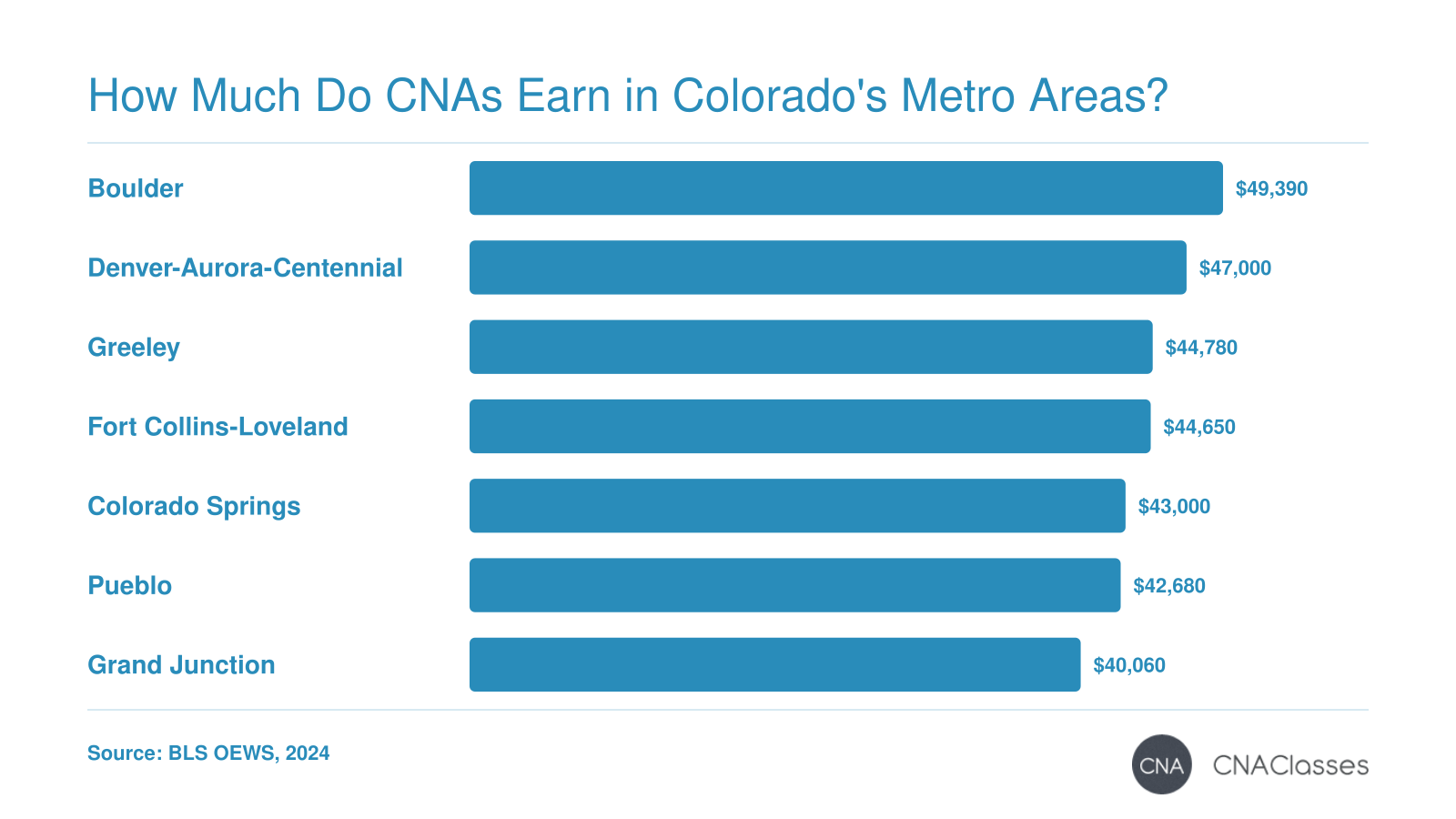
Understanding salary potential is a key step in planning your CNA career.
The CNA competency exam in Colorado is a two-part test that confirms you can safely perform the duties of a certified nursing assistant. Administered through the National Nurse Aide Assessment Program (NNAAP), it includes a written (or oral) knowledge test and a hands-on skills evaluation. You must pass both parts to earn placement on the Colorado Nurse Aide Registry.
The written portion consists of 70 multiple-choice questions, and you have 120 minutes to complete it. Questions cover topics like infection control, patient safety, communication, basic nursing skills, and residents' rights. You need a score of 70% or higher to pass. If you prefer, an oral version of the exam is available and includes 160 questions read aloud3, which can be helpful for candidates who are more comfortable listening than reading.
During the clinical skills portion, you perform a set of randomly selected nursing assistant tasks in front of an evaluator. You have roughly 30 minutes to demonstrate competencies such as handwashing, taking vital signs, repositioning a patient, and providing personal care. Each skill is scored on a pass/fail basis, so you either perform it correctly or you do not. Attention to detail matters here: evaluators watch for proper technique, safety precautions, and respectful communication with the "patient" throughout.
The national NNAAP pass rate sits at about 88% in 2026. Some Colorado programs consistently outperform that average. Emily Griffith, which offers CNA classes in Denver, reports a 94% pass rate4, Pikes Peak State College, known for its CNA classes in Colorado Springs, posts a 92% first-time pass rate4, and Care Synergy Training Program achieves a perfect 100% on the written exam with an 82% first-time pass rate on skills5. If you do not pass on your first try, Colorado allows up to three attempts within a 24-month window. The combined exam fee is $145 ($50 for the written test and $95 for the skills evaluation), so each retake adds cost.3
A structured study plan makes a real difference in your confidence on test day.
Programs with strong pass rates typically build exam preparation directly into their curriculum, so choosing the right school can set you up for success before you even sit for the test.
Finding a job after completing your CNA program is rarely the hard part in Colorado, but finding a program that actively supports your transition into the workforce can make a real difference in how quickly and confidently you land your first CNA job.
Before you enroll, spend time on individual program websites looking for published information about career services, employer partnerships, and graduate outcomes. Many programs highlight connections with local healthcare facilities or describe how they help students prepare for interviews and job searches. If you can't find this information online, call the admissions office directly and ask what career support looks like after graduation.
The Bureau of Labor Statistics at bls.gov publishes Colorado-specific employment projections and wage data for nursing assistants. This is one of the most reliable places to get a realistic picture of demand, hiring trends, and typical pay in the state.
The Colorado Department of Public Health and Environment and the Colorado Health Care Association are both worth contacting. These organizations are involved in workforce development and can point you toward employer partnerships, training incentives, and programs designed to help CNA graduates find stable positions.
Don't overlook LinkedIn. Searching for CNA graduates from programs you are considering can give you candid, firsthand perspectives on how well a school supported job placement. Most people are willing to share their experience if you reach out with a genuine question.
What does quality clinical training actually look like in a Colorado CNA program, and how can you tell the difference before you enroll?
The classroom portion of CNA training matters, but the clinical hours are where real competency is built. Colorado programs are required to meet state standards set by the Colorado Department of Regulatory Agencies (DORA), which means there is a baseline for clinical experience built into every approved program. Many programs go beyond that baseline, offering clinical rotations that span a range of settings, from skilled nursing facilities to hospitals and assisted living communities. Looking for that variety is a good starting point.
Most Colorado CNA programs provide between 75 and 120 clinical hours. When comparing programs, check the website or ask directly: How many hours are spent in a real care setting? What types of facilities are used? Programs that place students in only one type of facility offer a narrower foundation than those that rotate through multiple settings.
Some programs have formal relationships with healthcare systems in their region, which can shape the quality and consistency of your experience. When you contact a program, ask about their clinical site affiliations and what the instructor-to-student ratio looks like during those hours. A lower ratio generally means more individual feedback and supervision.
Beyond the program's own materials, you can consult the Bureau of Labor Statistics for CNA training standards, or look to the American Red Cross and LeadingAge for best practices in clinical education. Reading alumni reviews on job sites or healthcare forums can surface details that brochures leave out.
If at all possible, speak with current students or recent graduates. Ask them directly about the quality of supervision, how diverse the patient care experiences were, and whether they felt prepared for the CNA competency exam. A brief conversation can tell you more than any program ranking.
We answer the most common questions about CNA classes in Colorado to help you get started on your healthcare career path.
Beyond the top-ranked programs, here are more excellent CNA training options across Colorado. Whether you're looking for a program in a specific city or prefer a particular format, this directory covers additional schools that offer quality CNA education.