Key Points
- Florida requires in-person clinical hours for CNA certification.
- CNA jobs are projected to grow 2% nationally by 2034.
- Miami-Fort Lauderdale is a leading healthcare hub with high CNA demand.
Compare top-rated CNA programs, understand certification requirements, and explore job opportunities to jumpstart your healthcare career in South Florida.
South Florida's healthcare sector is growing quickly, and Broward County alone employs thousands of certified nursing assistants across hospitals, long-term care facilities, and home health agencies. For most prospective students, the key questions are simple: how quickly can you get licensed, and what will it cost? CNA programs in Fort Lauderdale typically last four to twelve weeks, with tuition ranging from roughly $800 at community colleges to $2,500 or more at private training centers.
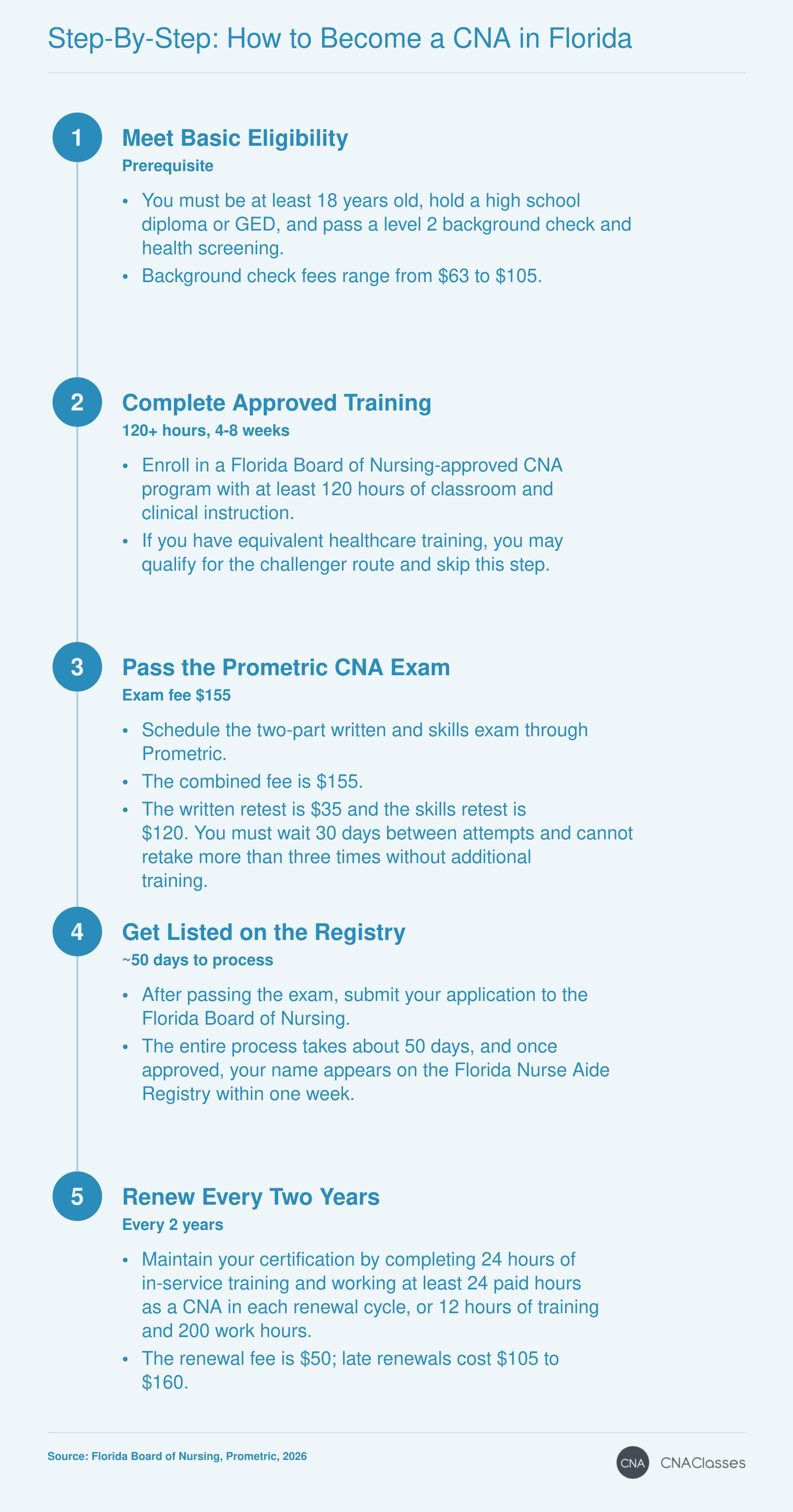
Florida requires candidates to complete a state-approved program that includes both classroom instruction and supervised clinical hours before sitting for the two-part certification exam. This clinical requirement shapes every training decision you will make, including whether a hybrid or online format is even possible.
This page covers local job prospects, hybrid program options, the step-by-step certification process, and a ranked list of top programs.
Which Fort Lauderdale employers are actively hiring CNAs, and do any offer tuition assistance or training programs? The Fort Lauderdale area sits within the Miami-Fort Lauderdale metro, one of Florida's most vibrant healthcare markets, and demand for certified nursing assistants remains steady across multiple care settings. Understanding which employers are hiring and what support they offer can help you choose a certified nursing assistant program and a future workplace at the same time.
Fort Lauderdale hosts a range of hospitals, skilled nursing facilities, rehabilitation centers, assisted living communities, and home health agencies that depend on CNAs every day. Large hospital systems operating in Broward County include multiple campuses and specialty care centers, while numerous nursing homes and long-term care facilities employ CNAs to assist residents with daily living activities. Home health agencies also hire CNAs to deliver care in patients' homes, a growing segment as more individuals choose to age in place.
Many of these employers maintain robust career pages listing open CNA positions and occasionally promote tuition reimbursement programs or partnerships with local CNA training schools. Some facilities offer new hires a stipend to offset certification costs or sponsor students through approved CNA courses in exchange for a commitment to work after graduation. It is worth checking the careers section of each employer's website directly, as sponsorship offerings can change seasonally based on staffing needs.
Local community colleges often maintain formal partnerships with area healthcare employers, connecting students to job placement assistance and sometimes to organizations willing to subsidize training costs. Reaching out to program coordinators at these institutions can yield a current list of sponsoring agencies and details on application windows for employer-funded seats. Some hospitals and nursing homes also post training opportunities on county workforce development boards or through the Florida Department of Health's training registry.
By researching both the college programs and the employers in parallel, you can identify which pathways offer the best combination of quality training, financial support, and how to get a CNA job in Fort Lauderdale's dynamic healthcare landscape.
Fully online CNA programs do not exist in Florida in the traditional sense, and for good reason: the Florida Board of Nursing requires hands-on clinical hours before a candidate can sit for the state certification exam. What does exist, and what works well for busy Fort Lauderdale students, is the hybrid model.
In a hybrid CNA program, you complete the theory portion of your coursework online or through a flexible class schedule, then fulfill your required clinical hours at an approved healthcare facility in person. The theory side covers subjects like anatomy basics, infection control, patient rights, and medical terminology. The clinical side puts those concepts into practice under the supervision of a licensed nurse. Florida requires a minimum of 120 to 165 clock hours total depending on the program, and a meaningful share of those must be hands-on clinical training.
This structure gives you real flexibility. You can watch recorded lectures in the evening, complete reading assignments on your own schedule, and then block off specific days for your clinical rotations at a local nursing home or hospital.
For students who are already working, raising a family, or balancing other obligations, the hybrid format removes a major barrier. You are not required to sit in a classroom five days a week. Gulf Coast State College, for example, offers a hybrid program that meets just twice per week and wraps up in about eight weeks. South Florida State College schedules evening and Sunday hybrid sessions, which is a practical fit for students with daytime jobs.
FVI School of Nursing and Technology, which offers CNA classes in Miami, just south of Fort Lauderdale, provides flexible day and evening class options and bilingual English/Spanish instruction, making it accessible to a wider range of South Florida students.
When evaluating hybrid options, ask each school these questions before enrolling:
If you need help finding CNA classes in the Fort Lauderdale area, our school-matching tool filters by location, schedule, and program format so you can find options that fit your actual life.
Beyond the top-ranked programs, this section includes additional CNA training providers across Florida that may be accessible to Fort Lauderdale students. While these schools are located in other cities, they offer flexible formats and affordable tuition options worth exploring.
Did you know? The Bureau of Labor Statistics projects a 2% increase in nursing assistant jobs nationwide from 2024 to 2034. This steady growth underscores the need for trained CNAs across the country. For Florida and Miami-Fort Lauderdale metro projections, visit the Florida Department of Economic Opportunity, where regional demand often exceeds national averages.
Understanding what you can expect to earn and the cna job outlook will help you plan your career with confidence. The Miami-Fort Lauderdale-West Palm Beach metro area is one of the largest healthcare markets in the Southeast, and demand for certified nursing assistants remains steady across hospitals, skilled nursing facilities, and home health agencies.
According to the most recent data, the median annual wage for nursing assistants in the Miami-Fort Lauderdale-West Palm Beach metro area is approximately $37,030.1 Those in the 25th percentile earn around $34,180 per year, while CNAs at the 75th percentile bring home roughly $39,330.1 These figures reflect base pay and do not always account for shift differentials, overtime, or facility-specific bonuses that can increase your take-home pay.
For comparison, the national median annual wage for nursing assistants is approximately $39,530.2 South Florida wages for CNAs have historically trailed the national median by a modest margin, though the region's lower state tax burden (Florida has no personal income tax) helps close the gap in terms of real purchasing power. Statewide Florida figures from the most recent available reporting period show a mean annual wage that was notably lower,3 though wages across the state have been trending upward as healthcare systems compete for qualified staff.
The metro area employs roughly 22,940 nursing assistants,4 making it one of the highest-concentration markets for this role in the state. Nationally, the occupation supports nearly 1.5 million workers, with an estimated 211,800 job openings projected each year.2 Most of these openings result from workers transferring to other occupations or retiring rather than from net new positions, but the overall volume keeps demand reliably high.2
South Florida's aging population is a significant driver of that demand. The region continues to attract retirees, which in turn fuels growth in long-term care, assisted living, and home health services.
Large hospital networks play a meaningful role in sustaining CNA employment in the Fort Lauderdale area. Broward Health operates multiple hospitals and outpatient centers across the county and regularly recruits CNAs for acute care and rehabilitation units. Memorial Healthcare System, one of the largest public healthcare systems in the country, has expanded its footprint with new facilities and service lines that require bedside support staff. These systems, along with a growing number of ambulatory surgery centers and specialty clinics, create a pipeline of opportunities for newly certified nursing assistants.
Keep in mind that wages and openings can shift as new facilities open and reimbursement policies evolve. Checking current job postings in the Fort Lauderdale area will give you a real-time sense of which employers are hiring and what compensation packages they offer. If you are just starting your CNA training, the outlook is encouraging: healthcare is one of the few sectors where entry-level workers can expect consistent demand year after year, and our guide to landing your first cna job can help you launch your career.
Finding a top-quality CNA training program in Fort Lauderdale means knowing where to look and what questions to ask before you enroll. The strongest programs prepare you not only to pass the state certification exam but also to step confidently into a clinical role. While no single public ranking tells you which school is best for your schedule and goals, a methodical approach to gathering information will reveal the programs that align with your needs.
Your first stop should always be the Florida Board of Nursing website. The board maintains a current list of approved training providers, which is essential because only state-approved programs qualify you to sit for the Florida CNA exam. Without this stamp of approval, your investment of time and money may not count. Review the list carefully and cross-reference any school that interests you, even if it claims accreditation from another body.
Once you have a shortlist of approved programs, dig into the details on each school’s own website. Look for concrete information that impacts your daily life during training:
While searching online, you may come across institutional names commonly associated with the Broward County area, such as Broward College or Sheridan Technical College. Keep in mind that program offerings and admission cycles can shift, so relying on a single snapshot from a third-party site is not enough. Always verify details on the school’s official website or with a phone call.
Employment statistics and recent graduate outcomes are rarely published in full on a school’s website. To get a clearer picture, contact the admissions office or program coordinator directly and ask:
For additional context, supplement program-specific inquiries with broader labor market data from the Bureau of Labor Statistics (BLS). The BLS website provides regional employment projections and wage estimates for nursing assistants in the Miami-Fort Lauderdale metropolitan area, which can help you set realistic salary expectations and understand long-term demand.
After collecting information from multiple sources, compare programs side by side using a simple checklist: approval status, cost, schedule fit, clinical opportunities, and any indicators of graduate success. Visiting a campus or attending an information session can also reveal the learning environment and support services available, such as tutoring or career counseling.
Remember that a “top” program is one that works for your life circumstances and sets you up for a reliable, rewarding career. Investing time in this upfront research will pay dividends when you begin your first CNA job with confidence.
Here are answers to the most common questions about becoming a Certified Nursing Assistant in Fort Lauderdale. Whether you are exploring program lengths, costs, or job prospects, we have clear, practical information to guide your next steps.