Key Points
- Florida projects 111,610 nursing assistant jobs by 2026.
- Tampa metro CNAs earn a median $36,700 annually.
- Free CNA training is available in St. Petersburg through employer sponsorships.
Compare St. Petersburg CNA programs by cost, format, and job placement to start your healthcare career.

Florida’s demand for nursing assistants is projected to reach 111,610 jobs by 2026, and St. Petersburg’s expanding senior care sector makes CNA certification a practical career move right now. Training formats range from employer-sponsored free programs to hybrid courses that blend online learning with required clinical hours. The real decision comes down to cost, schedule, and program quality: state exam pass rates can differ by 20 percentage points across local schools. Choosing a program with proven outcomes gives you a faster, more reliable path to the state registry and your first paycheck.
The demand for skilled nursing assistants across the Tampa-St. Petersburg metro area continues to grow, making it an opportune time to enter the field. Area hospitals, nursing homes, and assisted living facilities are actively recruiting CNAs, and local training providers are expanding cna classes to help meet this workforce need.
According to federal employment projections, healthcare support occupations like nursing assistants are expected to see steady job growth in the coming years. For the Tampa metro area, this translates to consistent demand for newly certified nursing assistants across a variety of care settings. St. Petersburg is home to several major healthcare employers, including large hospital systems and rehabilitation centers that frequently post openings for CNAs. Long-term care communities and home health agencies also regularly seek qualified assistants to support an aging population. The Florida Health Care Association and similar industry groups track hiring trends and can offer insight into where opportunities are expanding.
Many CNA training providers in the St. Petersburg area have established relationships with local healthcare employers. These partnerships often create direct pipelines for clinical placements and can connect graduates with job interviews. Programs at community colleges and technical schools may host career fairs or offer placement assistance, which removes some of the guesswork from the job search. By enrolling in a program with strong employer ties, students can benefit from networking and a clearer path into the workforce.
While specific wages vary by facility and experience, CNAs in the Tampa metro area typically earn competitive hourly rates and have access to flexible schedules, including full-time and part-time options. The role also offers a solid entry point into the healthcare field. Many nursing assistants go on to become LPNs or RNs, using their CNA experience as a foundation for further education and career advancement. Above all, the position provides job security in a field where personal impact is as valuable as the paycheck.
Did you know? By 2026, Florida is projected to have 111,610 nursing assistant jobs, according to state workforce projections. That growing demand means CNA graduates in St. Petersburg have strong job prospects.
Fully online versus hybrid training: that contrast is the first thing to understand before you start comparing programs. Florida does not permit a fully online CNA program. The Florida Board of Nursing requires that every approved program include hands-on clinical hours, which means no matter where you complete your theory work, you will still need to show up in person for lab and patient-care practice.4 The good news is that hybrid programs let you handle the lecture and reading portions on your own schedule, cutting down the number of days you actually need to be on campus.
In a hybrid program, the coursework is split into three parts: online theory, skills lab sessions, and a clinical rotation at a healthcare facility. Florida programs are required to include a meaningful number of clinical hours before a student can sit for the state certification exam. South Florida Healthcare Institute, for example, structures its five-week program around roughly 40 hours each of online theory, skills lab, and clinical practice.1 That kind of balance gives working adults and parents a real scheduling advantage without cutting corners on hands-on training.
Florida State College at Jacksonville also runs a hybrid nursing assistant program, completing in about five weeks with a 40-hour clinical rotation and evening and weekend class options.2 Gulf Coast State College offers an eight-week hybrid format as well.3 While these schools are not in Pinellas County, Florida's approval process means their clinical partnerships may include facilities in the Tampa Bay area, so it is always worth asking an admissions advisor whether a nearby clinical site is available to you.
The flexibility of a hybrid format is genuinely useful, but it comes with trade-offs:
Every CNA program in Florida, hybrid or otherwise, must carry approval from the Florida Board of Nursing.4 Before enrolling in any program you find online, confirm that it appears on the Board's approved training list. Programs that skip this step cannot legally prepare you to take Florida's certification exam. If a school's website is not clear about its approval status, call the program directly and ask for the Board of Nursing approval number. That one question can save you significant time and money.
Beyond the top-ranked programs, here are additional state-approved CNA training options within commuting distance of St. Petersburg. These schools offer diverse formats and schedules to fit your needs.
In 2024, nursing assistants in the Tampa-St. Petersburg-Clearwater metro area earned a median annual wage of $36,700 ($17.64 per hour). With 15,440 CNAs employed locally, wages ranged from $35,920 at the 25th percentile to $42,120 at the 75th percentile, reflecting solid earning potential in this high-demand field.
| Metro Area | Total Employment | Median Annual Wage | Median Hourly Wage | 25th Percentile Annual | 75th Percentile Annual |
|---|---|---|---|---|---|
| Tampa-St. Petersburg-Clearwater, FL | 15,440 | $36,700 | $17.64 | $35,920 | $42,120 |
| Miami-Fort Lauderdale-West Palm Beach, FL | 22,640 | $37,690 | $18.12 | $35,550 | $43,360 |
| Orlando-Kissimmee-Sanford, FL | 10,600 | $36,210 | $17.41 | $35,130 | $37,740 |
| Jacksonville, FL | 7,210 | $36,780 | $17.68 | $35,840 | $39,480 |
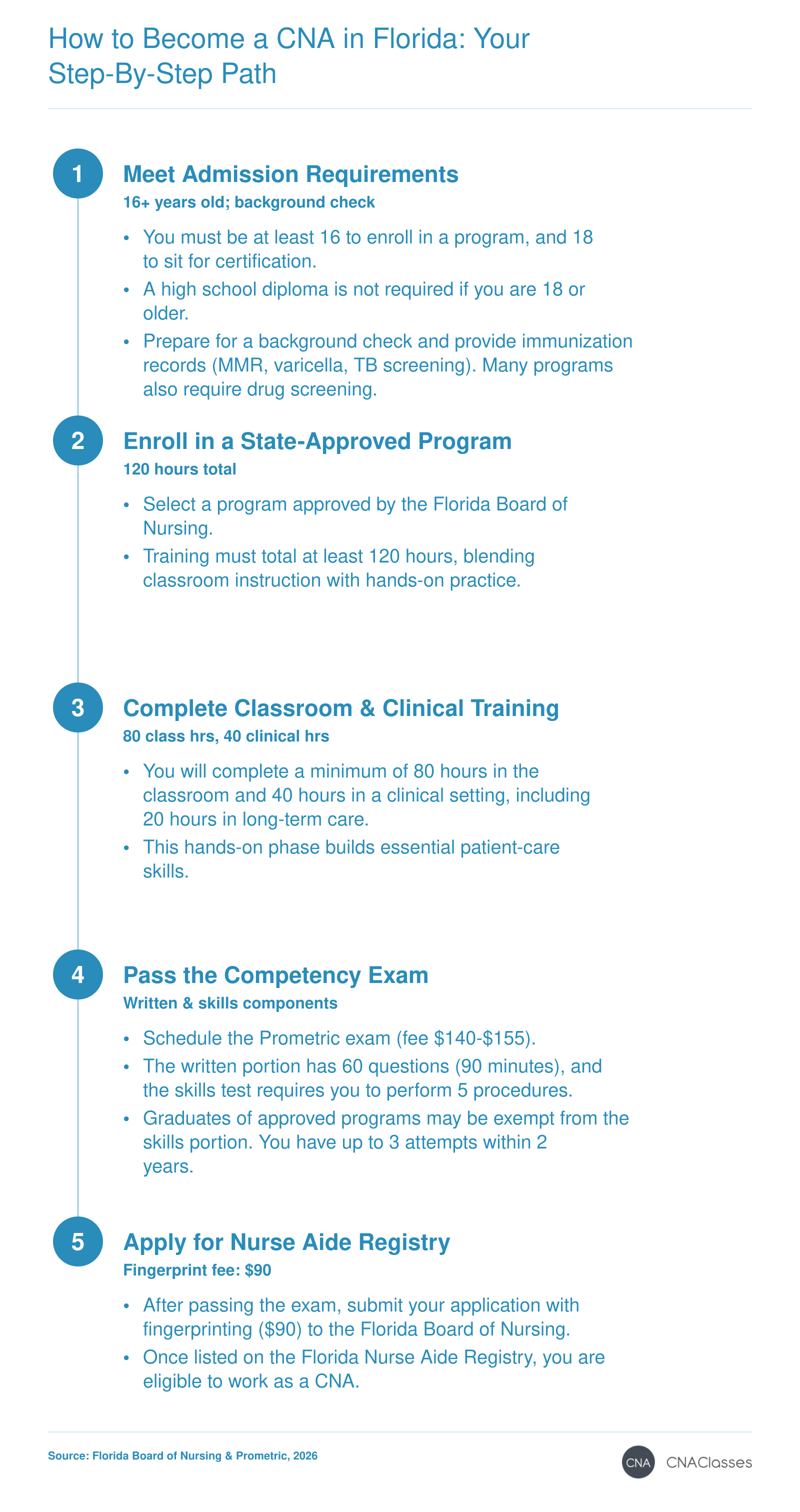
Becoming a Certified Nursing Assistant in Florida follows a clear step-by-step process. From meeting admission requirements to earning your place on the State Registry, here is what you need to know for 2026.
Free CNA training means you complete a state-approved nursing assistant program without paying tuition, typically because a healthcare employer, government agency, or nonprofit covers the cost on your behalf. In St. Petersburg and the surrounding Pinellas County area, several pathways can get you trained and certified for little or no money out of pocket.
Several organizations currently offer tuition-free CNA training to qualified applicants:
Some local skilled nursing facilities, including Abbey Rehabilitation and Nursing Center and Allegro at College Harbor, also sponsor CNA training for prospective employees. These arrangements typically require you to work at the facility for a set period after earning your certification.
If you do not qualify for a free program, affordable options are still within reach:
Both options keep your total investment well under $1,500, and you can check with each school about payment plans or workforce grants through CareerSource Pinellas.
Programs labeled as "free" often come with conditions you should understand before signing up. Work commitments are the most common: you agree to stay employed at a sponsoring facility, usually for six months to a year, after completing training. If you leave early, you may be required to repay some or all of the tuition costs. Other eligibility requirements can include income thresholds, age limits, residency in specific counties, and clean background checks.5
Before committing, request a copy of the full agreement and look for details on the length of the work obligation, the hourly wage you will earn during that period, and any penalties for early departure. A free program can be an excellent deal, but only if the terms align with your career plans. If flexibility matters more to you, a low-cost option like St. Petersburg College or Tampa Bay CNA may be the smarter investment.
What separates a strong CNA training program from a weak one in St. Petersburg? It comes down to two measurable outcomes: first-time pass rates on the Florida CNA exam and the speed of job placement after certification.
The Florida CNA certification exam consists of 60 questions, requires a minimum score of 70 percent, and costs between $135 and $155 to take. You have three attempts within a 24-month window. A program with a high first-time pass rate saves you time, money, and the stress of retakes. For example, the American Red Cross St. Petersburg Training Program reported a 90 percent first-time pass rate in 2019, as shown in the Florida Board of Nursing's 2019 pass rates report, well above the statewide average of 80 percent that year. When evaluating schools, ask for their most recent pass rate data. Programs that publish their numbers openly typically have nothing to hide.
Certification is only half the journey. The other half is landing your first CNA job in a market where more than 15,440 CNAs already work across the Tampa-St. Petersburg-Clearwater metro, according to Florida CNA license data. Many St. Petersburg programs offer career services including resume workshops, interview coaching, and direct referrals to hiring managers at local hospitals, nursing homes, and home health agencies. Some schools have formal partnerships with healthcare employers that guarantee interviews or even conditional job offers upon certification. Bayfront Health St. Petersburg, Northside Hospital, and ManorCare Health Services are among the facilities that regularly recruit from local CNA programs.
During your school visit, ask specific questions: Does the program host job fairs? Do graduates receive help with job applications? Which employers have hired recent graduates? Schools with robust placement support often track employment outcomes for six months or a year after graduation. If a program cannot or will not share this data, consider that a red flag.
Before enrolling, request the following from each program:
Programs that invest in student success will answer these questions readily. Those that dodge or defer may be prioritizing enrollment over outcomes. Your certification and your career are too important to leave to chance.
Below are the top CNA programs serving St. Petersburg students, ranked by median earnings of graduates one year after completion, a metric that reflects program quality and graduate success.
Miami, FL · $35,000 – $40,000/yr
Best for: Career changers needing swift entry
FVI School of Nursing and Technology offers a fast, 9-week Nursing Assistant/Home Health Aide program with flexible day and evening classes, including bilingual options in Miami. The program features hands-on lab training, a 40-hour clinical externship, and CPR/BLS certification. Job placement assistance and small class sizes support your transition into healthcare.
Fort Myers, FL
Best for: Budget-conscious in-state students
Fort Myers Technical College provides an affordable, 165-hour Nursing Assistant program costing around $1,290. The curriculum covers essential patient care skills and includes clinical rotations. Articulated credits allow for a seamless transition to Practical Nursing programs statewide.
Cape Coral, FL · $1,000/yr
Best for: Hands-on learning with articulation
Cape Coral Technical College's Nursing Assistant Articulated program takes just 6 weeks to complete at an estimated cost of $1,255. With small class sizes and 40 hours of clinical experience, you'll be well-prepared for the Florida CNA exam and can articulate credits toward further nursing education.
Avon Park, FL · $4,000/yr (net price)
South Florida State College combines online convenience with in-person training in an 8-week hybrid CNA program. Evening and Sunday classes cater to working adults, and scholarships through CareerSource Heartland may cover tuition. The program prepares you for state certification and immediate employment.
Gainesville, FL · ~$11,000/yr (est.)
Santa Fe College offers a 165-hour Nursing Assistant Certificate program in Gainesville, with no high school diploma required. First-come, first-served admissions and financial aid options like the Florida Open Door Grant make it accessible. High job placement rates and board approval ensure quality.
Fort Pierce, FL · $4,000/yr
Indian River State College's Nursing Assistant program is a 165-hour state-approved course with multiple campus locations and flexible day/evening schedules. The program emphasizes patient care skills and prepares you for the Florida CNA exam, with an affordable net price around $3,815.
Palatka, FL · $6,000/yr
Saint Johns River State College delivers a quick, 4-week CNA program focused on long-term care. With 120 training hours across two campuses, it includes CPR certification and medical terminology. Graduates are eligible to take the Florida CNA exam and enter the workforce rapidly.
Panama City, FL · ~$5,000/yr (est.)
Gulf Coast State College's hybrid CNA certificate can be completed in 8 weeks with just two weekly sessions. The affordable program (around $600 tuition) includes lab and clinical components and serves as a bridge to Practical Nursing. It's an ideal choice for St. Petersburg students seeking flexibility.
Marianna, FL · $1,000/yr (net price)
Chipola College's Nursing Assistant Long Term program admits students twice a year and offers extensive workforce support, including assistance with tuition, housing, and childcare through DWYER and CareerSource. The program's low net price (averaging $1,133) and small class sizes make it a strong value.
Miami, FL · $32,000/yr
The South Florida Institute of Technology offers a low-cost, 24-hour CNA exam prep course for those with prior nursing coursework. Over six Saturdays for just $250, you'll refresh essential skills and prepare for the state certification exam. It's a supplement, not a full training program.
Here are answers to common questions about becoming a Certified Nursing Assistant in St. Petersburg, covering training requirements, costs, and pathways to certification.