Key Points
- Michigan requires at least 16 supervised clinical hours for CNAs.
- Trinity Health Muskegon is a major local employer for CNAs.
- Grand Rapids Community College and West Shore Community College offer affordable options.

Compare Muskegon CNA programs by cost, schedule, clinical hours, and admission requirements to start your healthcare career.

Trinity Health Muskegon and several long-term care communities across the county are hiring nursing assistants faster than local programs can graduate them, and tuition for a state-approved course here ranges from free to $1,603 depending on the provider. That spread is the real decision point for most applicants: two people can earn the same credential in the same county for wildly different prices and wait times.
Michigan sets a minimum hour requirement for clinical practice, but individual schools publish that number inconsistently, so comparing programs on paper alone can be misleading. Admission rules, background check timing, and seat availability also shift by provider and by semester.
Muskegon's healthcare sector offers CNAs a variety of employment settings, from major hospital systems to specialized long-term care communities. Understanding the local landscape helps you target your job search and decisions about CNA classes in Michigan effectively.
Trinity Health Muskegon and Hackley Hospital anchor the city's acute care options, providing CNAs with fast-paced hospital environments where patient care ranges from surgical recovery to emergency stabilization. Mercy Health also maintains a strong presence in the region, expanding opportunities across multiple facilities.
Beyond hospitals, Muskegon County supports dozens of skilled nursing facilities and senior living communities. These long-term care settings represent the largest employment pool for newly certified CNAs, with facilities consistently recruiting to meet resident care needs.
The broader Grand Rapids metropolitan area, which includes Muskegon County, experiences steady CNA demand fueled by two primary factors. First, the region's aging population continues to grow, requiring more hands-on care in nursing homes, assisted living, and home health settings. Second, hospital turnover creates regular openings as CNAs advance into LPN or RN roles through CNA to RN programs or transition between departments.
This combination keeps job postings active year-round, making Muskegon a reliable market for certified nursing assistants seeking stable employment.
Most CNAs in Muskegon begin their careers in one of three settings:
Many Muskegon employers recognize the value of investing in their workforce. Tuition assistance programs help offset CNA training costs, while flexible scheduling accommodates students balancing coursework with clinical rotations. Some facilities sponsor free CNA training and require a work commitment after certification, lowering the upfront cost of entry.
Can you get certified as a CNA in Muskegon entirely online? No. Michigan does not allow fully online CNA training because state rules require at least 16 hours of in-person clinical practice at an approved facility, plus hands-on lab work that simply cannot be taught through a screen. What you can do is complete the classroom portion, the vocabulary, anatomy basics, and theory, on your own schedule online, then show up in person for skills labs and clinical hours.
A few hybrid CNA programs serve Michigan students with this structure. Heart to Heart Healthcare Training and Purpose Healthcare Institute both run hybrid CNA courses that pair online coursework with in-person components; Purpose's version runs about four weeks and totals roughly 80 hours. Davis Training Institute offers a similarly structured Nurse Aide Training program, though its in-person skills and 16-hour clinical requirement are based at a Saginaw-area site rather than in Muskegon itself. Parrish Academy also advertises a hybrid CNA path combining classroom, online learning, and clinical training. None of these list a Muskegon-based clinical site outright, so distance and travel time matter when you're comparing them.
Before paying tuition or a deposit, verify two things directly with the school. First, ask whether the program's classroom and clinical hours are approved by the Michigan Department of Licensing and Regulatory Affairs (LARA), since this approval is what makes your training count toward the state competency exam. Second, get specifics on where the in-person clinical hours actually happen and how far that site is from Muskegon. A hybrid schedule only saves you time if the in-person portion is realistic to attend consistently. Ask for the clinical site address, the days and hours required on-site, and whether placement is guaranteed or first-come, first-served. Programs that can't answer these questions clearly are worth a second look before you commit.
This table focuses on what is currently confirmed for CNA programs in the Muskegon area. Michigan requires at least 145 total training hours; individual program clinical-hour totals may vary and are not always published.
| Program | Estimated Cost | Schedule / Duration | Clinical Hours | Total Training Hours | Notes |
|---|---|---|---|---|---|
| Muskegon Community College, Certified Nurse Assistant (2026) | $1,415 | July 13–Aug 13, 2026; 4:00–9:00 p.m. | 16 hours (unverified secondary breakdown) | 145 hours (Michigan minimum; MCC breakdown not confirmed) | MCC’s own listing confirms cost and schedule but not total clinical hours. |
| Baker College of Muskegon | Not available | Not available | Not reported | Not reported | No current CNA program cost, schedule, duration, or clinical-hour details were confirmed in 2026 sources. |
| Muskegon Career Tech Center | Not available | Not available | Not reported | Not reported | Offers CNA training in Muskegon; current program details are not published in available sources. |
| Stepping Stones | Not available | Not available | Not reported | Not reported | Offers CNA training in Muskegon; current cost, schedule, and clinical-hour details are not available. |
Requirements vary by program, so use this checklist as a starting point, and confirm final details with each provider before applying.
Classroom instruction gives you the knowledge, but clinical rotations give you the confidence to perform skills on real patients under supervision. Michigan requires a minimum of 75 hours of approved CNA training, including at least 16 supervised clinical hours in a hospital or clinical environment before you can enter the workforce.
Clinical experiences in Muskegon area programs typically take place at a variety of healthcare settings. Students may rotate through long-term care facilities such as nursing homes, assisted living centers, rehabilitation facilities, and hospitals. Mercy Health Muskegon and Spectrum Health are major regional healthcare systems that partner with local training programs, though specific clinical placements vary by semester and program availability.
Muskegon Community College structures its CNA curriculum to prepare students for work in hospitals, long-term care facilities, and assisted living settings. West Michigan Works programs combine classroom work with skills labs and clinical experience across similar facility types.
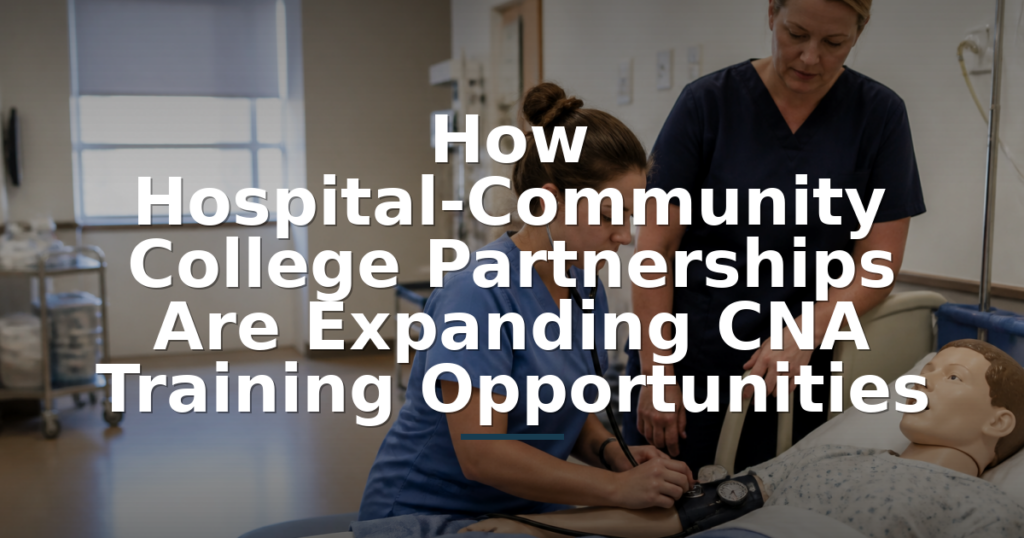
Knowing How to Prepare for CNA Clinicals helps you get the most from clinical rotations, which allow you to practice essential nursing assistant skills with actual patients. Under instructor supervision, you will assist with daily living activities like bathing, dressing, feeding, and mobility. You will take vital signs, document patient observations, and communicate with nursing staff. These hours help bridge the gap between practicing on mannequins in a skills lab and providing real patient care independently.
After completing your approved training program, you must pass both a criminal background check and the state competency exam to become certified. Michigan uses Headmaster for the certification exam, which includes a written or oral test and a hands-on skills demonstration. You will schedule your exam through Headmaster after your training program submits verification of completion. Most candidates complete testing within a few weeks of finishing coursework, though scheduling availability varies by location.
Picking a CNA program in Muskegon usually comes down to weighing sticker price against real-world outcomes, since the cheapest option isn't always the one that gets you licensed and hired fastest.
The advertised tuition rarely tells the whole story. Ask each program for a full breakdown that includes registration fees, uniforms and shoes, textbooks, background checks, immunizations, and the state exam fee itself. Two programs with similar tuition can differ by several hundred dollars once these extras are added, so request an itemized total before comparing.
Michigan requires a 70% or higher score on the written exam plus a flawless run through every scored skill on the hands-on portion, so a program's job is to prepare you to clear both bars on the first try. When you talk to admissions staff, ask for their most recent cna program pass rates and how many students in that cohort it actually reflects. A small group's results can look better or worse than they really are, so ask about cohort size too. Also ask whether their placement numbers mean graduates working as CNAs specifically, or just employed somewhere in healthcare. Get clarity on whether these figures come from the school directly or from a third party.
Check whether classes run days, evenings, or weekends, and whether those flexible CNA class schedules match your work or family obligations. Ask where clinical rotations happen and how far that site is from home, since clinical hours often require reliable transportation on a fixed schedule.
Before enrolling anywhere, confirm the program is currently approved by the Michigan Department of Licensing and Regulatory Affairs. Approval affects your eligibility to take the state exam. Finally, if the school can connect you with a recent graduate or current student, take that conversation seriously. Firsthand accounts of instructor quality, clinical experience, and job support often reveal more than any brochure.
Below are the top CNA programs serving Muskegon students, ranked by affordability and program fit. Grand Rapids Community College and West Shore Community College stand out for their direct Muskegon-area connections, including a Muskegon satellite offering and clinical rotations at Trinity Mercy Hospital. The remaining programs are strong statewide options but often require travel or temporary relocation for Muskegon residents.
Grand Rapids, MI · ~$9,000/yr (est.)
Best for: Muskegon-area learners wanting regional clinical access
Grand Rapids Community College is the strongest regional option for Muskegon students, with a documented Muskegon satellite CNA offering and a four-week accelerated format. The program is in person, uses small class sizes, and exceeds Michigan's minimum training hours. The effective net price is about $8,600 after financial aid, which is higher than some community colleges but reflects strong local employer partnerships and career coaching. Students without access to the Muskegon satellite can commute to the Grand Rapids campus.
Scottville, MI · ~$2,000/yr (est.)
Best for: Students needing Muskegon hospital clinical placements
West Shore Community College combines one of the lowest net prices on this list, about $1,500 after financial aid, with direct Muskegon relevance through clinical rotations at Trinity Mercy Hospital's Mercy Campus. The nurse assistant program is campus-based in Scottville, about an hour from Muskegon, and is not offered online. For Muskegon-area students willing to commute to Scottville for coursework, the clinical placement in Muskegon is a major advantage.
Ann Arbor, MI · $3,000/yr (est. net price)
Best for: Cost-conscious learners able to relocate
Washtenaw Community College offers a low-cost, four-to-five-week nursing assistant program in Ann Arbor with an effective net price around $3,200 after aid. The program is fully in person with no online option, so Muskegon residents must account for relocation or temporary housing during the short block. It is a strong statewide option for students who can dedicate a month to intensive training away from Muskegon.
Battle Creek, MI · ~$5,000/yr (est.)
Kellogg Community College provides flexible nursing assistant training through 11-week, six-week, and three-week options at campuses in Albion, Battle Creek, Coldwater, and Hastings. The effective net price is approximately $4,900 after financial aid, and the college also offers a free iACT CNA pathway for eligible students. These programs are campus-based and are not within a reasonable daily commute for most Muskegon residents, though the flexible formats help students who can arrange local housing or have family in South-Central Michigan.
Lansing, MI · $5,000 – $10,000/yr (est.)
Lansing Community College offers a combined CNA and Patient Care Technician pathway with an effective net price around $5,400 after aid. The campus-based program can be completed in under one semester and is approved by Michigan's licensing agency. For Muskegon students, Lansing is outside daily commuting range, making this a better fit for those considering relocation or extended stays.
University Center, MI · $5,000/yr (est. net price)
Delta College in University Center offers two CNA-related pathways: a 24-credit Health Foundations advanced certificate and a 116-hour Certified Nursing Assistant program that blends online and in-person coursework. The effective net price is about $4,500 after financial aid, and the blended format offers more online flexibility than many other Michigan CNA programs. Muskegon students should plan for the distance to the Saginaw-Midland area, though the online components reduce some on-campus time.
Livonia, MI · under $5,000/yr (est.)
Schoolcraft College in Livonia offers a nursing assistant skills certificate with an effective net price around $2,300 after aid, one of the lowest in the state. The program is entirely campus-based at the Livonia main campus, with no online delivery, and requires official college admission before enrolling. For Muskegon residents, this is a Metro Detroit option only practical for those able to relocate.
Port Huron, MI · ~$6,000/yr (est.)
St Clair County Community College offers a fast-track, 96-hour Certified Nurse Aide program in Port Huron with no prerequisites. The effective net price is about $5,600 after financial aid, and the program is campus-based with no online option. Port Huron is several hours east of Muskegon, so this program is not a practical commute and works best for students with Port Huron-area connections or willingness to relocate.
Petoskey, MI · $10,000 – $15,000/yr (est.)
North Central Michigan College offers a 19-credit Certified Nurse Aide certificate with an effective net price around $10,100 after aid. The campus-based program in Petoskey combines classroom, lab, and long-term care clinicals, and includes both four-week and semester formats. It is not offered online. Petoskey is in Northern Michigan, far from Muskegon, so this program is best for students already living north of Muskegon or able to relocate.
Midland, MI · $15,000 – $20,000/yr (est.)
Ross Medical Education Center-Midland offers a two-week nursing assistant program with a net price around $19,800, the highest on this list. The program is campus-based in Midland with no online option, and includes only 6.5 clinical hours, so Muskegon students face both high cost and significant travel. Current published materials do not confirm a Muskegon-based CNA cohort at Ross, making this a weak fit for Muskegon residents despite the school's statewide presence.
Here are direct answers to the questions Muskegon-area students ask most often about CNA training costs, free options, admission steps, timelines, clinical hours, and online formats. Costs and availability change, so treat these as planning ranges and confirm current details with each provider.
In Muskegon, CNA program prices typically range from $400 to $1,200 depending on whether books, supplies, and testing are included. Muskegon Community College has published costs around $1,415 to $1,600 for its CNA offerings, but those prices vary by schedule and source and may not be financial-aid eligible. Ask whether a lower advertised price covers materials or leaves them separate.
Yes, free CNA training and no-cost options have been available in the Muskegon area, though seats and funding are not guaranteed every term. Muskegon Career Tech Center lists a free CNA program, Orchard View Adult Education runs an 18-week free training through that center, Thompson MTEC is free for eligible Orchard View adults, and West Michigan Works! has offered a 13-week no-cost program. Confirm current eligibility and open enrollment.
Most Muskegon CNA programs require that you be at least 16 or 17 years old, pass a state and federal criminal background check with fingerprinting, complete TB or health screening before clinicals, and enroll in a state-approved CNA program. Some providers also require a Michigan ID, CPR/BLS certification, or parental consent for applicants under 18. Muskegon program pages do not always list every prerequisite, so confirm directly.
Full CNA programs in Muskegon commonly take 13 to 18 weeks. Muskegon Community College lists a 15-week option, Orchard View Adult Education offers an 18-week free training, and West Michigan Works! has run a 13-week no-cost program. Michigan allows the 75-hour minimum to be arranged in different schedules, so shorter accelerated formats may also exist. Plan for a few additional weeks for testing and registry placement.
Michigan requires a LARA-approved CNA program of at least 75 total training hours. Within that total, at least 16 hours of classroom instruction must be completed before any resident contact, and programs must include at least 16 hours of supervised clinical skills training. The remaining hours cover additional theory, lab work, and clinical practice. Your Muskegon program may schedule these hours across evenings or weekends.
CNA training in Muskegon is generally hybrid, not fully online. The classroom and theory portion can often be completed through online CNA programs or in a blended format, but hands-on skills labs and clinical rotations must be done in person because Michigan requires supervised clinical hours. Check whether your chosen Muskegon program offers online lectures around scheduled in-person lab and clinical dates.
The programs below round out the picture of CNA training across Michigan, from Detroit and Flint to Grand Rapids, the southwest corner of the state, and the Upper Peninsula. Tuition, schedules, and admission steps vary from school to school, and many Michigan students offset the cost with workforce funding, employer sponsorship, or state scholarship programs. Contact each school directly to confirm current pricing, start dates, and clinical placement details.