Key Points
- San Jose CNAs earn a median $56,220, among California's highest wages.
- California requires 160 training hours, typically completed in six to twelve weeks.
- Nearly two-thirds of California CNAs work in skilled nursing facilities.

Compare CNA programs, costs, and job prospects in San Jose to start your healthcare career journey.

At $56,220, the median annual wage for certified nursing assistants in the San Jose metro area tops most California cities. An aging population and a healthcare sector that relies heavily on CNAs in hospitals, skilled nursing facilities, and home health settings create steady demand for newly certified workers. Training programs can be completed in as little as six weeks, making the CNA credential a fast-entry pathway to a healthcare career and a common stepping stone toward licensed vocational nursing or registered nursing degrees. Employers across Santa Clara County regularly recruit from local programs, creating a reliable pipeline from classroom to job. Jump straight to the program list →
Where do CNAs actually work in San Jose, and is the job market strong enough to justify the CNA Training investment? The short answer: yes, and the employers span everything from world-class hospital systems to neighborhood skilled nursing facilities and in-home care agencies.
Santa Clara County's healthcare employment base is one of the deepest in California. A few of the largest and most active employers of nursing assistants in the metro area include:
Senior living communities like MorningStar Senior Living3 round out the picture for CNAs who prefer a residential care setting over a hospital pace.
According to BLS metro-level data, the San Jose-Sunnyvale-Santa Clara area employs roughly 4,910 nursing assistants, with an annual median wage near $56,220. That's one of the highest CNA medians in California, well above the CNA classes in Los Angeles and CNA training San Diego metros. Demand is driven by an aging Bay Area population, ongoing hospital expansions, and steady turnover in skilled nursing.
In California, CNAs work under a defined scope of practice regulated by the California Department of Public Health (CDPH). That means clear boundaries on tasks like vital signs, mobility assistance, and personal care, plus mandated continuing education to keep your certification active.
The takeaway: CNA work in San Jose offers real job security, strong entry-level pay for the credential, and a clear ladder into LVN, RN, or specialty tech roles down the line.
Nursing assistants in the San Jose metro area earn among the highest wages in California.
California law requires a minimum number of supervised clinical hours before any CNA candidate can sit for the state certification exam, which means no program in the state is fully online. That said, some schools offer hybrid formats where lecture content and written coursework are completed remotely, while skills labs and clinical rotations take place at approved facilities in person.
In a hybrid CNA program, you typically log into recorded lectures or live video sessions from home for the theory portion, covering topics like infection control, patient rights, anatomy basics, and communication skills. When it comes time to practice hands-on techniques or complete clinical hours, you report to a designated skills lab or a licensed long-term care facility. For San Jose students, this means your clinical site needs to be within reasonable commuting distance, so confirming the location of approved sites before enrolling is a practical first step.
Gavilan College in nearby Gilroy is one campus-based option close to San Jose that includes clinical training and state certification preparation. Its program runs across fall and spring semesters and requires 100 percent attendance, which reflects how strictly California regulates the hands-on component regardless of how theory is delivered.
Whether a program advertises itself as hybrid or campus-based, the same checkpoints apply:
Fully remote CNA programs do not exist in California, and any program claiming otherwise should raise a red flag. The most realistic flexible option is a hybrid format that reduces your time on campus for lectures while keeping the required in-person clinical hours intact. Online directories can help you compare CNA classes in California by location and delivery format so you are comparing options that are actually available to you in the South Bay area.
Community college options for CNA training within driving distance of San Jose have expanded as workforce shortages push institutions to open more seats. While the city itself has limited campus-based programs, nearby communities in Santa Clara County and the South Bay offer accessible alternatives that keep commute times reasonable.
Gavilan College, located about 30 miles south of San Jose in Gilroy, offers a state-approved Certified Nursing Assisting program. The curriculum requires 8.5 units of coursework, combining classroom theory with supervised clinical practice. California residents pay approximately $46 per unit, bringing tuition to around $391 before additional costs. Non-residents should expect roughly $338 per unit. Beyond tuition, students budget for:
Gavilan runs classes in fall and spring semesters and requires 100 percent attendance throughout the program. Students must hold current CPR certification before starting clinicals.
For students willing to commute north, Mt. Diablo Adult Education in Concord offers a three-month CNA program at $2,645. This adult education center partners with Opportunity Junction to provide grant funding and payment plans for qualifying students. The program emphasizes basic patient care, safety, hygiene, and clinical experience in local facilities. Applicants must attend an information session and pass an admission assessment.
Several California community colleges outside the immediate Bay Area also accept students from the San Jose metro. Citrus College in Glendora, for example, lists estimated program costs around $341 plus supplies and operates on a first-come, first-served admission model. Long Beach City College, which offers CNA classes in Long Beach CA, runs its program through a premier nursing department with a 2,600-square-foot skills lab.
Commuting to one of these nearby cities can significantly expand your options without requiring relocation. Many students drive 20 to 40 minutes to reach their program, treating the travel time as part of their investment in a healthcare career that starts quickly and offers immediate employment opportunities upon certification.
According to the Bureau of Labor Statistics (2024), certified nursing assistants in the San Jose metro area enjoy some of the strongest pay in California. The median annual wage is $56,220, with experienced CNAs in the top quarter earning above $65,950. This puts San Jose ahead of other major California metros, including San Francisco ($53,990) and Los Angeles ($46,140), highlighting the region's high demand and competitive compensation.
| Metro Area | Employment | Annual Mean Wage | Annual Median Wage | 25th Percentile | 75th Percentile |
|---|---|---|---|---|---|
| San Jose-Sunnyvale-Santa Clara, CA | 4,910 | $58,190 | $56,220 | $50,900 | $65,950 |
| San Francisco-Oakland-Fremont, CA | 10,750 | $57,400 | $53,990 | $49,460 | $58,810 |
| Los Angeles-Long Beach-Anaheim, CA | 39,910 | $47,900 | $46,140 | $44,870 | $48,460 |
| San Diego-Chula Vista-Carlsbad, CA | 9,790 | $47,990 | $46,600 | $45,300 | $49,010 |
| Riverside-San Bernardino-Ontario, CA | 9,040 | $45,300 | $44,950 | $40,640 | $47,050 |
| Sacramento-Roseville-Folsom, CA | 5,410 | $48,370 | $46,260 | $44,960 | $48,800 |
California requires a minimum of 160 total training hours (60 classroom, 100 clinical) to qualify for CNA certification, one of the most rigorous state standards in the nation. The process from enrollment to certification typically spans six to twelve weeks, depending on whether you attend full-time or part-time. Follow these steps to earn your license in 2026.
Your first step is to complete a California Department of Public Health (CDPH) approved CNA program. Programs must deliver at least 60 hours of classroom instruction and 100 hours of supervised clinical practice in a licensed skilled nursing or acute care facility. You must be at least 16 years old to enroll, and California does not require a high school diploma or GED for admission. Most San Jose area programs run between four and twelve weeks, with full-time schedules completing faster than evening or weekend tracks.
Before you can sit for the state exam, you must clear a Live Scan fingerprint background check conducted by the California Department of Justice. Your training program will typically coordinate this step during your enrollment process. Certain criminal convictions, especially those involving abuse, fraud, or violent offenses, may disqualify you from certification. The background check fee is separate from tuition and typically ranges from $50 to $80.
Once you complete training, you are eligible to take the Nurse Aide Competency Evaluation, administered in California by Credentia. The exam has two parts: a written (or oral) test with 60 multiple-choice questions (70 percent passing score required) and a skills demonstration in which you perform five randomly selected tasks5 in front of an evaluator. The exam fee ranges from $115 to $2003 depending on testing site and scheduling. You have three attempts to pass both components within two years of finishing your training program. Some San Jose schools report first-time pass rates above 85 percent, though program-level data is not uniformly published by CDPH.
After passing the exam, Credentia forwards your results to the California Department of Public Health Aide and Technician Certification Section (ATCS). Within two to four weeks, ATCS will mail your official CNA certificate and add your name to the state registry. You can then accept employment offers and begin practicing as a certified nursing assistant.
California CNA certification renews every two years. To maintain active status, you must complete 48 hours of in-service training or approved continuing education (up to 24 hours may be completed online6)6. You must also work at least eight paid hours5 as a CNA during each renewal period. Renewal applications are submitted through CDPH using the CDPH 283A renewal form6, and the renewal fee is typically around $60 to $706. If your certification lapses, you may need to retake the competency exam.
A CNA certification is distinct from other nursing credentials. Licensed Vocational Nurses (LVNs) and Registered Nurses (RNs) require separate state licenses, significantly longer training, and broader scopes of practice. Many CNAs use their certification as a stepping stone to LVN or RN programs, earning while they continue their education. CNA experience often strengthens nursing school applications and can reduce prerequisite coursework in some California nursing programs.
According to a 2023 report from the California Health Care Access and Information, nearly two-thirds of all CNAs in California (64.3 percent) work in skilled nursing facilities. That concentration means San Jose CNAs have a strong, predictable job market to tap into right after earning their certification.
Tuition at California community colleges offering CNA programs typically ranges from about $1,100 to $1,600 for in-state students, though total out-of-pocket costs vary once you add fees for uniforms, textbooks, CPR certification, background checks, and state exam registration. Private vocational schools in the San Jose area may charge $1,500 to $2,500 or more for accelerated programs. Understanding your options for covering these expenses can determine whether you start your healthcare career now or wait indefinitely.
Federal Pell Grants remain a primary funding source for students who qualify based on financial need. If your CNA program is offered through an accredited college, you may be eligible for federal student aid by completing the FAFSA. California residents can also apply for state-funded Cal Grants to offset tuition costs.
The Workforce Innovation and Opportunity Act provides funding through local workforce development boards. Approval typically takes three to five weeks, so plan ahead if you intend to use WIOA funds.3 The Tri-Valley Career Center offers full financial aid for CNA training to individuals who are: collecting or have exhausted unemployment insurance; military spouses; displaced homemakers; those recently self-employed but now unemployed; and refugees or asylees.3
Students receiving CalWORKs benefits may access Welfare-to-Work education and training support. Individuals with documented disabilities can apply for vocational training funding through the California Department of Rehabilitation.6
The Santa Clara Family Health Plan Scholarship awards $5,000 to students who are current Medi-Cal members of the plan. Applicants must submit a one-to-two-page essay and a thank-you letter. This scholarship can cover the majority of CNA program costs at most community colleges in the region.
VA Healthcare Scholarships are available to U.S. citizens pursuing healthcare careers who maintain a minimum 3.3 GPA. These awards support veterans and their dependents pursuing CNA certification.5
Some skilled nursing facilities and long-term care employers in the San Jose area sponsor CNA training for new hires. Under these arrangements, the employer pays your tuition in exchange for a commitment to work at their facility after you earn your certification. CAL ACE Nursing Sponsorships follow this model, though you'll need to visit the sponsoring facility in person and speak with the administrator to explore availability.
This approach lets you earn your certification without upfront costs, helping you landing your first CNA job with guaranteed employment. The trade-off is a work commitment, typically six months to one year, at the sponsoring facility.
Many private CNA schools offer installment payment plans that spread tuition across several months. Community colleges often have the lowest total costs and accept financial aid, making them the most affordable option for students who qualify. Before enrolling, ask each program for a complete cost breakdown that includes clinical supplies, immunizations, and any additional fees beyond tuition.
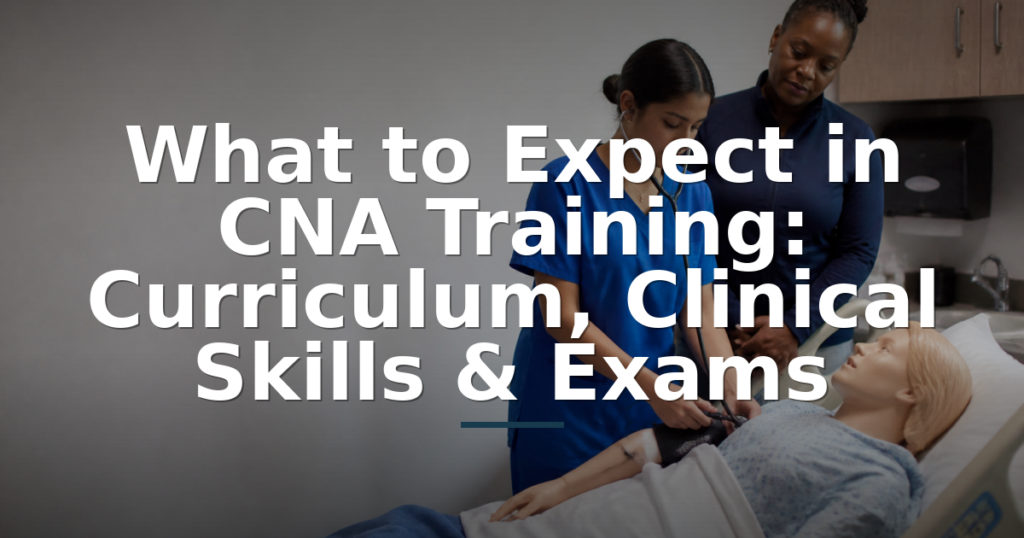
California requires all certified nursing assistant programs to deliver at least 60 hours of classroom instruction and 100 hours of supervised clinical training, totaling 160 hours minimum.1 Most San Jose area programs meet this baseline exactly, though some extend their curricula to 180 or even 200 hours when additional certifications or specializations are included.2
Your classroom hours will cover the foundational knowledge every CNA needs to provide safe, competent care. Expect to study:
Programs at Evergreen Valley College, Mission College, and Diamond School of Nursing all structure their classroom components around these core competencies, ensuring graduates are prepared to pass the state certification exam.
The 100 hours of supervised clinical practice take place in real healthcare settings under the guidance of a licensed nurse. In the San Jose area, students typically rotate through skilled nursing facilities, rehabilitation centers, or hospital long-term care units. During clinicals, you will apply classroom knowledge by assisting actual patients with daily activities, practicing infection control in live scenarios, and documenting care according to facility protocols.
Clinical hours are where many students discover whether bedside care suits them. You will experience shift work, interact with patients from diverse backgrounds, and learn to manage the physical demands of the job.
Full-time students often complete training in four to six weeks, while part-time or evening schedules can stretch the program to eight to twelve weeks. Community colleges like Evergreen Valley College and Mission College tend to align their schedules with academic terms, whereas private schools such as Diamond School of Nursing may offer rolling start dates.
Many programs bundle CPR and Basic Life Support certification into their tuition, saving you the cost and hassle of obtaining it separately. Evergreen Valley College also offers a Home Health Aide add-on that requires an additional 20 hours of classroom instruction and 20 hours of clinical practice. Completing this add-on expands your employment options beyond skilled nursing facilities into private home care.
While California mandates 160 total hours, some San Jose schools exceed this threshold to give students extra practice time or additional credentials. If you see a program advertising 180 or 200 hours, the extra time likely goes toward extended clinicals or supplementary certifications. More hours are not automatically better, but they can provide a competitive edge when you begin applying for jobs.
Choosing among San Jose's CNA programs can feel overwhelming when every brochure promises quality instruction and job-ready skills. The truth is that programs vary widely in cost, calendar, and student outcomes, so your checklist should start with hard evidence rather than glossy marketing.
Every legitimate CNA program in California must carry CDPH approval. Look for the phrase "CDPH-approved CNA training program" on the school's website or ask the admissions office to show you the approval letter. Training at a non-approved provider will not make you eligible to sit for the state competency exam, no matter how many clinical hours you complete. The California Department of Public Health maintains a searchable registry of approved programs if you want to cross-check a school's claims.
Tuition stickers tell only part of the story. Add registration fees, textbooks, scrubs, background checks, physical exams, CPR certification, and state exam fees to arrive at your true out-of-pocket number. Our cost section above shows typical San Jose ranges; most programs land between $1,200 and $3,500 all-in. Ask for an itemized cost sheet before you enroll so you are not surprised by a $300 lab-supply invoice halfway through the semester.
Strong programs publish completion rates (the share of enrolled students who finish) and first-time pass rates on the state competency exam. California does not mandate that schools post these figures publicly, but many do. If a school declines to share its data, ask why. Programs with pass rates above 85 percent signal solid instruction and adequate clinical preparation.
San Jose programs run on every calendar you can imagine: four-week intensives, ten-week evening tracks, weekend-only cohorts, and hybrid models that put didactic content online. If you work full-time or juggle childcare, a part-time evening or weekend option may be non-negotiable. Make sure the clinical rotation times also fit your availability. Some hospitals schedule students for early-morning or overnight shifts that conflict with day jobs.
An in-person visit or virtual open house lets you tour the skills lab, meet instructors, and gauge the program's culture. Pay attention to the student-to-instructor ratio during clinical rotations (California caps it at ten students per instructor), the condition of mannequins and hospital beds in the lab, and whether faculty answer your questions directly or defer to a sales script. A program that invests in updated equipment and experienced instructors usually delivers better preparation than one that treats CNAs as a revenue line.
Below are the top CNA training programs for San Jose students, ranked by completion outcomes, accreditation status, and program fit. The list includes nearby community college options as well as other California programs that meet state certification requirements. All listed programs are CDPH-approved for California CNA certification; verify current status through the state database before enrolling.
Gilroy, CA · ~$7,000/yr (est.)
Best for: South Bay students needing low-cost training
Gavilan College is a nearby public option for South Bay and San Jose-area students, offering a campus-based CNA program with hands-on clinical training. Fall and spring start dates plus low in-state tuition make it a practical choice for local learners.
Pasadena, CA · under $5,000/yr (est.)
Best for: Entry-level students wanting structured prerequisites
Pasadena City College offers a structured CNA certificate built around one 6-unit course, with CPR and clinical prerequisites. Its pass/no pass format and community college pricing appeal to entry-level learners, though the campus is in Los Angeles County.
Glendora, CA · $4,000/yr (est. net price)
Best for: Budget-minded students seeking first-come enrollment
Citrus College in Glendora offers an affordable Nurse Assistant Program with first-come, first-served admission and a mandatory orientation. Estimated costs around $341 plus supplies keep it among the lower-priced community college options.
Sacramento, CA · ~$17,000/yr (est.)
Charles A Jones Career and Education Center in Sacramento runs a five-week Nursing Assistant program with 192 hours of instruction and CPR certification. Current tuition is about $950 with scholarships available, and no high school diploma is required.
Imperial, CA · under $5,000/yr (est.)
Imperial Valley College offers a one-semester CNA/Home Health Aide program with campus-based clinical training. Students must be 17 or older, in good health, and complete physical exam, immunizations, background check, drug screen, and CPR requirements.
Redding, CA · $1,000 – $9,000/yr (est.)
Shasta College in Redding offers a CDPH-approved Nurse Assistant/Home Health Aide program focused on hospitals, long-term care, and home health settings. Students earn a certificate and may take the state competency exam after meeting health and safety requirements.
Visalia, CA
College of the Sequoias in Visalia offers a Skill Certificate in Certified Nurse Assistant through a single 6-unit course requiring a C or better. Criminal background and CPR clearances are needed before clinical training.
Long Beach, CA · $2,000 – $13,000/yr (est.)
Long Beach City College houses a Nursing Assistant certificate within its Vocational Nursing program and features a 2,600-square-foot hospital simulation skills lab. Students can earn the certificate alongside an AS in Vocational Nursing and access a career ladder toward RN pathways.
Oroville, CA · $1,000 – $9,000/yr (est.)
Butte College in Oroville offers a Certificate in Certified Nursing Assistant combining 204 theory hours and 153 clinical hours. The 7-unit program prepares students for state certification, though it has special admission and is not eligible for federal financial aid.
Santa Barbara, CA · ~$11,000/yr (est.)
Santa Barbara City College offers a 13-week Certified Nursing Assistant program through its School of Extended Learning, with in-person classes and weekend scheduling. Students complete clinical training focused on elderly care and gain a pathway to LVN or RN programs.
Here are answers to common questions about becoming a Certified Nursing Assistant in San Jose. From training timelines to exam details, we have you covered.
A standard CNA program in California takes about 6 to 12 weeks to complete, depending on whether you attend full-time or part-time. Accelerated programs can finish in as little as 4 to 5 weeks.
Costs vary by school type. Community college programs typically range from $500 to $1,200, while private training centers may charge $1,500 to $2,5004. Additional fees for textbooks, uniforms, and the certification exam may apply.
California requires completion of a state-approved training program with at least 60 hours of classroom instruction and 100 hours of supervised clinical practice. After training, you must pass the competency exam administered by Credentia, which includes a written and a skills test.
While free programs are rare, some nursing homes and hospitals in the San Jose area may sponsor your training in exchange for a work commitment after certification. It is also worth checking with local workforce development boards or community colleges for financial aid or low-cost options.
The need for CNAs in the San Jose metro area is high and continuing to grow, driven by an aging population and steady turnover in healthcare settings. Graduates typically find jobs quickly in hospitals, skilled nursing facilities, and home health agencies.
The exam is manageable if you have completed an approved training program. It consists of a written multiple-choice section and a hands-on skills demonstration. You have up to three attempts within two years to pass both parts.
Some programs offer hybrid formats where you complete theory coursework online, but the required clinical hours must be done in person at a healthcare facility. Fully online CNA programs are not available because of the hands-on nature of the training.
A CNA is a state-certified professional who works in hospitals, nursing homes, and other medical settings, performing basic nursing tasks such as taking vital signs. A Home Health Aide typically provides non-medical personal care and companionship in a client's home and may not require the same level of certification.
In California, CNA certification must be renewed every two years. To renew, you must have worked a minimum number of hours as a CNA during that period and complete a set number of continuing education units. Check with the California Department of Public Health for the exact requirements.
Fast-track CNA training in San Jose trades a spread-out schedule for a compressed calendar: you can finish in about a month, but you are committing to full-time classroom and clinical hours. These programs do not reduce the required training. In California, the total is typically around 160 hours, roughly 60 hours of theory and 100 hours of clinical practice, but fastest CNA programs fit those hours into 21 to 28 days or about 4 to 5 weeks.
Fast-track intensity leaves little buffer for missed steps. You still need a CDPH-approved program and CDPH-approved clinical sites. Verify the school is on California's approved list, and confirm your TB test, Live Scan fingerprinting, and drug screen can be completed before clinical starts. Make-up days are usually limited.
A fast-track may be right if you have strong study skills, urgent job timelines, or prior caregiving experience. If you are new to healthcare, balancing work and family, or prefer more time to absorb the material, a standard schedule may be a better fit. For comparison, CAL ACE Nursing Academy often runs about 9 weeks, and S.J. Institute of Nursing about 11 weeks, though advertised durations can vary. Confirm current dates, hours, and eligibility directly with each school.