Start Your CNA Career from Zero: Training Options and First Steps
Explore no-experience CNA training paths, free programs, and step-by-step first steps.
Reviewed by Editorial staffUpdated September 16, 202617 min read
Key Points
State-approved CNA training accepts complete beginners with no healthcare background.
Employer-sponsored CNA programs often offer tuition-free training with work commitments.
Median CNA pay is $39,530 with 204,100 yearly job openings projected.
Most state-approved CNA programs require nothing more than a high school diploma or GED equivalent, a clean-enough background check, and four to twelve weeks of seat time, no healthcare resume necessary for entry level medical careers. That's the tradeoff worth naming up front: entry requirements are genuinely low, but cost, scheduling, and paperwork still trip up plenty of beginners before they ever sit for a certification exam.
Some states waive the GED requirement entirely for older applicants or those enrolled in adult education tracks, while others hold firm. Tuition ranges from a few hundred dollars at a community college to several thousand at a private center, and background check timing can delay clinical placement by weeks if not started early.
The fastest path from zero experience to landing your first CNA job runs through matching the right program type to your state's specific rules and your own budget constraints.
Can You Really Become a CNA With No Experience?
Can you get into a CNA program and pass certification if you have never worked in healthcare? Yes. State-approved CNA training is designed for complete beginners, so the real entry requirements are much simpler than many people expect.
The prerequisite myth
The idea that you need nursing home or hospital experience before training is one of the most common myths about becoming a CNA. State-approved programs generally do not require prior healthcare work, college coursework, or a medical background. Basic CNA requirements usually include a minimum age, a high school diploma or equivalent in many states, a background check, and current immunizations. Some programs may also require a basic reading or math assessment, but this is usually for placement, not a barrier to entry. The CNA training curriculum itself starts with fundamentals and builds up to supervised patient care.
What matters more than a resume
Instructors and employers often look for empathy, dependability, clear communication, and physical stamina. Those qualities are harder to train than the hands-on skills. In class and clinical rotations, you will practice vital signs, patient positioning, safety, and infection control step by step. Life experience such as caring for a family member can help you understand the work, but it is never a requirement.
High school students can begin in some states
Some states let high school students start CNA training through career and technical education or dual enrollment CNA, often at age 16 or 17. That means no previous job experience is expected at all for younger students. Because age and eligibility rules vary by state, the next section covers state-specific expectations.
CNA Training Program Options for Complete Beginners
Pick a Format That Fits Your Starting Point
If you have no healthcare background, start with a program that combines structured instruction with supervised hands-on practice. Classroom and hybrid formats are usually the most beginner-friendly because they keep skills training in person while providing clear guidance. For complete beginners, these two formats provide the safest path because instructors can correct technique in real time before you are tested.
Traditional classroom programs
Classroom-based programs commonly run 80 to 175 total hours over 4 to 8 weeks.3 Lectures, lab practice, and clinical rotations happen face to face. The schedule is less flexible, but direct instructor support helps first-time students build confidence. Examples include Lake Region State College's 80-hour program1 and Utah CNA Training Centers' 100-hour program, which listed tuition around $575 in 2025-2026.2
Hybrid programs
Hybrid CNA programs move theory online but keep labs and clinicals in person. Total hours often range from 100 to 175 over 4 to 12 weeks.3 This format works well for working adults and for beginners who want some flexibility without losing hands-on training. Current examples include Howard Community College's 145-hour program over about 5 weeks3 and CUNY hybrid programs ranging from 124 to 152.5 hours with reported costs between $1,148 and $1,650.3
Online-heavy and facility-based options
Online-heavy programs still require in-person clinicals, but they demand more self-direction and are generally better for learners who can study independently. Total hours often fall between 160 and 200, although some compressed programs are shorter.3 Facility-based or employer-sponsored training, sometimes called CNA partnership programs, may run 2 to 8 weeks4 and can reduce upfront costs in exchange for a work commitment.
What to Check Before You Enroll
Confirm that the program is state-approved, includes clinical hours, gives a clear total cost, and prepares you for your state's certification exam. Check CNA program pass rates, whether the school arranges clinical placements, and whether exam preparation is built in. Avoid any program that promises CNA certification without an in-person clinical component, since supervised clinical practice is a required part of state-approved training.
CNA Requirements by State: What to Expect
Requirements vary by state and sometimes by individual program. The table below shows common state-level benchmarks for California, Texas, and Florida, plus selected program-level variations where sources differ. Always confirm current requirements with your state nursing board and chosen training program before enrolling.
State
Minimum Age
Education / GED Requirements
Clinical Hours
Background Check Timing
California
16 years
High school diploma or GED required by most programs; some adult education programs may differ.
100 hours
Live Scan fingerprinting required when enrolling, before beginning clinical rotations.
California (LicenseMap source)
16 years
No high school diploma required at the state level; programs may set their own requirements.
100 hours
Live Scan fingerprinting submitted during training before sitting for the competency exam.
California (HealthStar Academy)
16 years
N/A
100 hours
Criminal background check and Live Scan fingerprinting required before or at program enrollment, prior to clinical training.
California (CI Institute of Nursing)
16 years
High school diploma or GED required.
160 hours
Background check and fingerprinting completed during enrollment, before clinical practice begins.
California (NursingLicensure.org)
16 years
N/A
100 hours
Live Scan background check required before beginning the patient-care portion of the program.
Texas
16 to enroll in some CNA programs; other programs require 18
High school diploma, GED, or college transcript required by at least one Texas CNA program.
40 hours
Criminal background check required prior to attending clinical for at least one Texas community college CNA program.
Texas (Tarrant County College CNA)
18 years
High school diploma, GED, or college transcript required.
N/A
Criminal background check required prior to attending clinical.
Texas (North Central Texas College CNA)
16 years
GED or high school diploma required for Occupational Skills Award.
N/A
Criminal background check required (timing specified in program admission steps, typically before clinical).
Florida
18 years
Must be at least 18 years old OR hold a high school diploma or equivalent to qualify for the exam.
40 hours
Level II electronic fingerprint background check required in conjunction with licensure; training programs note requirement during the licensing process.
Florida (Exam eligibility pathway)
18 years
May take exam without state-approved training if at least 18 years old or holding a high school diploma or equivalent.
N/A
N/A
Step-By-Step: From Zero Experience to Certified CNA
This step-by-step path shows how to go from no healthcare experience to holding a state CNA certification. Timelines vary by program type and state, so use these as general estimates.
Free and Employer-Paid CNA Training: How to Find Them
Free CNA training is more common than most beginners realize, but you have to know where to look. The catch: nearly every no-cost program comes with strings attached, whether that's a work commitment, a residency requirement, or a limited number of seats per cohort.
Facility-Sponsored Programs
Nursing homes, hospital systems, and long-term care facilities are the largest source of paid or tuition-free CNA training programs in 2026. They cover training because they need to fill open beds and shifts.
Avon Health Center (Connecticut): Runs a free 3-week CNA class in 2026. Tuition is covered, but the facility does not pay you for class hours.1
Mozaic Senior Life: Offers free training and pays trainees during the program.2
Life Care Center of Andover (Kansas): A 4-week accelerated program where trainees are only responsible for the state exam fee.
Ballad Health (Tennessee/Virginia): Free hybrid training through their internal workforce pipeline.
Most facility-sponsored programs expect a work commitment of roughly 6 to 12 months after certification.7 Leave early and you may owe repayment, so read the agreement before you sign.
Workforce Development and Nonprofit Programs
County and state workforce boards fund CNA training through WIOA (Workforce Innovation and Opportunity Act) grants, usually with income-based eligibility. Nonprofits and community partners fill in the rest.
Baltimore County MedStar/CCBC partnership: A 10-week program that pays participants $18/hour as Student Nurse Assistant Interns at no cost to the trainee.3 Open to county residents.
WisCaregiver Careers (Wisconsin): Free training plus a $500 completion bonus for Wisconsin residents.6
Uplift Communities: Tuition-free CNA training through their workforce development track.4
YM & YWHA of Washington Heights & Inwood (NYC): Free CNA training through their Workforce Development Center.5 Note: the Summer 2026 cohort is already full, so ask about the next intake.
Apprenticeships and Federal Reimbursement
Registered CNA apprenticeships combine paid on-the-job training with classroom hours. Eligibility usually requires being 18+, having reliable transportation, and passing a background check and drug screen.
One rule worth knowing: under 42 CFR 483.152, Medicare-certified skilled nursing facilities must reimburse your CNA training and exam costs on a pro rata basis if you were hired within 12 months of completing a state-approved program.7 This only applies to that facility type, so verify certification through CMS Care Compare before counting on it.
To find unlisted options, call local nursing homes directly. Many facility programs never appear online.
How Much Does CNA Training Cost? Financial Aid Options
Community college CNA programs in 2026 often charge $500 to $1,500 in tuition, while private training centers typically run $800 to $2,500.1 Hospital-based and employer-sponsored programs are the wild card: many are tuition-free in exchange for a 6-to-12-month work commitment, but availability can depend on grant funding or local hiring needs.
What You Pay Beyond Tuition
Tuition is rarely the whole bill. Common additional costs include:1
Books and materials: $100 to $200
Uniforms and shoes: $50 to $100, sometimes included
Background check and fingerprinting: $50 to $100
Immunizations and TB tests: $100 to $200 if not current
CPR/BLS certification: $50 to $75
State exam fee: $100 to $200, though some programs include the first attempt
Registry application: $50 to $100
Altogether, many students pay $575 to $1,850 or more for tuition, common extras, and the first exam attempt. In higher-cost private programs, total costs including fees can reach $1,000 to $3,500.3 If you are paying out of pocket, self-pay costs generally run $500 to $3,000 depending on location, program type, and what the tuition includes. Ask program coordinators for a full nursing school cost sheet before enrolling.
Ways to Cut or Cover the Cost
Federal workforce funding through WIOA can cover up to 100% of eligible CNA training costs, including tuition, books, uniforms, supplies, and exam fees.2 For the 2026-2027 award year, the maximum Pell Grant is $7,395, which can fully pay for many programs.2 If you do not qualify for WIOA or do not want a work commitment, ask schools about income-based scholarships, grants, or payment plans.
Employer-Sponsored and State-Funded Options
Employer-sponsored training often eliminates out-of-pocket costs because a nursing home or hospital hires you first and pays for your CNA program. Some states go further. Wisconsin's WisCaregiver Careers program offers free training and a $500 bonus for eligible participants. Tennessee residents may access free CNA training through WIOA or SNAP Employment and Training.4
CNA Salary and Job Outlook: What Recent BLS Data Shows
Recent U.S. Bureau of Labor Statistics data shows nursing assistants held about 1.39 million jobs in 2024, with a median annual wage of $39,530. The broader nursing assistant, orderly, and psychiatric aide group reported a median near $39,470. The table below details employment and wage percentiles for these occupational groupings.
Occupation
Total Employment
Mean Annual Wage
25th Percentile Wage
Median Annual Wage
75th Percentile Wage
Nursing Assistants
1,388,430
$41,270
$36,260
$39,530
$46,070
Home Health and Personal Care Aides; and Nursing Assistants, Orderlies, and Psychiatric Aides
5,464,490
$36,690
$31,870
$35,940
$39,950
Nursing Assistants, Orderlies, and Psychiatric Aides
1,476,350
$41,290
$36,200
$39,470
$46,070
Highest-Paying Metro Areas for CNAs
Among the largest metro areas for nursing assistants, these six stand out for pay at or above $46,000 at the median. Seattle leads the list, followed closely by New York and Minneapolis. Local wages reflect demand, cost of living, and employer competition.
Metro area
Estimated employment
Average annual wage
25th percentile wage
Median annual wage
75th percentile wage
New York-Newark-Jersey City, NY-NJ
77360
49100
45570
47810
52980
Chicago-Naperville-Elgin, IL-IN
42800
45450
39780
46050
48720
Los Angeles-Long Beach-Anaheim, CA
39910
47900
44870
46140
48460
Boston-Cambridge-Newton, MA-NH
25870
47280
41890
46110
48830
Seattle-Tacoma-Bellevue, WA
14910
52500
46820
50690
56830
Minneapolis-St. Paul-Bloomington, MN-WI
13830
47010
43210
46910
48870
According to the Bureau of Labor Statistics, nursing assistant employment is projected to grow 2.3 percent from 2024 to 2034, adding about 32,600 net new jobs nationwide. That growth, combined with steady turnover, translates to roughly 204,100 openings each year, meaning newcomers with no prior healthcare experience have consistent opportunities to break into the field.
What to Expect in CNA Training and the Certification Exam
In Florida, the combined written and skills exam costs $155 through Prometric1, but exam providers and fees vary widely by state.
Classroom and Skills Lab
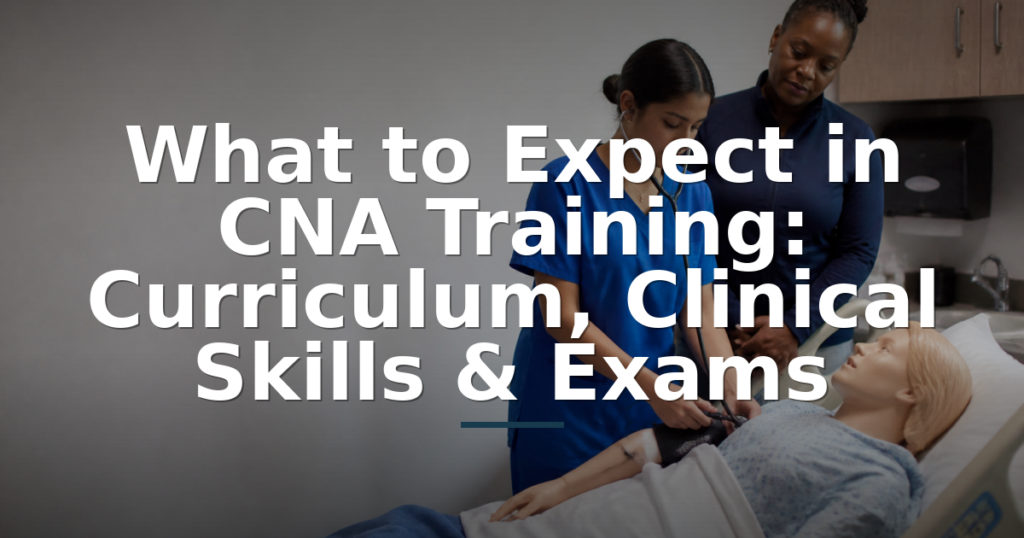
Most state-approved CNA programs open with classroom lessons in infection control, taking vital signs, safe patient transfers, and clear communication with residents and staff. From there, you move to a CNA skills lab to practice tasks like handwashing, positioning, range-of-motion exercises, and using gait belts. This is where instructors watch your technique and correct it before you work with real patients.
Clinical Rotations
Clinical hours place you in a licensed facility, usually a nursing home or hospital, under instructor supervision. You will apply the same skills in a real care environment, which also gives you a first look at typical CNA workflows. Attendance is critical because states set minimum approved training hours before you can sit for the exam.
The Two-Part Competency Exam
The CNA exam always has two parts: a written knowledge test, or an oral version in some states, and a skills demonstration. You must pass both to be placed on the state nurse aide registry. If you fail one part, you usually retake only the failed section rather than the full exam.
Retake Rules and Fees
Retake policies are state-specific, so check your state's current candidate bulletin. Florida requires a 30-day wait between attempts, allows three attempts within two years, and may require repeating an approved 120-hour training program if you are not successful in that window1. Minnesota lists a $100 knowledge-only test fee and a $170 skills-only fee through some testing vendors2, and describes up to three attempts within two years of training, though site rules vary. Texas fees commonly run $120 to $130. Federal guidance allows three attempts within 24 months of training, but stricter state rules take precedence.
What CNAs Actually Earn: Median Annual Wage
Nursing assistants earned a median annual wage of $39,530 in the latest federal data.
Landing Your First CNA Job With No Experience
Which employers actually hire brand-new CNAs with no prior healthcare work history? The short answer: most entry-level employers do, especially in long-term care and home-based settings. Job postings frequently say "experience preferred, not required," and federal data classifies nursing assistant roles as requiring no prior work experience.1
Where new CNAs are most likely to land first
Skilled nursing facilities, assisted living communities, and home health agencies are often the best facilities for new CNAs and the most common starting points. They consistently hire newly certified aides and often provide close supervision. Hospitals also hire entry-level CNAs, though they may favor candidates with clinical rotation experience or flexibility for nights, weekends, and high-need units.
How to build a resume without paid healthcare history
Lead with your state CNA certification, total training hours, and specific skills lab competencies, such as taking vital signs, transferring residents, and infection control. Then list transferable skills from any non-healthcare job or volunteer role: reliability, teamwork, customer service, communication, and physical stamina. If you have provided unpaid care for a family member, include a brief line about that experience because it shows comfort with personal care, lifting, and patience.
Addressing employer expectations
Entry-level employers generally want proof of certification, schedule flexibility, and a realistic understanding of the work. In interviews, mention that you understand bathing, positioning, and dementia care can be physically and emotionally demanding. Do not overexplain a lack of job history. Instead, redirect to your clinical training hours and readiness for ongoing training.
Turning training contacts into job leads
Use the people you met during clinical rotations. Ask your instructor or a supervising nurse if they can recommend facilities that hire new graduates. Also look for employer-sponsored training pipelines and registered apprenticeship programs, which offer paid on-the-job training while you work toward certification. Some apprenticeships pair about 2,000 hours of paid training with 144 clinical hours per year.2 Finally, target regions and settings with strong demand. Long-term care demand projections are especially strong,3 and nursing homes and home health agencies often have the most immediate openings. Nationwide, annual openings for nursing assistants and orderlies remain substantial at roughly 211,800 per year.4