Key Points
- CNAs provide 80-90% of direct care in long-term care facilities.
- Virginia mandates 120 training hours with 40 clinical hours.
- Chesapeake employers may fully reimburse your CNA training costs.
Compare local CNA training options, understand state requirements, and find jobs in Chesapeake.
The Virginia Beach-Norfolk-Newport News metro area is projected to add hundreds of nursing assistant positions by 2028, a reflection of both regional hospital expansions and an aging population requiring more long-term care. Certified Nursing Assistants provide the bulk of direct patient care in hospitals, nursing homes, and assisted living facilities, handling everything from vital-sign monitoring to helping residents with mobility and daily hygiene.
The path from interest to certification, though, involves more than just enrolling in the first program you find. Training length varies from three weeks to three months, costs range from $500 to $2,000, and not every program offers evening or weekend schedules. Some facilities in Chesapeake will reimburse tuition if you commit to employment after graduation, while others expect you to arrive already certified.
This guide covers the local job market, training formats, state certification requirements, and financial aid options.
The demand for Certified Nursing Assistants in Chesapeake, VA, is both urgent and enduring, driven by a rapidly aging population and a robust local healthcare system. For those entering the field, this translates to immediate job opportunities and a career path built on stability.
Chesapeake is part of the Virginia Beach-Norfolk-Newport News metropolitan area, one of the largest and fastest-growing regions in the state. The area's senior population is expanding quickly, prompting hospitals, nursing homes, and home health agencies to hire CNAs at an accelerated pace. This sustained need means graduates of CNA classes in Virginia often step directly into jobs, making it a practical choice for those looking to how to get a CNA job in a matter of weeks.
Several large healthcare systems and long-term care facilities anchor the local job market. Chesapeake Regional Medical Center, Sentara Healthcare, and Bon Secours are among the biggest hospital employers, each regularly posting CNA openings across various units. In the skilled nursing and rehabilitation sector, facilities like Deep Creek Health & Rehabilitation, Our Lady of Perpetual Help, and Saber Healthcare Group hire actively.3 Home health agencies such as Keep Safe Care Direct and dialysis providers like Fresenius Medical Care also offer roles, giving CNAs flexibility to choose the setting that fits their schedule and career goals.
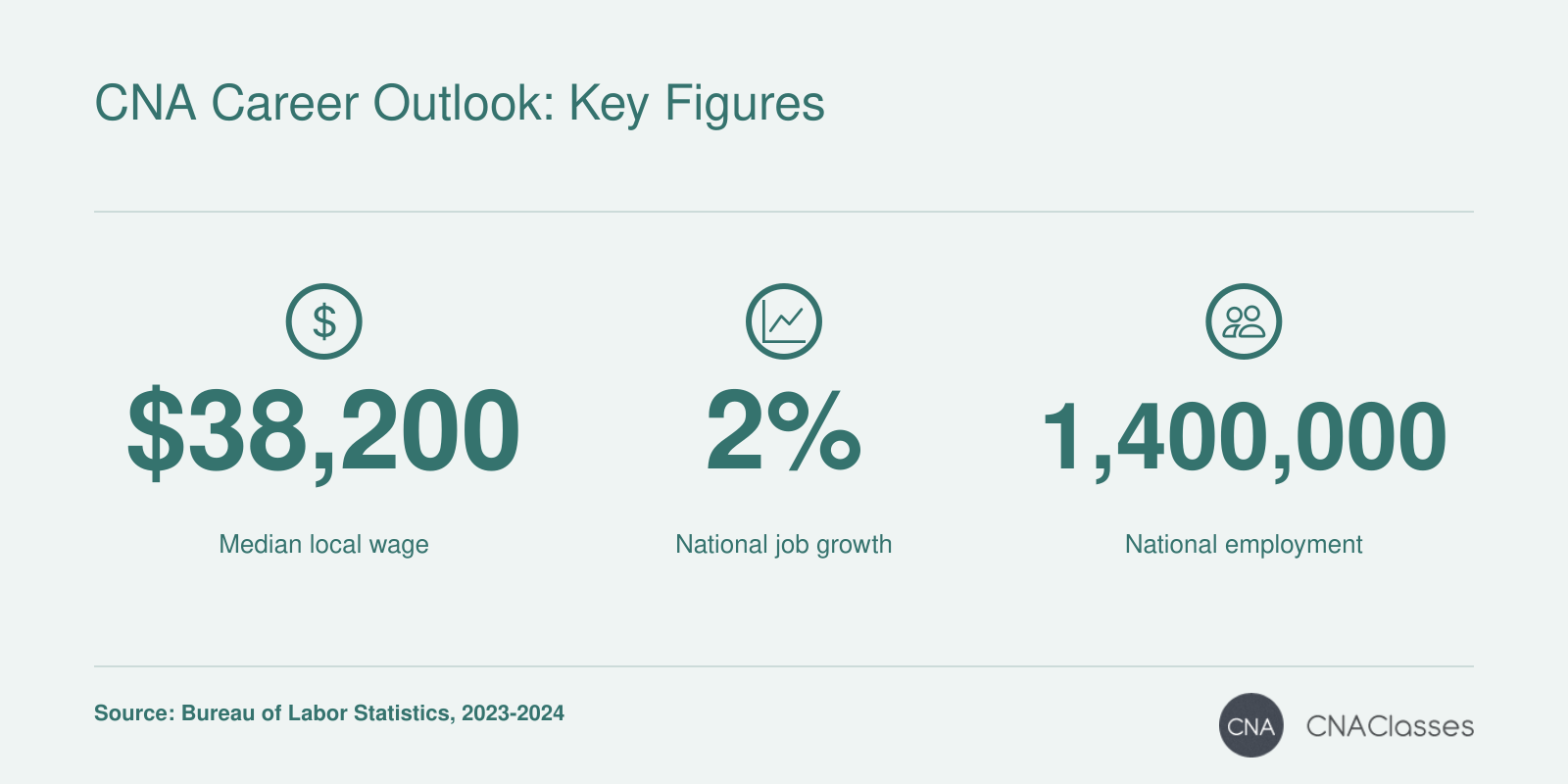
Recent wage data reflects this hiring urgency. The mean annual salary for CNAs in Chesapeake is around $31,463,1 but many employers exceed that figure. For example, Saber Healthcare Group reports an average of nearly $49,650 per year2, while recent job listings for Deep Creek Health & Rehabilitation show hourly rates of $19 to $22.05. Keep Safe Care Direct advertises wages ranging from $18 to $30 per hour2, illustrating how experience, shift differentials, and workplace setting can boost earnings.
Although official projections for the next decade are still being updated, current trends point to faster-than-average growth for nursing assistants in the region. Virginia's healthcare sector added thousands of CNA positions in the past few years, and the U.S. Bureau of Labor Statistics has consistently ranked this role among the top occupations for new openings. For CNAs in Chesapeake, the opportunity does not stop at the entry level. Many use their certification as a stepping stone to advanced credentials, enrolling in Licensed Practical Nurse (LPN) or Registered Nurse (RN) programs while working and earning. Hospitals and long-term care facilities often support this progression through tuition reimbursement and flexible scheduling, making the role a launchpad rather than a dead end.
CNA training requires hands-on clinical experience that simply cannot be replicated through a screen. Because Virginia mandates a minimum number of in-person skills hours, fully online programs are essentially nonexistent. Any school claiming to offer a 100 percent online CNA course without a clinical component will not meet state certification requirements. The good news is that hybrid formats blending online theory with in-person clinical rotations have become a flexible and popular alternative for busy Chesapeake students.
Several state-approved providers now serve the Chesapeake area with hybrid or blended programs. These allow you to complete lecture-based coursework online at your own pace, while scheduling in-person skills labs and clinical rotations at designated facilities.
Note that while Senora Angels Training offers a well-regarded CNA class for $975, their current format is entirely in-person, not hybrid.
Before enrolling, confirm that the program is listed as approved on the Virginia Board of Nursing website. A low tuition price tag or a short completion timeline means little if the training does not qualify you to sit for the state exam. Ask where clinical rotations will be held. Many hybrid programs partner with nursing homes or hospitals in neighboring cities like Virginia Beach CNA classes or Norfolk CNA programs because no hybrid provider currently guarantees clinical placements directly in Chesapeake. In-person skills labs are typically conducted at the school’s site or at a nearby healthcare facility, so factor travel time into your schedule.
Hybrid CNA classes give you the flexibility to study lecture material online, often during evenings or weekends, while still getting the crucial bedside experience employers expect. As you compare options, reach out to programs directly and ask about their hybrid format, total hours, and clinical logistics to find the best fit for your life and career goals.
The following programs are located within a 30-mile radius of Chesapeake and are approved by the Virginia Board of Nursing. Each provides the required 120 hours of training, including 40 clinical hours, to prepare you for the CNA certification exam.
The Nurse Aide I / CNA program at Chesapeake Career Center offers comprehensive training in patient care. The program is designed to prepare students for entry-level nursing assistant roles.
Dailey's Health Care provides CNA training with a focus on hands-on skills. The program is geared toward immediate employment in healthcare settings.
The Virginia Beach-Norfolk-Newport News metro area offers competitive wages for Certified Nursing Assistants, with a mean annual salary of $35,760. Compared to the state average of $36,820, the metro area remains a strong job market, supported by a large number of healthcare facilities across Virginia.
| Metric | Virginia Beach-Norfolk-Newport News Metro | Virginia |
|---|---|---|
| Mean Annual Wage | $35,760 | $36,820 |
| Mean Hourly Wage | $17.19 | $17.70 |
| Total Employment | N/A | 39,750 |
| Number of Hospitals | N/A | 95 |
| Number of Nursing Homes | N/A | 290 |
| Number of Home Health Agencies | N/A | 245 |
120 hours of state-approved training is the minimum Virginia requires before you can sit for the nurse aide competency exam and earn your CNA certification. Here is a step-by-step breakdown of the process so you know exactly what to expect.
Virginia's Board of Nursing mandates that every CNA training program include at least 120 hours split across three components:
You must be at least 16 years old to enroll. Programs in and around Chesapeake typically finish within four to eight weeks for full-time students, though part-time and evening schedules can stretch the timeline.
Virginia requires a criminal background check before you can be placed on the state registry. Your training program will usually guide you through this process, which involves fingerprinting and a review by the Virginia State Police and the FBI. Certain criminal convictions can disqualify you, so address any concerns with your program coordinator early.
Once you finish training, you have 24 months to take and pass the National Nurse Aide Assessment Program (NNAAP) exam, which is administered in Virginia by Credentia. The exam has two parts:
The exam fee is $140. If you do not pass on your first attempt, you may retake the exam up to three times within that 24-month eligibility window. After three unsuccessful attempts, you will need to repeat a training program before testing again.
After you pass both parts of the exam, your name is automatically added to the Virginia Nurse Aide Registry maintained by the Board of Nursing.6 Employers verify your active status through this registry before hiring, so there is no separate application you need to file.
To keep your certification active, you must complete paid nursing assistant work within the renewal period and meet any continuing education requirements the Board of Nursing sets. Letting your certification lapse means you may need to retest or retrain, so keep track of your renewal deadline.
During the pandemic, Virginia adopted emergency waivers that allowed temporary nurse aides to work under modified requirements. As of 2026, most of those flexibilities have expired. If you are unsure whether any current waivers apply to your situation, check directly with the Virginia Board of Nursing or ask your training program for the latest guidance.
Planning ahead and understanding each step of this process will help you move through certification smoothly. cnaclasses.org can help you find approved programs in Chesapeake that prepare you for both the classroom and clinical components Virginia requires.
Financial aid for CNA training in Virginia combines state grants, federal programs, employer benefits, and payment plans that reduce or eliminate your out-of-pocket costs for a nurse aide course. Chesapeake students have access to some of the strongest workforce funding in the country, and most students who apply pay far less than the sticker price.
FastForward is Virginia's demand-driven grant for short-term, noncredit workforce credentials, and CNA is one of the qualifying programs. The state covers roughly two-thirds of your tuition, and you pay the remaining one-third, capped so that your total out-of-pocket cost stays affordable (grants cover up to $3,000 per credential1). To qualify, you must be a Virginia resident, age 18 or older, and enrolled in an approved FastForward program. You keep the full grant by completing the course and earning the credential. The FANTIC supplement can further reduce your student share by an additional 10% for eligible learners.2
The G3 program (Get a Skill, Get a Job, Get Ahead) is a last-dollar scholarship that covers tuition, fees, and books for high-demand fields, including healthcare, at Virginia community colleges. Households earning under $124,000 can qualify for zero out-of-pocket cost. If you enroll in a credit-based CNA program, you may also qualify for the Federal Pell Grant, which awards between $2,000 and $7,000 in 2026 depending on financial need.3 The Mary Marshall Nursing Scholarship adds another $2,000 for Virginia residents with a 2.5 GPA or higher who show financial need.3
Employer tuition reimbursement is widespread in Chesapeake. Long-term care facilities, hospital systems, and home health agencies routinely cover training costs in exchange for a work commitment after certification. Ask potential employers about this benefit before you enroll. Many training providers also offer interest-free monthly payment plans so you can spread tuition across the length of the course.
Choosing the right CNA programs in Chesapeake means balancing affordability, schedule flexibility, and the quality of instruction that leads to first‑time certification success. With several options available across the Hampton Roads region, you do not need to settle for a program that does not align with your career goals or learning style. The strongest programs share a few critical markers: they are fully approved by the state, transparent about outcomes, and connected to local employers.
The Commonwealth requires all certified nurse aide training programs to hold active approval from the Virginia Board of Nursing. That approval is not a one‑time event; programs must maintain compliance with curriculum standards, instructor qualifications, and clinical hour mandates. The Board publishes a searchable directory of approved in‑state programs on its official website. Limiting your search to that list protects you from spending time and money on a program that will not qualify you to sit for the state competency exam. Bookmark this resource early in your decision process and check it again right before you enroll , program statuses can change.
Once you have identified a handful of Board‑approved options, go beyond the brochure. Visit each school’s own website and look for concrete data: recent first‑time pass rates on the Virginia Nurse Aide Competency Evaluation, total program cost including textbooks and exam fees, and the ratio of clinical hours completed in a real healthcare setting versus a simulation lab. Hands‑on time with residents matters. If a program’s website omits these details, call the admissions office. Ask how long the average graduate waits to receive an authorization‑to‑test letter after completion. Short wait times often signal a well‑organized program with strong exam preparation.
Understanding the employment landscape gives you leverage when evaluating program quality and potential return on investment. Use the Bureau of Labor Statistics (BLS.gov) to pull data for nursing assistants in the Virginia Beach‑Norfolk‑Newport News metropolitan area. While national figures provide a baseline, local median wages and projected job growth tell a more accurate story for Chesapeake residents. Compare those earnings with the total cost of the programs you are considering. A slightly more expensive program that consistently places graduates in higher‑paying facilities may be worth the premium.
Employer partnerships often separate adequate programs from exceptional ones. Reach out to professional bodies like the Virginia Health Care Association or the LeadingAge Virginia chapter. Both can offer perspective on which training providers have formal clinical agreements with reputable nursing homes, assisted living communities, and hospital systems. Local long‑term care facilities themselves are also a rich source of intelligence , many hire CNAs directly and may recommend the programs that produce their most job‑ready new hires. Some facilities even sponsor students in exchange for a work commitment, which can eliminate tuition costs entirely.
Compile a short list of direct questions and pose them to every program you are serious about. Consistent, straightforward answers indicate a program that has nothing to hide.
Putting in this research work upfront pays off quickly. A well‑vetted program sets you up not just for a passing test score, but for a confident first day on the unit.
Did you know CNAs provide 80 to 90 percent of direct patient care in long-term care facilities? This means that in nursing homes and assisted living communities, CNAs are the hands-on caregivers responsible for daily living assistance, mobility support, and vital sign monitoring. Their role is essential to the quality of life for residents.
Have questions about becoming a CNA in Chesapeake? We've compiled answers to the most common inquiries about training length, costs, requirements, and more. Read on to get the details you need to start your healthcare career.