Key Points
- In 2026, most CNA programs require CPR/BLS before clinicals.
- AHA BLS or Red Cross BLS is accepted; Heartsaver often is not.
- Albany High embedded free BLS training for 27 CNA students in 2026.

Get clarity on CPR timing before clinicals, accepted BLS providers, tuition inclusion, and renewal steps.

The question "Do I need CPR certification before I start CNA clinicals?" appears constantly on nurse aide program forums, and the honest answer is layered. A CNA card typically takes 4 to 12 weeks to earn, but clinical rotations, the hands-on portion where you practice skills from CNA simulation training on real patients under supervision, almost always come with a separate credential requirement attached by the school or the clinical site, not by state statute.
That gap between what state law technically requires and what your program or hospital partner demands in practice trips up a lot of applicants who assume one governs the other.
On September 16, 2026, Albany High School hosted an onsite Basic Life Support session for 27 Health Science CNA students, taught free by Albany Medical Center staff. It's a useful, concrete illustration of how best CNA programs increasingly build CPR training directly into the CNA pipeline rather than leaving students to find it on their own.
The tension most applicants run into is that the answer is almost always "yes, in practice" but almost never "yes, by law." You can search your state's nurse aide regulations and find no line item demanding a CPR card, then get an email from your program two weeks before clinicals telling you that you cannot set foot on the hospital floor without one. Both things are true at the same time, and understanding why saves you a lot of scrambling.
It helps to separate the layers, because they do not always agree:
When those three layers conflict, the strictest one wins. Your program will enforce whatever its clinical partners demand, because losing a placement site is far more costly to the school than inconveniencing a cohort.
Here is the distinction that matters for planning. Very few programs block enrollment over a missing CPR card. You can typically register, pay tuition, and start classroom and lab instruction without one. What you cannot do is begin your CNA clinicals, and since those hours are federally required for certification eligibility, a missing card stalls your entire timeline.
Some programs build the training into tuition and certify students during the first few weeks. Others hand you a list of approved providers and a deadline. Ask which model your school uses before you enroll, and ask specifically what the deadline is. Students who treat CPR as a first-week task rather than a last-minute one rarely have a problem; students who assume the school will handle it sometimes lose a clinical rotation slot and wait for the next cohort.
Most CNA programs require a valid CPR card before you set foot in a clinical facility, not before you submit your application. That distinction matters, because assuming you need certification up front can cost you $70 to $120 on a card you could have earned for free through your school.
CNA programs generally fall into one of three patterns for when they expect CPR certification:
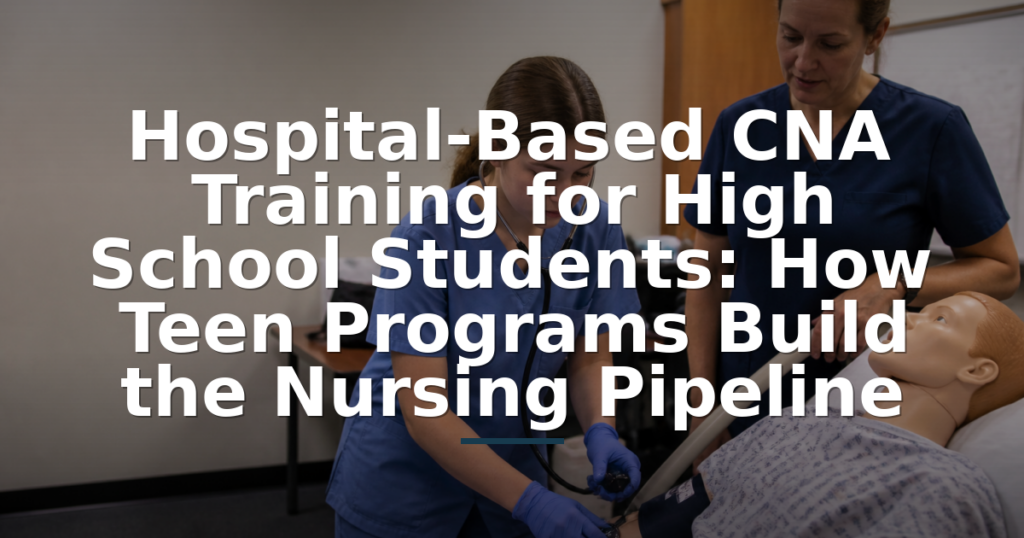
Albany High School's Career and Technical Education Health Science pathway is a clean example of the embedded model: hospital-based CNA training for high school students. In September 2026, 27 students on the CNA track completed a full Basic Life Support session onsite during CPR training at Albany High, taught by seven instructors from Albany Medical Center's Center for Learning and Development. Students who passed the exam walked out with a two-year BLS card at no cost, well before they ever entered the workforce. That is the outcome to look for: certification handled inside the program, not tacked on as an out-of-pocket prerequisite.
Community college and technical school CNA programs frequently schedule CPR training during the first two to three weeks of the term. The logic is practical. Clinical rotations usually start in week four or five, and instructors want every student cleared and card-in-hand before the first hospital or long-term care shift.
Before you book a Red Cross class on your own, contact the program directly and ask two questions: When is CPR required, and is it included in tuition? If the answer is "embedded" or "first month of class," hold off. Paying for a card you did not need is a common, avoidable mistake.
CNA programs and clinical sites usually want a healthcare-provider level CPR card, not a general community CPR course. The three cards most often discussed are American Heart Association (AHA) Basic Life Support (BLS), American Red Cross Basic Life Support, and AHA Heartsaver CPR AED. The key difference is whether the course is designed for healthcare workers and includes a hands-on skills check.
| Certification | Typical CNA program acceptance | Clinical site acceptance | Online option | Renewal period |
|---|---|---|---|---|
| AHA Basic Life Support (BLS) Provider | Typically accepted; nearly all nursing programs require AHA BLS before clinicals. | Widely accepted; many healthcare facilities specifically require AHA BLS. | Blended learning (HeartCode BLS online plus in-person skills session) or classroom course; online-only completion is not sufficient for an AHA card. | 2 years |
| AHA Heartsaver CPR AED | Usually not accepted in place of healthcare-provider BLS; designed for the general public. | Usually not accepted for CNA clinical credentialing when the site requires healthcare-provider BLS; employers commonly specify BLS and will not accept Heartsaver. | Online coursework available, but accepted completion pathways include a hands-on skills session; online-only completion should not be assumed to satisfy CNA or clinical-site requirements. | Not established |
| American Red Cross Basic Life Support (BLS) for Healthcare Providers | Designed for healthcare clinicians, including CNAs; typically suitable for CNA requirements when the program accepts Red Cross BLS. | Widely accepted by employers and healthcare organizations nationwide. | Online self-paced instruction available, but it does not include demonstration of skill proficiency; the 2-year online certificate may not meet workplace requirements. | 2 years |
CNA students can find low-cost CPR and BLS training through AHA Training Centers, the American Red Cross, community colleges, employer partnerships, and some CNA programs that include certification in tuition. Prices range from free employer-sponsored sessions to about $120 for blended private provider options. Always confirm with your program whether the card is accepted before you pay.
| Training Option | Typical Cost | Certification Type | Online/In-Person | CNA Program Acceptance Notes |
|---|---|---|---|---|
| AHA BLS Provider Course (University of Texas School of Nursing) | $40 for UT students, $60 for non-UT participants | AHA BLS Provider (CPR) | Not specified | Not specified |
| American Red Cross Blended BLS for Healthcare Providers | $80 to $110 | Blended Basic Life Support (BLS) for healthcare providers | Blended: online coursework plus 60-minute in-person skills session | Not specified |
| Forsyth Technical Community College AHA Certification Courses | $53, $63, and $70 options | American Heart Association certification | In-person at Mazie S. Woodruff Center | Not specified |
| Williams Healthcare Training CNA Program CPR/AED Training | Included in CNA tuition (valued at $60) | AHA Basic Life Support CPR/AED | Not specified | Included for CNA program students; may decline for a $60 tuition deduction |
| Albany High School CNA Track BLS Training (Albany Medical Center Partnership) | Free | Basic Life Support certification (valid for two years) | Onsite, in person | Embedded in CNA training; no cost to students |
| Arizona Western College CPR-Basic Life Support | $79; $50 for skills check-off only | CPR-Basic Life Support (BLS) | Skills check-off available; full course format not specified | Not specified |
| Winder CNA Instructor-Led BLS and CPR | $80 | BLS and CPR | Instructor-led, in person | Not specified |
CPR/BLS rules for CNA clinicals are not uniform nationally. Some states or individual programs explicitly require certification before clinical participation, while many state nurse aide certification sources describe training and clinical hours without naming CPR/BLS. The table below separates what is stated in state-level sources from what may be a program, employer, or clinical site policy.
| State | CPR/BLS Required for CNA Clinicals? | Legal Mandate or School Policy? | Licensing Board Source |
|---|---|---|---|
| South Carolina | Yes: BLS Healthcare Provider CPR certification is required before any healthcare experience outside the classroom, including clinical situations. | Course and clinical participation requirement stated in South Carolina Health Science-Clinical Study standards. Not established as a statewide CNA certification legal mandate. | South Carolina Department of Education, Health Science-Clinical Study Course Standards |
| Arizona | Yes: current CPR/BLS certification is listed as a clinical requirement for the identified nursing assistant training program. | Training program requirement. Not established as a statewide legal mandate for CNA certification. | Arizona Job Connection program listing, not an Arizona nurse aide registry or licensing board rule |
| Virginia | CPR/basic first aid certification is required for the cited Certified Nurse Aide employment position. This does not establish a statewide CNA clinical requirement. | Employer position requirement. Not demonstrated as a statewide CNA certification mandate. | City of Norfolk Certified Nurse Aide position document, not a Virginia nurse aide licensing board rule |
| Illinois | No CPR/BLS mandate is identified in the cited CNA requirements. | No CPR/BLS mandate is stated in the cited Illinois CNA requirements. | Illinois Department of Public Health, Health Care Worker Registry, CNA Facts |
| New York | No CPR/BLS mandate is identified in the cited nurse aide training requirements. | No CPR/BLS mandate is stated in the cited New York nurse aide training requirements. | New York State Education Department, Nurse Assisting (Nurse Aide) |
| Michigan | No CPR/BLS mandate is identified in the cited Nurse Aide Registry information. | No CPR/BLS mandate is stated in the cited Michigan registry information. | Michigan Department of Licensing and Regulatory Affairs, Nurse Aide Registry |
| Wisconsin | No CPR/BLS mandate is identified in the cited nurse aide requirements. | No CPR/BLS mandate is stated in the cited Wisconsin nurse aide requirements. | Wisconsin Department of Health Services, Nurse Aide Program: Becoming a CNA in Wisconsin |
| Texas | No CPR/BLS mandate is identified in the cited nurse aide curriculum. | No CPR/BLS mandate is stated in the cited Texas nurse aide curriculum. | Texas Health and Human Services, Texas Curriculum for Nurse Aides in Long-Term Care Facilities |
| Delaware | No CPR/BLS mandate is identified in the cited CNA Registry requirements. | No CPR/BLS mandate is stated in the cited Delaware CNA Registry requirements. | Delaware Health and Social Services, CNA Registry |
| Tennessee | No CPR/BLS mandate is identified in the cited nurse aide requirements. | No CPR/BLS mandate is stated in the cited Tennessee nurse aide requirements. | Tennessee Department of Health, Nurse Aide Programs and Registry |
| Indiana | No CPR/BLS mandate is identified in the cited state CNA program information. | No CPR/BLS mandate is stated in the cited Indiana CNA program information. | Indiana state CNA occupation and program information published through IN.gov |
American Heart Association BLS Provider cards and American Red Cross BLS certifications are both issued for two years. The two-year clock starts when you complete the course and pass the exam, not necessarily when you start CNA training or enter clinicals.
Red Cross also offers a two-year Certificate of Completion, but that format may not meet workplace, licensing, or facility requirements.1 If an employer or registry asks for "current BLS certification," confirm you have the certification card, not just a completion record.
CPR certification and your CNA registry status are separate. Your nurse aide listing can remain active until its own renewal deadline even if your CPR card lapses, and your CPR may expire even if your CNA registry renewal is not due. However, some states require a current CPR or BLS card at CNA registry renewal, while others require it only for initial training, clinical placement, or employment.
Because rules vary by state, do not assume the registry renewal form tells you everything. A facility or clinical site may still require proof of a current card on the floor, regardless of what the registry asks. If your state requires current CPR for renewal, an expired card can delay reinstatement or block employment even if your CNA registry has not yet lapsed.
Put two reminders on your calendar: one for the CPR card expiration printed on the card, and one for your state's CNA registry renewal deadline. They may fall on different dates.
Even when your state does not require a current CPR card for CNA registry renewal, an employer, hospital, or long-term care facility may have its own policy. Many clinical sites require a current AHA BLS or Red Cross BLS card as a condition of starting rotations or continuing employment. Treat your CPR card as a working requirement for the entire time you are on a schedule, not just a checkbox for the certification date.
Greater Nevada County College's 2026-2027 CNA program requires American Heart Association Healthcare Provider CPR/BLS before clinicals, but a separate First Aid certificate is not on its checklist.1 That pattern is common: CPR/BLS is usually the hard requirement among CNA clinical requirements, while First Aid is program-specific or site-specific.
CPR/BLS prepares you for cardiac arrest, breathing emergencies, AED use, and airway obstruction in adults, children, and infants. Full First Aid goes broader, adding bleeding control, burns, fractures, shock, allergic reactions, and other sudden illness or injury care. They are not interchangeable. Monroe County Community College's 2026 CNA orientation states its required AHA Basic Cardiac Life Support covers adults, children, infants, and AED, and a First Aid and Safety course does not satisfy the CPR requirement.2
Most program handbooks do not list a separate First Aid certificate. Maryland's CNA program of study requires CPR/AED under AHA guidelines with no separate First Aid requirement.3 Titus, however, requires BLS CPR and expects first aid competency, even though it does not require a standalone First Aid card.4 Some state checklists include CPR, AED, airway obstruction, and First Aid content, but that does not mean every state or clinical site demands a separate certificate. Employers or pediatric, school, and home health settings can add their own rules.
Because exact requirements vary, verify the current CNA certification requirements with your program handbook and clinical site before starting rotations.
Requirements vary by state, training provider, and clinical site. Use this checklist as a starting point, then confirm each item with your program.
Strong CNA programs treat CPR certification as a built-in step, not a surprise expense. Albany High School demonstrated that model on Tuesday, September 16, 2026, when 27 students in the high school CNA program within the Career and Technical Education Health Science pathway completed onsite BLS training at no cost.
The session was facilitated by Albany Medical Center's Center for Learning and Development. Seven instructors, including nurse educators, nurse clinicians, education specialists, and bedside nurses, taught basic life support for adults and children through video segments, live demonstrations, guided practice, and Q&A.
Students who passed the exam that day received a Basic Life Support certification card valid for two years. Senior Akira Snype summed up the value for entry-level healthcare work: "It feels good, because now if anything ever happens, I can say 'Here I am'!"
This example is not just a local news item. It shows what to look for when comparing CNA program rankings. Programs with hospital or medical center partnerships can embed employer-recognized certification into tuition or training at no extra charge, which saves students time and money. The instruction came from working clinicians, not a generic online module, and the credential is valid for two years, which aligns with the typical CNA training and early employment window.
Before enrolling, ask whether CPR or BLS certification is included, who teaches it, and whether the card is issued on the same day as the skills test. A free, employer-linked BLS card is a practical resume asset for nursing assistant roles.