Key Points
- Wyoming high school and hospital launched a five-junior CNA pathway in 2026.
- Wyoming requires 75 classroom hours and 36 clinical hours for CNA certification.
- Cody Regional Health covers certification costs; employment is not guaranteed.

Your guide to district-hospital CNA pathways: curriculum, clinicals, eligibility, and startup steps.

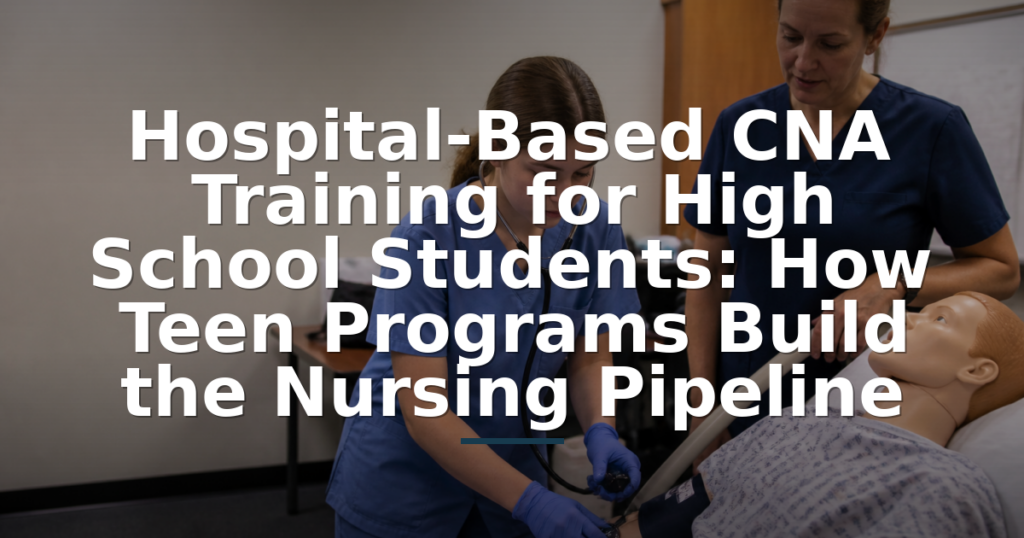
High schools are shifting from general career exposure to a direct training pipeline for licensed nursing assistants. On September 24, 2026, Cody High School and Cody Regional Health announced the Cody High School-Cody Regional Health CNA Career Pathway Program, putting five juniors into a sequence that includes the state-required 75 classroom hours and 36 clinical hours at a long-term care center.
The arrangement shows how a district and a hospital can move a student from elective credit to state certification without making the teenager travel to a separate campus. That compression of time and place matters because the CNA job outlook remains strong while adult training programs often compete with work schedules and family obligations.
A high school CNA career pathway program is a structured sequence of nursing assistant instruction, clinical practice, and certification preparation delivered during regular high school years. These high school CNA programs are not a single health class but a coordinated track that lets students earn a CNA credential before graduation. For teens considering healthcare, it is a practical first step that can save time and money later.
For students, this model offers early entry into a stable healthcare career. Training may be free or low-cost, and many schools award elective credit for the coursework. For hospitals and nursing homes, high school pathways build a local pipeline of nursing assistants, reducing hiring gaps in entry-level roles. Districts and health systems often share instructors, clinical sites, and exam fees, making CNA partnership programs sustainable for both sides. Completion can also satisfy some dual enrollment or career and technical education requirements.
Nursing assistant positions are opening faster than they can be filled. The Bureau of Labor Statistics projects about 203,300 openings for nursing assistants and orderlies each year, on average, from 2025 to 2035, with many openings tied to workers leaving the field rather than brand new jobs.
A CNA partnership is a formal agreement in which a school district, a hospital or health system, and sometimes a community college divide the work of providing CNA training for high school students and nursing assistant certification. The design can lean several ways.
Funding is usually split and often includes CNA training grants. Hospitals or hospital districts often cover startup costs, instructor pay, supplies, uniforms, and certification exam fees. School districts typically contribute classroom space, student recruitment, transportation, and scheduling support. In Bunker Hill, Illinois, the district paid registration, CPR certification, and textbooks; a health foundation donated scrubs and stethoscopes; Alton Memorial Hospital coordinated clinical hours; and Lewis and Clark Community College provided coursework.2
Clinical placements require more than a handshake. Agreements cover facility access, liability coverage, student-to-instructor supervision ratios, and background checks. Classroom instruction is often delivered by an RN employed by the hospital, while clinical supervision must include a licensed nurse on-site. That structure keeps training consistent with state rules and lets students learn in a working care environment without displacing staff.
The tradeoff students weigh is speed versus readiness. A shorter CNA training program may get you certified faster, but more clinical hours can build the comfort and muscle memory you will rely on in a real nursing assistant role. State rules set very different baselines, so you cannot assume a 75-hour course is enough everywhere.
Under federal OBRA standards, a nurse aide training program must include at least 75 total hours, with 16 of those spent in clinical practice.1 Many states add requirements on top of that floor: - Rhode Island: 120 total hours, including 80 classroom and 40 clinical2 - Idaho: 120 total hours, including 80 classroom and 40 clinical3 - New York: 75 total hours, including 59 classroom and 16 clinical4 - Indiana: 75 total hours, including 30 classroom and 45 clinical5
These figures come from state nursing board or health department rules, and they change. A program that meets Rhode Island's 120-hour standard may be far above what is required in a neighboring state. For high school students, that gap affects scheduling: a 120-hour pathway may need summer or after-school sessions, while a 75-hour pathway may fit within a single semester.
Always check CNA license status with your state's nurse aide registry or nursing board before enrolling. What looked accurate in 2025 may be revised for 2026.
CNA age requirements vary widely by state. Some states allow students to start training at 16, while a few have no set minimum age for enrollment or testing. Others let students under 18 finish classroom and clinical hours but wait until a later birthday to sit for the certification exam.
| State | Minimum Age to Enroll | Minimum Age for Certification Exam | Special Provisions |
|---|---|---|---|
| Pennsylvania | Not specified | 16 | Only graduates of a state-approved nurse aide training program may take the state nurse aide competency examination. Some nursing facilities may require candidates to be at least 18. |
| New York | 16 | 17 | Students may enroll at 16, complete the program, and become eligible to test at 17. Employment age is governed by local employer policy. |
| Louisiana | 16 | Not specified | A nurse aide trainee must be at least 16 years old. |
| Utah | 16 | Not specified | The nurse aide registry must admit a student who is 16 or older on or before the first day of class. |
| Missouri | 16 | Not specified | General eligibility threshold is 18, but a 16-year-old may enroll if currently enrolled in a secondary-school health-services occupation program or cooperative work-education program and placed for work experience under the rule's conditions. |
| Indiana | No age requirement | No age requirement | Applicants must complete a state-approved 75-hour nurse aide training program and pass both the written and skills tests. |
| Michigan | No age requirement | No age requirement | Minors aged 16 to 17 may work where bloodborne-pathogen exposure is likely if the employer complies with the applicable occupational-safety standard. Employment restrictions are separate from training and testing. |
| Nebraska | 16 | 16 | Eligibility requires being at least 16, completing approved training, and passing the written or oral and clinical/skills examinations. A nurse aide must be 18 to use a lift independently; those aged 16 to 17 may assist. |
| Maine | 16 | Not specified | A CNA must be at least 16 and provide documented proof of completing at least the ninth grade. The source does not separately state a certification-exam minimum age. |
| New Mexico | 16 to 18 (varies by program) | Not specified | The minimum age varies by training program. High-school-based programs may not require a current diploma or GED. The source does not separately state an exam minimum age. |
For high school students, the cost of a CNA pathway usually includes more than tuition. You are looking at registration fees, textbooks, scrubs or uniforms, a background check and drug screen, a physical with required immunizations, CPR certification for CNA, possible transportation to clinical sites, and the CNA certification exam. When a program does not cover these, out-of-pocket costs can add up quickly.
These are general ranges, not fixed prices. Every state and district handles them differently.
Many high school CNA pathways are free or very low cost because a career and technical education program, the district, or a hospital partner covers most expenses. Total program costs in high school settings often run from $0 to a few hundred dollars, compared with $500 to $2,000 for many standalone CNA programs and $5,000 or more at some private schools. Tuition itself is often $0 in district-run or dual-enrollment programs, meaning these can function as free CNA training programs, but students may still owe smaller fees. Registration fees vary and may be waived depending on the funding source.
For example, Cal-Wheat Community School District's 2026 program is listed as free, but students still pay a $25 background check fee. Forsyth Tech's Career & College Promise has no tuition, but books and fees may still apply. Hospital partners are not required to contribute, but some cover certification exam fees; in the Cody High School-Cody Regional Health partnership, Cody Regional Health pays certification costs for participating students.
Dual enrollment programs may let you earn college credit while completing a CNA pathway, which can reduce what you pay later for an LPN degree or CNA to RN Programs. Ivy Tech's dual enrollment CNA option is free for high school participants, though students may still be responsible for books, supplies, background checks, and other charges. Always ask for a written list of what is covered and what you will owe before enrolling.
How do you actually start a CNA career pathway program in a high school district? The work combines a needs assessment, a willing healthcare employer, state-approved curriculum, and a clinical placement agreement that protects students and patients.
Before writing curriculum, administrators usually gather local data on nursing assistant vacancies, long-term care hiring plans, student interest, and nearby CNA training programs. Use that evidence to recruit a hospital, nursing home, or health system as a partner. In the Cody High School and Cody Regional Health model, the health system supplied classroom instruction and opened its long-term care center for clinicals. Funding often comes from district career and technical education budgets, employer contributions, state workforce grants, or local foundations. Put the partner agreement in writing early.
Instructor requirements vary by state, so check with your state board of nursing and nurse aide registry before hiring. Tennessee, Iowa, and Delaware generally require classroom instructors to hold a current RN license and at least two years of nursing experience. Delaware permits an LPN instructor with three years of experience if an RN provides supervision. Several states also require one year of long-term care experience, and some require adult teaching preparation. Clinical instructors should hold a current RN or LPN license in most states. Submit the program for state approval early, and confirm your classroom and clinical hour totals match state testing eligibility and the CNA program length rules.
A written agreement should cover access to patient care areas, student supervision ratios, liability insurance, HIPAA compliance, and facility policies. New York guidance, for example, states that students and instructors should carry liability insurance, while Alabama requires a copy of the student liability insurance approval letter. Clinical placements should not start until this agreement is in place, because state nurse aide testing rules apply to your clinical hours.
Transportation help, exam prep tutoring, and flexible scheduling can determine whether students finish. Many districts use early release blocks or after-school clinical rotations. A single program coordinator can track attendance, uniforms, and state paperwork so students can focus on skills.
No national study directly compares high school CNA graduates to peers without a credential. Still, the Bureau of Labor Statistics reports nursing assistants earned a median $38,200 in 2023, and a Washington program reported 71% employment after completion. That points to real entry-level earnings and job access for high school completers.
Median annual wages for nursing assistants vary widely by state, based on 2025 Occupational Employment and Wage Statistics from the U.S. Bureau of Labor Statistics. The five highest paying states in this dataset are Oregon, Washington, New York, New Hampshire, and the District of Columbia. Keep in mind these figures cover all nursing assistants, not only high school graduates, so use them as a regional benchmark rather than a guaranteed starting salary.
| State | Median annual wage |
|---|---|
| Oregon | $49,830 |
| Washington | $49,180 |
| New York | $48,590 |
| New Hampshire | $47,870 |
| District of Columbia | $47,700 |
| California | $47,630 |
| Colorado | $47,380 |
| Vermont | $47,130 |
| Maine | $47,070 |
| New Jersey | $46,830 |
| Minnesota | $46,680 |
| Massachusetts | $46,680 |
| Rhode Island | $46,440 |
| Alaska | $46,370 |
| Illinois | $45,960 |
| North Dakota | $45,820 |
| Nevada | $45,490 |
| Hawaii | $45,350 |
| Wisconsin | $45,130 |
| Connecticut | $44,790 |
| Arizona | $44,780 |
| Pennsylvania | $44,590 |
| Maryland | $43,240 |
| Virginia | $43,200 |
| Delaware | $42,030 |
The field still lacks consistent public reporting on high school CNA completers, so families should read any CNA program pass rates with care. Most states publish program-level or combined results rather than separate numbers for students still in high school.
One bright spot appears in Nassau County School District, Florida, where high school CNA students posted a 100% pass rate on industry certification exams in 2026. The report, however, does not specify how many students were tested or whether all were first-attempt passes.
Elsewhere, Minnesota's Nursing Assistant Initiative logged 365 high school participants completing exams in fiscal year 2022 out of 1,397 total participants. A follow-up survey found 56% self-reported working as nursing assistants, but that figure combines high school and adult participants, so it cannot be treated as high school CNA program job placement rates.
Cody High School's program does not guarantee jobs. Successful completers get a direct pathway to explore potential employment with Cody Regional Health, which covers certification costs. That mirrors the broader pattern: many pathway programs open a door to an interview or internal hiring preference, but actual hiring depends on openings, interview performance, and state registry requirements.
Because few states publicly track whether high school CNA graduates later become licensed practical nurses or registered nurses, qualitative outcomes matter. Students typically report entering nursing assistant roles after graduation or continuing into college nursing programs such as CNA to RN programs, but those outcomes are not yet consistently measured or published.
A small Wyoming school district and its local hospital built one of the clearest examples of a high school CNA career pathway.
Cody High School and Cody Regional Health launched the Cody High School-Cody Regional Health CNA Career Pathway Program on September 24, 2026.1 The program starts in the 2026-27 school year with an initial cohort of five Cody High School juniors. Students complete 75 state-required classroom hours at Cody High School, with instruction provided by Cody Regional Health, and 36 state-required clinical hours at the Cody Regional Health Long-Term Care Center, a geriatric CNA setting. The school awards elective credit for the program.
After finishing classroom and clinical hours, students take final classroom and skills exams, followed by the state testing process for CNA certification. Cody Regional Health covers certification costs for participating students. Successful completers have a pathway to explore potential employment with Cody Regional Health, but positions are not guaranteed.1 This structure shows what to look for in any school-hospital partnership: clear hour requirements, a supervised clinical site, employer-funded exam fees, and honest language about CNA job placement.