Key Points
- Specialty certifications can boost pay by $2,000 to $5,000 yearly.
- Bridge programs allow MAs to become LPNs in as little as 6 months.
- Clinical advancement roles pay 40% to 100% more than the MA baseline.
Compare salaries, education, and job outlook for top clinical and non-clinical roles that build on your medical assistant experience.

What can a medical assistant actually become, and how long does it take? The Bureau of Labor Statistics projects medical assisting to grow 15 percent through 2033, far faster than the average occupation, and that expansion is pulling experienced MAs into higher-paying clinical, administrative, and specialty roles.
The practical tension is timing versus tuition. A phlebotomy or EKG certification can lift pay within months, while an LPN bridge runs 12 to 18 months and an RN pathway takes two to four years. Each step carries a different cost, licensure exam, and clinical hour requirement, and the right sequence depends on whether you want faster income or a higher ceiling.
Medical assistants sit at a crossroads that few entry-level healthcare workers reach so quickly: you gain hands-on clinical experience and front-office administrative know-how at the same time, which makes you genuinely versatile in a job market that rewards versatility.
Most healthcare careers require you to specialize early, but medical assisting is different. A working MA learns to take vital signs, assist with minor procedures, administer injections, and document patient histories on the clinical side, while also handling scheduling, billing codes, insurance verification, and patient communication on the administrative side. That dual skill set is not a consolation prize; it is a genuine advantage when you want to pivot toward a specialty, step into a supervisory role, or pursue additional education without starting from scratch, a flexibility not found in many entry level medical careers.
Those transferable skills include:
According to the latest Bureau of Labor Statistics data, there are roughly 793,000 medical assistants employed nationally, with a median annual wage of about $44,200, a solid figure among entry level medical career salaries. That baseline is a starting point, not a ceiling. The 25th-to-75th percentile wage range runs from approximately $37,600 to $48,200, meaning experience and specialization already move the needle within the profession itself.
The broader healthcare industry continues to expand faster than most sectors of the economy. An aging population, growing chronic disease management needs, and the expansion of outpatient and urgent-care settings all create demand for workers at every level of the clinical ladder. Medical assistants benefit directly from that growth because employers often prefer to promote or sponsor training for staff who already understand their workflows. In practical terms, that means your current MA role can serve as a paid on-ramp to becoming a licensed practical nurse, a medical records specialist, a health information technologist, or a clinical team lead (just some of the reasons to become a medical assistant), depending on how much time and education you want to invest.
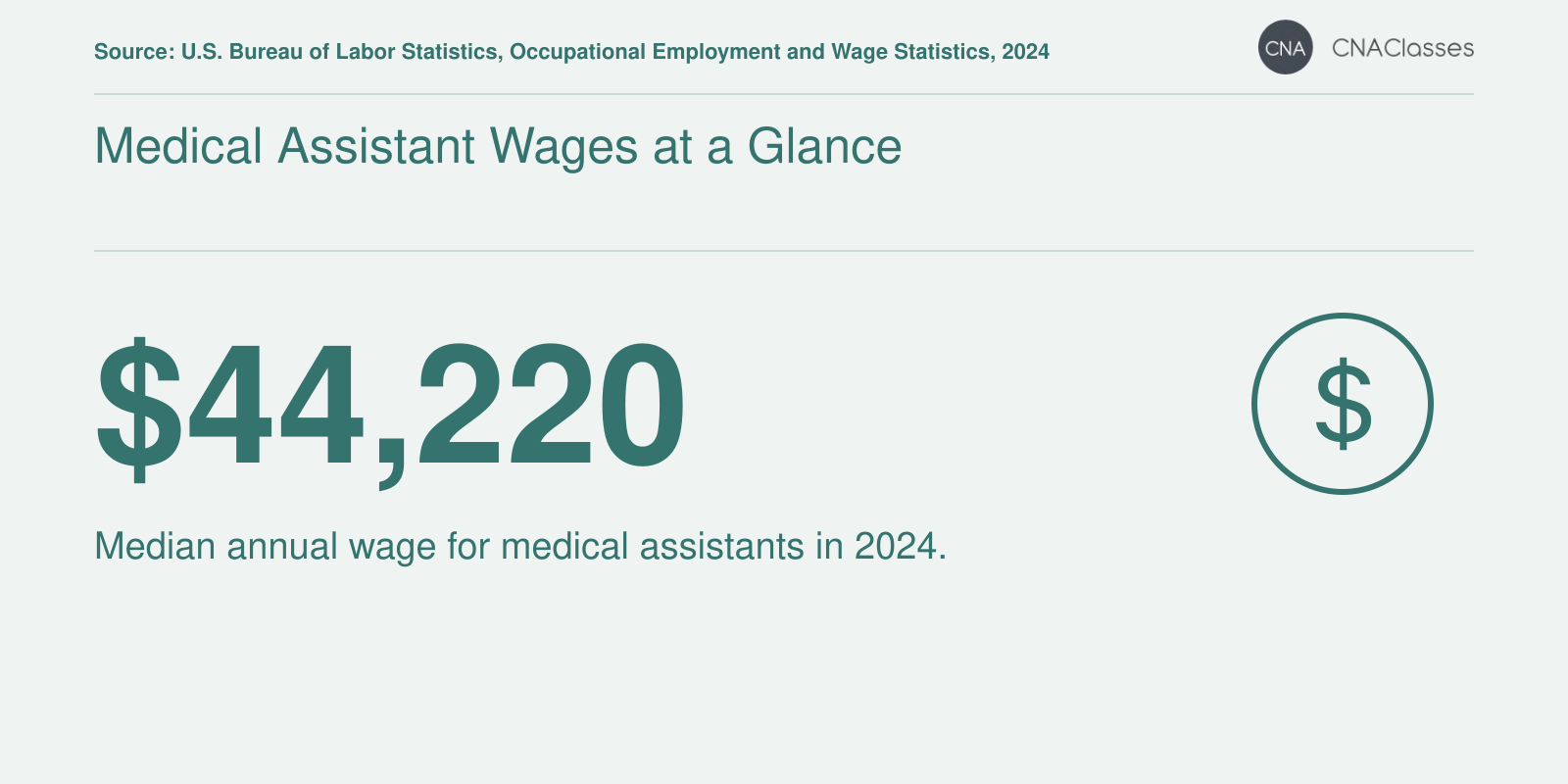
Medical assistants are essential to healthcare teams, and their pay reflects that importance. Nationwide, the median annual wage is $44,220, with the top 25% earning above $48,160.
If you like the patient-facing side of medical assisting, the fastest way to grow your paycheck is to move deeper into direct care. Clinical advancement roles typically pay 40% to 100% more than a medical assistant's baseline of around $38,000 per year, and each one builds directly on the vital signs, patient prep, and clinical workflow skills you already use every day.
LPN is the most common next step for MAs who want more clinical responsibility without committing to a full nursing degree. Training runs about 12 months at a community college or technical school, ends in a postsecondary nondegree award, and requires passing the NCLEX-PN exam. The median annual wage sits at $62,340 as of 2024, with 3% projected job growth through 2034 according to the Bureau of Labor Statistics. Daily work includes basic bedside nursing, medication administration, monitoring patient status, and documenting care under an RN or physician's supervision. Bridge programs designed specifically for medical assistants can shorten the timeline by giving credit for prior clinical coursework.
RN is the bigger jump: an associate degree (ADN, roughly 2 years) or bachelor's (BSN, 4 years) plus the NCLEX-RN. Median pay is substantially higher than LPN, and the scope of practice broadens to include care planning, IV therapy, and supervising other clinical staff. Many MAs step through LPN first to keep earning while they finish an RN program.
Surgical techs assist in the operating room, prepping instruments, maintaining the sterile field, and passing tools to surgeons. Training is usually a 12 to 24 month program. Respiratory therapists manage patients with breathing disorders and typically need an associate degree plus state licensure. Both roles offer meaningful pay bumps over MA work and put you in higher-acuity settings if hospital work appeals to you.
Not every medical assistant wants to spend their career in exam rooms, and that is perfectly fine. Your clinical training and healthcare experience create a strong foundation for administrative roles that keep medical facilities running smoothly behind the scenes. These positions often offer regular schedules, less physical strain, and competitive salaries that can exceed what you earn at the bedside.
Medical billing and coding represents one of the most popular transitions for MAs seeking desk-based work. Your familiarity with medical terminology, diagnostic procedures, and insurance processes gives you a head start over candidates without clinical backgrounds. Certified Professional Coders earn a median salary of $61,000 annually in 20262, a significant jump from the MA average of around $41,3701. Medical Collections Specialists, who focus on payment processing and account resolution, earn approximately $43,000 with strong year-over-year salary growth of 4.9 percent2.
Health information management encompasses roles focused on patient records, data accuracy, and regulatory compliance. Your experience documenting patient visits and maintaining charts translates directly to positions like medical records coordinator or health data analyst. These roles require attention to detail and understanding of healthcare workflows, both skills you have already developed. With additional certification in health information technology, you can advance into management positions overseeing entire records departments.
Healthcare organizations need staff who understand both clinical operations and customer service. Member Services and Enrollment Specialists earn around $41,750 annually2, while Credentialing Specialists who verify provider qualifications earn approximately $48,7502. Provider Relations Specialists, who maintain relationships between healthcare networks and physicians, earn about $44,750 with steady growth2.
Administrative roles offer clear advancement paths into leadership. Starting in billing or coding, you might progress to revenue cycle supervisor, then director of patient financial services. Those in health information can move toward compliance officer or quality assurance manager positions. Project management roles in healthcare IT are increasingly accessible to professionals who combine clinical knowledge with organizational skills. These leadership positions frequently command salaries comparable to or exceeding clinical roles, making administration a financially viable long-term path.
According to the Bureau of Labor Statistics, phlebotomy-certified medical assistants can point to a national median wage of $43,660 per year for phlebotomists. This is competitive with the $44,200 median for medical assistants overall and often comes with higher hourly rates at facilities that specifically need blood-draw expertise. Adding even one specialty credential signals to employers that you bring focused, verified skills to the team, and that distinction frequently translates into better pay, priority hiring, or access to roles that general MAs cannot fill.
Several certifications stand out for their accessibility and return on investment:
Healthcare practices lose time and money when they have to train new hires from scratch on specialty procedures. When you walk in with a recognized certification, you shorten that ramp-up period considerably. Many clinics and hospitals tie pay scales directly to the number of certifications a candidate holds, and some offer tuition reimbursement to encourage existing staff to earn additional credentials.
From a practical standpoint, stacking one or two specialty certifications on top of your MA credential can open doors to higher-paying departments without requiring a full degree program. It is one of the most time-efficient strategies for boosting your earning potential while you decide whether to pursue a longer educational pathway like nursing or health information technology.
Bridge programs typically run 12 to 18 months for medical assistants transitioning to LPN, with accelerated formats available in as few as 6 to 12 months. These structured pathways recognize your existing clinical knowledge and let you advance without starting from scratch.
Most MA-to-LPN bridge programs require a high school diploma or GED, current medical assistant certification, and at least one year of documented clinical work experience. You'll also need to pass an entrance exam like the TEAS or HESI and complete a background check before enrollment. Tennessee College of Applied Technology in Nashville offers a 16-month Certified Medical Assistant to Practical Nursing Bridge Diploma that builds directly on your MA foundation. Lakeshore Technical College requires either 3,000 hours of work experience as a credentialed medical assistant or 6,000 hours for those without formal credentials, along with a minimum 2.0 GPA overall and a 3.0 in anatomy and physiology.3
Associate degree pathways from MA to RN typically require 76 to 90 credits and take two to three years to complete, depending on your transfer credits and course load. Mount Wachusett Community College's nursing program requires 76 to 77 credits4 and at least six months of prior medical assistant work experience. Green River College's Medical Assistant Certified to Practical Nursing AAS is 90 credits5 but accepts up to two transfer credits for prior coursework. Many programs allow you to transfer general education credits earned during your MA certificate, shortening your time to degree and reducing overall tuition costs.
Several schools now offer hybrid or accelerated formats that blend online coursework with required in-person clinical rotations. These options let you maintain part-time work as a medical assistant while earning your LPN or RN credential. Accelerated tracks condense didactic content but still require full clinical hours, so you'll need to plan for intensive lab and practicum schedules.
Bridge programs are designed as career ladders, meaning your MA certification and work experience often satisfy prerequisites or earn you advanced standing. This structure reduces duplication, lowers tuition, and gets you into higher-paying roles faster than enrolling in a standard LPN or RN program. Many states recognize MA clinical hours toward nursing school requirements, and some employers offer tuition reimbursement for bridge students already on staff.
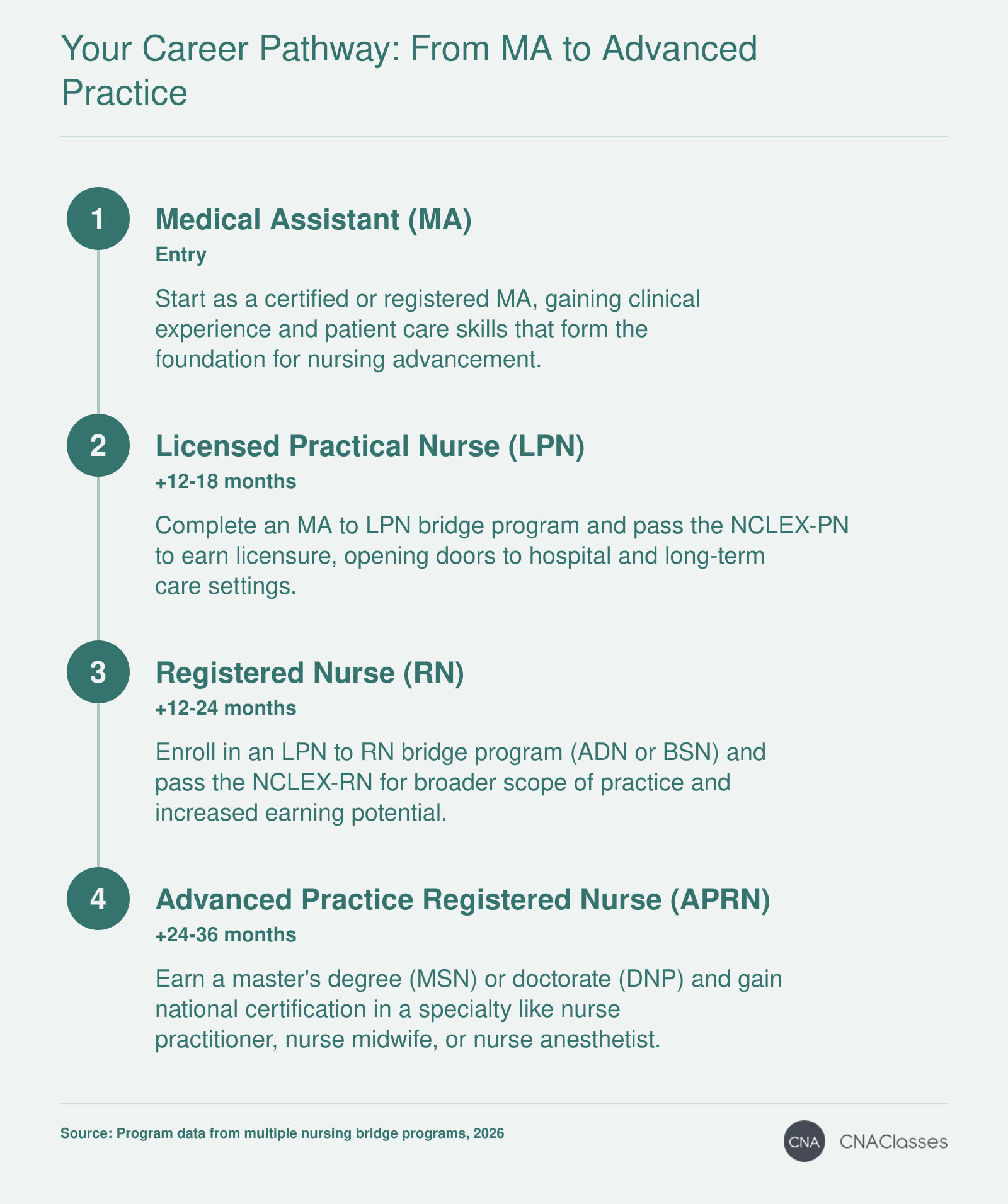
With the right educational bridges, medical assistants can transition into higher-paying nursing roles. This step-by-step pathway shows typical timelines from MA to APRN, with durations based on common bridge program structures.
Medical assistants who earn specialty certifications in areas like phlebotomy or EKG technology typically see salary increases of $2,000 to $5,000 annually. That translates to a 5 to 12 percent pay boost over non-certified peers, making certification one of the fastest ways to increase your earning potential without returning to school full time.
Healthcare employers are increasingly rewarding experience and stacked credentials, which means the earnings gap between a new MA and one with five to ten years in the field has widened noticeably in recent years. Understanding that curve helps you plan when to certify, when to specialize, and when to bridge into a higher license.
New MAs in 2026 typically earn around $30,3601 to $31,6002 per year as a national median, with pay varying by region, employer type, and whether you hold a CCMA or RMA credential. Expect this stage to focus on speed, accuracy, and building the clinical and administrative rhythm of a busy practice.
Once you have a few years of chart time, salaries commonly move into the $33,500 to $37,000 range3, especially for MAs who add specialty certifications in areas like phlebotomy, EKG, or ophthalmic assisting. Lead MA and clinical coordinator roles start opening up here, often bringing raises in the 15-23% range over entry-level pay1.
This is where career-changers see the biggest jumps. LPNs generally earn meaningfully more than experienced MAs, and RNs earn substantially more again, particularly with a BSN and a few years of bedside experience. Nurse practitioners and PAs sit higher still. The pattern is consistent: each added credential tends to reset your earnings floor rather than just nudge it upward.
Medical assistants have numerous pathways to advance their careers, whether moving into clinical roles, administrative positions, or specialized certifications. Here are answers to common questions about transitioning from a medical assistant role to other healthcare careers.