Key Points
- Median CNA pay in Peoria is $39,660 annually, or $19.07 hourly.
- Midwest Technical Institute offers a seven-week evening training program.
- Illinois only counts training from IDPH-approved schools toward certification.
Compare cost, schedule & duration of Peoria CNA programs. Find evening, weekend, and accelerated classes.
Peoria's healthcare sector employs thousands of nursing assistants across major systems like OSF HealthCare and UnityPoint Health, plus dozens of long-term care facilities, and the demand continues to climb. For anyone weighing how to break into bedside care quickly, the real question is which training format, cost structure, and schedule fit your situation.
Local programs range from seven-week evening courses to longer community college options, with tuition spanning a few hundred dollars to well over a thousand. Median CNA pay in the Peoria metro sits around $39,660 a year, a solid entry point that can grow with experience or further credentials.1
What kind of job can you get as a CNA in Peoria, and is the demand actually there?
The short answer is yes. Peoria's healthcare sector is anchored by two major health systems, OSF HealthCare and UnityPoint Health1, along with a wide network of skilled nursing facilities, assisted living communities, and home care agencies. That concentration of employers creates steady, year-round hiring pressure for certified nursing assistants. As of 2026, roughly 100 CNA openings are active in the Peoria metro at any given time2, spread across inpatient, long-term care, and community-based settings.
For someone just starting out in healthcare, Peoria offers something rare: genuine options. OSF HealthCare alone operates multiple hospitals and specialty units in the region, including oncology and inpatient care floors that actively recruit CNAs. UnityPoint Health fills out the picture with additional hospital and clinic roles. Beyond those two anchors, independent skilled nursing facilities and home care agencies compete for the same talent pool, which works in a new CNA's favor.
Starting pay reflects that competition. The median hourly wage for CNAs in Peoria sits at $19.69 in 20263, with the full range running from about $16.06 to $22.16 per hour depending on employer and shift, aligning with national entry level medical career salaries. Many facilities sweeten the offer further with sign-on bonuses near $1,0004 and shift differentials of $1.75 per hour for evenings and weekends and $2.25 per hour for overnight work.
CNAs work directly alongside nurses, helping patients with bathing, dressing, mobility, vital signs, and meals. It is hands-on, relationship-driven work that some find more meaningful than any desk job they have held. The pace varies by setting: a hospital floor moves faster than a long-term care unit, and home care offers a quieter, one-on-one rhythm.
Many CNAs treat the role as a launching pad to other entry level medical careers. The typical path moves from CNA to licensed practical nurse (LPN), then to registered nurse (RN), with each step adding responsibility, autonomy, and pay. Several Peoria-area employers offer tuition assistance or clinical scheduling flexibility specifically to support CNAs pursuing nursing credentials. Starting as a CNA gives you verified clinical hours, real patient experience, and a clearer sense of which direction in nursing suits you before you commit to a longer degree program.
The Bureau of Labor Statistics projects that nursing assistant jobs will grow steadily through the next decade, with demand fueled by an aging population that needs more hands-on care. Even a modest national growth rate translates into tens of thousands of new positions each year, making this one of the most reliable entry points into healthcare.
Midwest Technical Institute in East Peoria runs a seven-week evening program that meets Monday through Thursday from 5:00 p.m. to 9:30 p.m., meaning you can hold a day job and still earn your CNA credential in under two months. That schedule answers the question most prospective students ask first: yes, you can become a CNA in Peoria while working full time.
Program length in the Peoria area depends almost entirely on how many days per week you attend.
The state of Illinois requires a minimum number of clinical hours for any approved program, so shorter calendar lengths mean longer daily sessions, not fewer total hours.
Three local schools stand out for working adults:
Helping Hands Home Healthcare in East Peoria is also noted as a CNA training contact, though no public schedule is available at this time.2 Reaching out to them directly is worth a call if other options are full.
Some hybrid CNA programs in the region are moving toward a model where the classroom theory component is completed online, while skills labs and clinical rotations remain in person at a licensed facility. This format offers flexibility during the academic portion without sacrificing the hands-on hours required by CNA classes in Illinois. If a hybrid schedule matters to you, ask each school directly whether their current cohort supports online coursework, since delivery formats can shift from one term to the next.
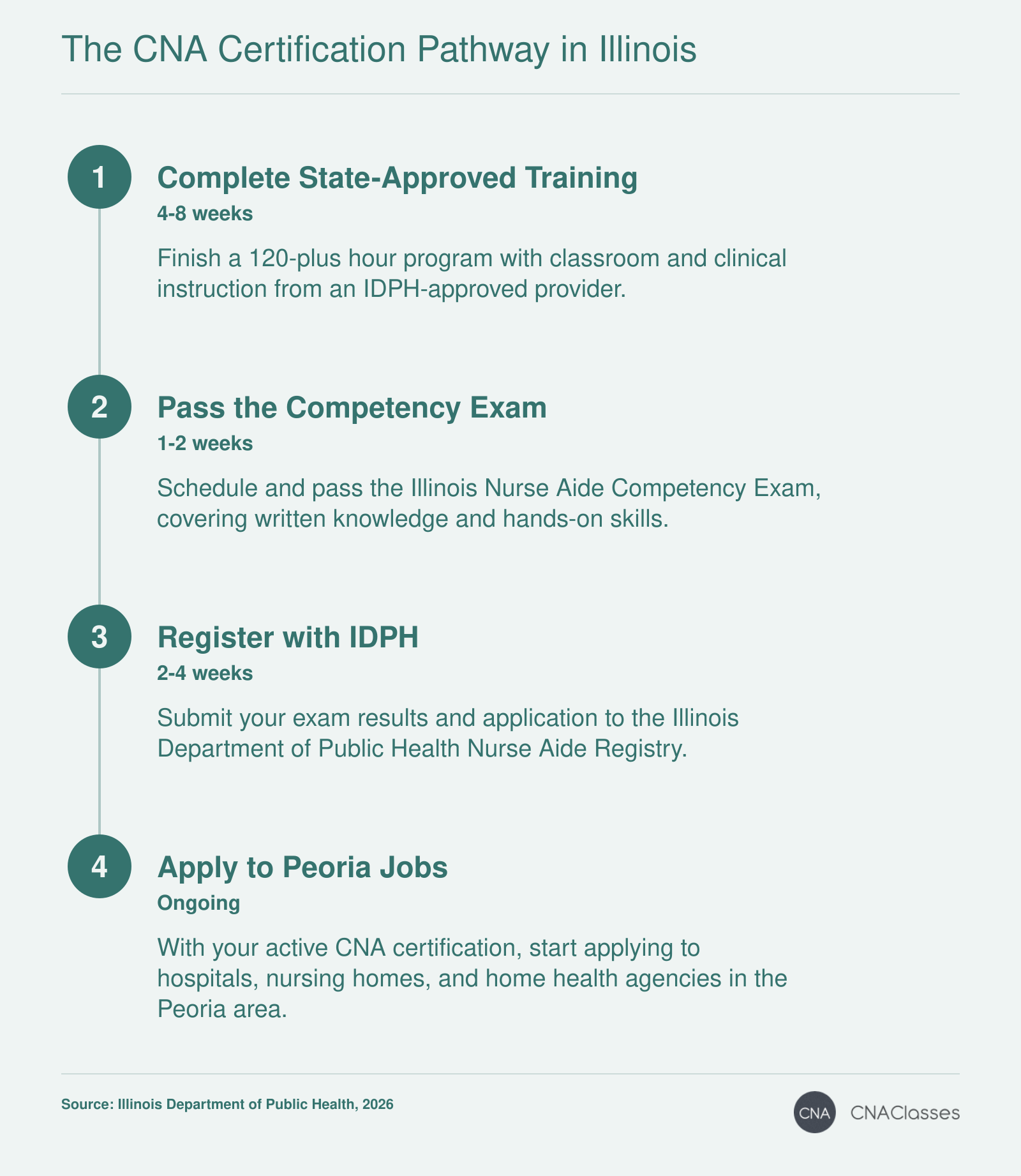
Becoming a Certified Nursing Assistant in Illinois follows a clear, state-mandated process. Here's what to expect from your first class to your first paycheck.
In addition to the top-ranked options, many other state-approved CNA programs are within a reasonable drive from Peoria. Below you'll find a directory of schools offering training, including community colleges and private institutions across central Illinois and beyond.
Nursing assistants in the Peoria metropolitan area earn a median annual wage of about $39,660, or roughly $19.07 per hour, according to the latest Bureau of Labor Statistics data. Major healthcare employers including hospitals, nursing homes, and home health agencies are actively hiring, with recent job postings showing hourly rates from $16 to $25. Many facilities also offer shift differentials for evenings and weekends, along with benefits like health insurance and paid time off.
| Employer / Source | Hourly Wage | Annual Wage (Approx.) | Sign-On Bonus | Employment (Peoria Metro) |
|---|---|---|---|---|
| Peoria Metro Area (BLS, 2024) | $19.07/hr | $39,660/yr | N/A | 3,320 |
| The Loft Rehabilitation & Nursing of Peoria | $24.50/hr | N/A | N/A | N/A |
| Right at Home Peoria | $22 - $25/hr | N/A | N/A | N/A |
| Interim HealthCare of Downstate Illinois (Peoria) | $22 - $24/hr | N/A | N/A | N/A |
| Nextaff of Illinois (Peoria) | $21/hr | N/A | N/A | N/A |
| Hopedale Medical Complex | $18 - $19/hr | N/A | N/A | N/A |
| Villas of Holly Brook (East Peoria) | $16 - $19/hr | N/A | N/A | N/A |
Nursing assistant wages vary by location, and Peoria offers a competitive but slightly lower pay scale than the Illinois state average. Below, compare median hourly and annual earnings across the Peoria metro area, Illinois, and the United States.
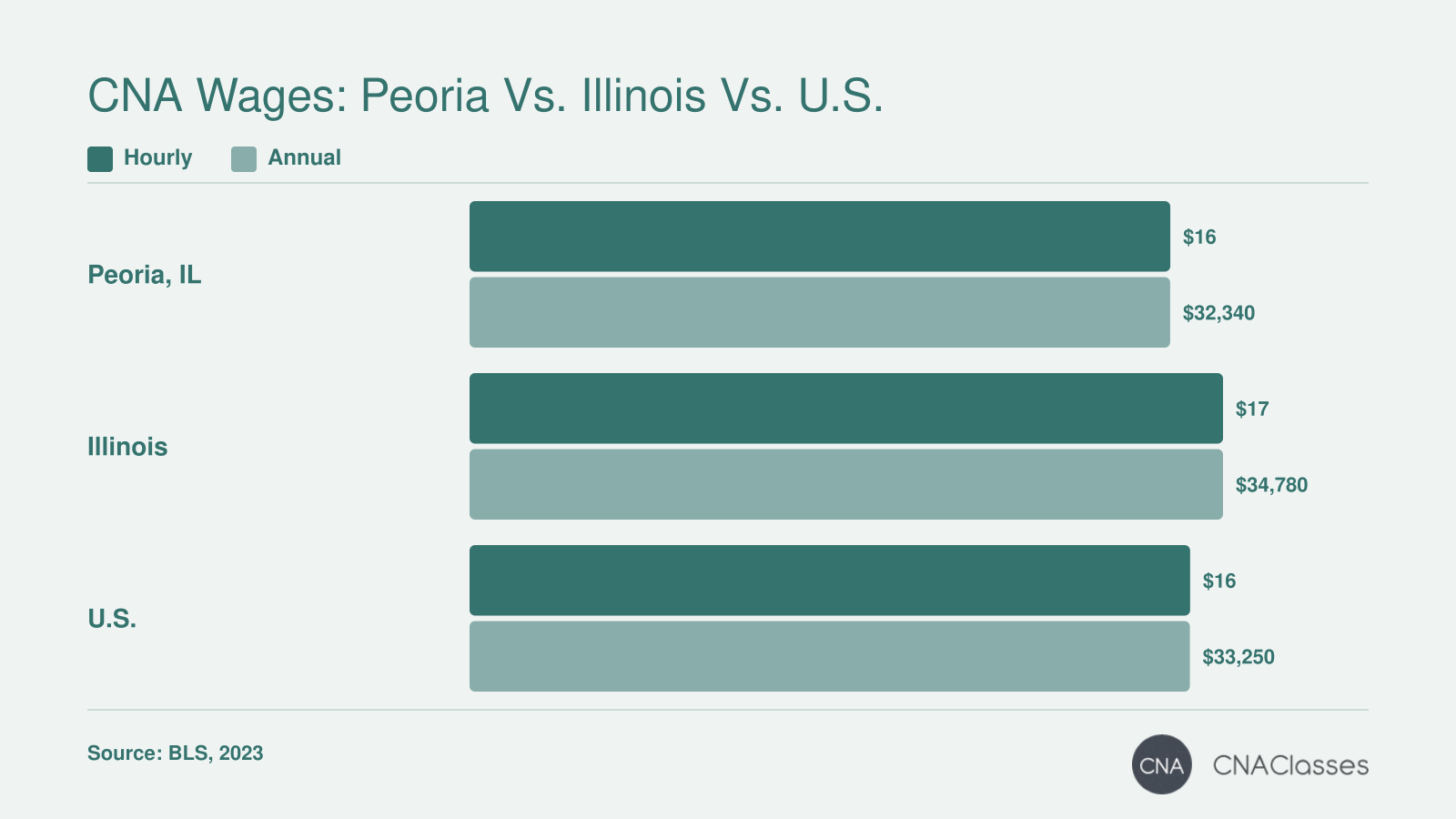
Illinois updated its CNA training framework in recent years to align more closely with federal standards, requiring programs to meet specific hour thresholds before graduates can sit for the state competency exam. Understanding these requirements helps you choose an approved program and prepare for a smooth path to certification.
Illinois mandates a minimum of 120 hours from a state-approved CNA training program.1 This breaks down into 80 hours of classroom instruction covering topics like infection control, resident rights, and basic nursing skills, plus 40 hours of supervised clinical practice in a healthcare setting. Before you can begin clinical rotations, you must complete at least 16 hours of preclinical training to ensure you have foundational knowledge for hands-on patient care.
After completing your approved training, you must pass the Illinois Nurse Aide Competency Exam.1 The exam includes two components: a written test (with an oral option for those who need it) and a skills demonstration where you perform CNA tasks in front of an evaluator. If you do not pass after your initial attempts, you must complete additional training before testing again.
Illinois requires a criminal background check before you can work as a CNA.1 Most programs also require a physical exam and tuberculosis test to ensure you can safely provide patient care. These screenings protect both residents and healthcare workers in clinical environments.
Once you pass your exam, your name is added to the Illinois Health Care Worker Registry, which employers check before hiring.1 Your certification must be renewed every 24 months, and renewal requires proof of employment as a CNA during that period.1 Unlike initial certification, renewal does not require retaking the competency exam, just verification that you have been actively working in the field.
CNA training in Peoria is among the more affordable healthcare credentials you can earn, but costs vary depending on where you enroll. Understanding what to budget and where to find financial help makes the decision easier.
Tuition across Peoria-area programs currently ranges from roughly $1,100 to $2,450, and that spread reflects real differences in program length, setting, and what each school bundles into its price.
On top of tuition, plan for additional expenses in the $150 to $250 range, which generally covers items like background checks, scrubs, and textbooks if they are not bundled. The Illinois CNA certification exam itself adds another $135 to $175.
Most CNA programs in Peoria are short-term, non-credit offerings, which means traditional Pell Grant funding typically does not apply. However, you still have solid options.
The Workforce Innovation and Opportunity Act (WIOA) program can cover training costs for eligible students. Illinois Central College is WIOA-eligible, so if you qualify through your local workforce development office, ICC may cost you little or nothing out of pocket. ICC also offers a payment plan for students who need to spread costs over time, and Methodist College offers a payment plan as well.
Local scholarships, employer tuition assistance, and workforce development grants are worth researching through the Peoria Area Workforce Development board before you pay out of pocket.
If upfront cost is the biggest barrier, employer-sponsored training is worth exploring seriously. Helping Hands operates an earn-as-you-learn model where students can be placed with an employer during training, offsetting the cost with real wages. Some regional healthcare employers, including hospital systems in the Peoria market, run similar programs that pay you to train in exchange for a work commitment after certification. These arrangements can make the cost question largely moot, so it is worth asking any prospective employer whether they sponsor CNA training before you enroll anywhere.
Which CNA programs near Peoria offer the best combination of hands-on clinical training, flexible scheduling, and strong graduate outcomes?
The Peoria area is home to a range of state-approved CNA training programs, each with its own strengths. Some emphasize accelerated timelines, while others build in additional clinical hours or evening class options. Choosing the right fit depends on your schedule, budget, and career goals. Below are practical steps to help you evaluate the programs that serve Peoria students most effectively.
Most CNA programs in the Peoria region can be completed in a matter of weeks, though exact timelines vary by school and format. Programs that run on accelerated or intensive schedules may finish sooner, while evening and weekend tracks typically stretch out over a longer calendar period. Because schedules often change from one quarter to the next, your best move is to visit individual school websites or call admissions offices directly. Many programs update their upcoming start dates on a quarterly basis, so checking in regularly ensures you have the most current information.
Illinois requires CNA students to complete a set number of clinical hours under supervision before they can sit for the state competency exam. However, some programs exceed the state minimum to give students extra preparation. If you want to confirm the exact clinical hour requirements for a program you are considering, contact the program coordinator or reach out to the Illinois Department of Public Health (IDPH). IDPH maintains the official list of approved training programs and can verify whether a specific school meets all state standards.
Some CNA training programs in the Peoria area advertise job placement assistance, partnerships with local healthcare employers, or high exam pass rates. These features can make a meaningful difference in how quickly you transition from the classroom to a paying position. When evaluating these claims, ask for specifics:
Before committing to a program, it helps to understand your CNA career earning potential and job prospects once you are certified. The Bureau of Labor Statistics (BLS.gov) publishes state and metro-level data on median wages and projected employment growth for nursing assistants. Looking up the Peoria metropolitan area specifically gives you a clearer picture than relying on national averages alone. This information can also help you weigh the return on your training investment.
No single program is the best fit for every student. A working parent may prioritize evening classes and a nearby clinical site, while a recent high school graduate might favor the fastest possible completion time. Use the steps above to create a short list of two or three programs, then visit each campus if you can. Speaking with current students or recent graduates often reveals practical details that brochures leave out, from parking availability to instructor quality. For additional guidance matching your situation to a specific program, cnaclasses.org offers tools to help you compare approved schools in the Peoria area.
Here are answers to common questions about becoming a Certified Nursing Assistant in Peoria. We cover training duration, costs, scheduling, salary, and certification requirements to help you get started.