Key Points
- Wisconsin CNA jobs are projected to decline 3% through 2032.
- Madison Area Technical College offers CNA training for just $656.
- The median CNA salary in Wisconsin is $43,250 per year.
Compare top Wisconsin CNA programs by cost, schedule, location, and outcomes to jumpstart your healthcare career.
Wisconsin employs more than 18,000 certified nursing assistants across hospitals, skilled nursing facilities, and home health agencies. Entry-level training takes as little as six weeks. Most programs cost less than $1,000, giving you a credential with immediate earning power and a built-in pathway to higher-level nursing roles.
The state's 16 technical colleges and dozens of private schools offer state-approved CNA courses in classroom, hybrid, and employer-sponsored formats. Tuition ranges from under $600 at public technical colleges to around $1,500 at private providers, and some employers will cover the full tab if you commit to working for them after graduation.
Pass rates matter. Programs with first-time exam pass rates above 90% signal strong instruction and adequate clinical preparation, and Wisconsin publishes those figures publicly. Median wages hover around $43,250 annually, but metro areas like Milwaukee and Green Bay push closer to $45,000.
We evaluated Wisconsin's CNA programs on affordability, graduate outcomes, and scheduling flexibility to identify six schools that deliver exceptional value. Each pick offers state-approved training that leads to certification, with options ranging from budget-friendly tuition to hybrid delivery and clear nursing career ladders.
Rice Lake, WI · $5,000 – $10,000/yr
Best for: Multi-campus learners advancing toward nursing
Northwood Technical College's Nursing Assistant program offers a 2-credit, 90-hour technical diploma available at multiple campuses and outreach centers across northwestern Wisconsin. Approved by the Wisconsin Department of Health Services, the training covers infection control, patient care, and communication, with hands-on clinicals under licensed supervision. With multiple start dates and potential financial aid, the program serves as a direct pathway to state certification and further nursing education.
Fond du Lac, WI · ~$9,000/yr (est.)
Best for: Budget-focused students eliminating textbook costs
Moraine Park Technical College's Nursing Assistant program stands out for its exceptionally low total tuition of $357.40 and zero textbook costs, making it one of the most affordable options in the state. The 78-hour technical diploma meets Wisconsin DHS requirements and includes partial online delivery alongside clinical placement opportunities. Graduates report a median salary of $34,837 and are eligible for the Wisconsin Nurse Aide Registry exam.
Fennimore, WI · $13,000/yr
Best for: Career starters wanting online theory flexibility
Southwest Tech offers an 81-hour Nursing Assistant technical diploma with flexible part-time and full-time scheduling, including an online theory component for convenience. The state-approved curriculum prepares students for the National Nurse Aide Assessment Program exam, with hands-on skills training and a nursing home clinical. Open to those 16 and older with no prior healthcare experience required, this program provides an accessible entry into patient care roles.
Wisconsin Rapids, WI · $11,000/yr
Mid-State Technical College's Nursing Assistant program delivers an 81-hour hybrid training that blends online coursework with on-campus labs and a 27-hour clinical practicum. With an exceptionally low total program cost of $445.15 and multiple start terms, it accommodates both daytime and evening learners. The program is state-recognized and prepares students for the Wisconsin certification exam, offering multiple campus locations and credit for prior learning.
Green Bay, WI · $5,000 – $10,000/yr
NWTC's Nursing Assistant technical diploma offers both hybrid and on-campus formats at multiple locations, with day, evening, and weekend classes to fit busy schedules. The program boasts a 91% graduate employment rate and a median starting salary of $39,520, with credits that apply toward an associate degree in nursing. Approved by the Wisconsin Department of Health Services, the 3-credit curriculum includes clinical experience and requires an 80% passing grade.
Kenosha, WI · $13,000/yr
Gateway Technical College's 75-hour Nursing Assistant program provides affordable entry at around $599 total, with campus-based instruction and hands-on simulation labs using real medical equipment. Open to students 16 and older, the program leads to Wisconsin CNA certification and offers start dates in fall, spring, and summer. Gateway is a Hispanic-Serving Institution, emphasizing inclusive support for a diverse student body.
Nursing assistants in Wisconsin earn competitive wages, with a median annual salary of $43,250. Most CNAs make between $38,500 and $45,920.
Where you work in Wisconsin can shape your paycheck as a nursing assistant. This table compares median annual wages and total employment across the state's metro areas, using the latest federal data. Keep in mind that higher wages in places like Sheboygan or Kenosha may reflect a higher cost of living, while larger job markets like Milwaukee offer more opportunities.
| Metro Area | Total Employment | Median Annual Wage |
|---|---|---|
| Milwaukee-Waukesha, WI | 8,280 | $44,370 |
| Madison, WI | 3,260 | $43,620 |
| Green Bay, WI | 1,810 | $42,760 |
| Eau Claire, WI | 990 | $41,810 |
| Appleton, WI | 930 | $39,900 |
| La Crosse-Onalaska, WI-MN | 920 | $41,460 |
| Oshkosh-Neenah, WI | 810 | $40,130 |
| Kenosha, WI | 630 | $44,850 |
| Racine-Mount Pleasant, WI | 630 | $40,750 |
| Janesville-Beloit, WI | 600 | $43,760 |
| Wausau, WI | 600 | $37,770 |
| Fond du Lac, WI | 580 | $44,260 |
| Sheboygan, WI | 450 | $45,660 |
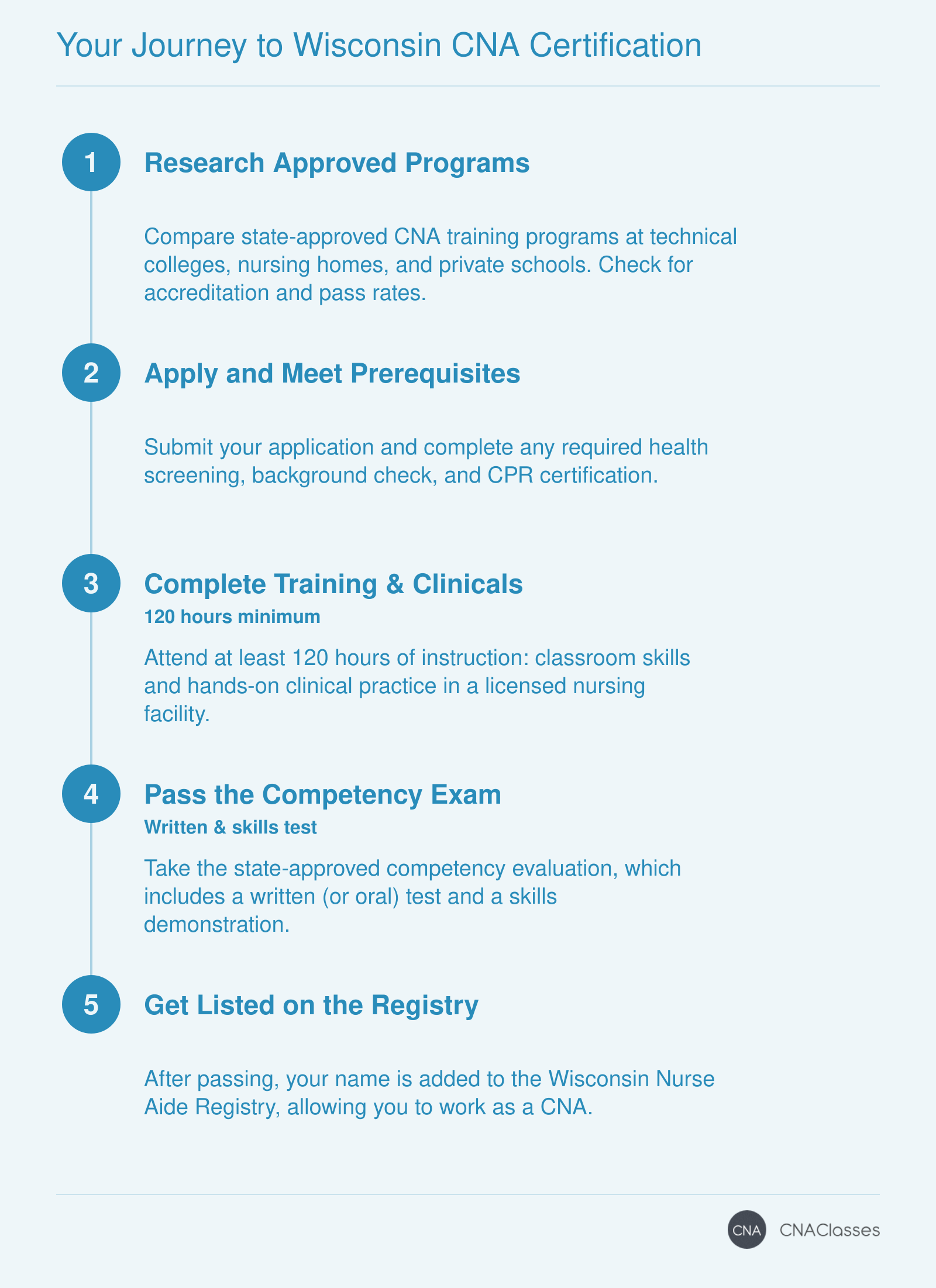
To become a certified nursing assistant in Wisconsin, you'll need to check these boxes.
Figuring out the true cost of CNA training is rarely as simple as reading a tuition number. What you ultimately pay depends on the type of provider, available financial support, and whether an employer steps in to cover the bill. Wisconsin makes that equation more manageable through a network of local, state, and employer-sponsored funding streams designed to remove barriers for people entering the field.
Community colleges and technical schools list course fees that often fall between a few hundred and a couple thousand dollars, but that is only part of the picture. Additional costs such as textbooks, scrubs, immunizations, and the state competency exam can add several hundred dollars. More importantly, many students never pay the full amount out of pocket. Workforce grants, facility-based sponsorships, and association scholarships routinely trim or eliminate the upfront financial burden, especially for those willing to work in long-term care settings after certification.
For general guidance on funding healthcare training, the Bureau of Labor Statistics website points to state-specific workforce boards as a first stop. In Wisconsin, the Department of Workforce Development administers the federal Workforce Innovation and Opportunity Act, or WIOA. WIOA grants cover tuition, books, and exam fees for eligible individuals pursuing high-demand occupations, and CNA is consistently classified as high-demand. A quick call to a local Job Center or a visit to the DWD website can connect you with a caseworker who will walk you through eligibility and help you apply. Many training providers maintain a dedicated WIOA liaison who handles the paperwork, so it is worth asking about this option when you inquire about a program.
Long-term care facilities and hospitals routinely face staffing shortages and respond by covering training costs. In interviews or informal conversations with hiring managers, ask plainly: "Does your facility offer tuition reimbursement or free training in exchange for a work commitment?" Many nursing homes and hospital systems do, but they may not advertise it prominently. Programs through organizations like the Wisconsin Health Care Association or LeadingAge Wisconsin often serve as bridges; their websites can point you toward member facilities that have active sponsorship initiatives. Some associations also maintain small scholarship pools that are awarded a few times per year, so reaching out directly can surface opportunities that never appear in a web search.
Community colleges, technical schools, and healthcare providers that run CNA classes often publish financial aid pages listing scholarships unique to their institution. These can include small, local awards from community foundations or internal funds set up by alumni. While amounts vary, even a few hundred dollars can cover exam fees or textbooks. Bookmark the financial aid section of any school you are considering and check back regularly; deadlines can be seasonal and are easy to miss.
Before enrolling, request a detailed breakdown of all costs: tuition, registration fees, supplies, uniform requirements, background checks, and CNA Testing fees. Then ask about payment plans, WIOA acceptance, employer sponsorship, and any institutional scholarships. When you compare offers side by side, you often find that the program with a higher headline tuition becomes the more affordable path once third-party funding is applied.
Did you know? Wisconsin's nursing assistant jobs are projected to shrink by 3% through 2032, according to Wisconsin Watch's analysis of state workforce data. This decline contrasts with the growing demand for home health and personal care aides in the state.
A fully online CNA program isn't possible in Wisconsin because the state requires hands-on clinical hours. However, several Wisconsin technical colleges have designed hybrid formats that let you complete a big chunk of the coursework from home, on your schedule, while still meeting the in-person training mandate. This blend can be a game-changer if you're balancing work or family commitments.
Looking at current program offerings, these schools list their Nursing Assistant program as a hybrid or blended delivery:
A few campus-based programs, like Blackhawk Technical College, also advertise online components in their learning formats, so it's worth asking about the flexibility when you contact any school.
Hybrid Online CNA Classes split the curriculum into two clear parts:
Because the online portion is often self-paced or scheduled in the evenings, you can fit studying around a job or childcare. Just budget for the clinical rotation days, which are typically during business hours and a set schedule.
The Wisconsin Department of Health Services mandates a minimum number of training hours, including direct patient care experience under a licensed nurse. This means you must physically attend clinical rotations, no matter which school you choose. When comparing programs, ask where clinical sites are located: some schools place students in facilities close to campus, while others may send you to partner nursing homes that could be a drive away. Verifying the location ahead of time helps you avoid commutes that don't fit your life.
Madison Area Technical College offers a 3-credit hybrid CNA program at an estimated cost of $656, making it one of the most accessible options in the state capital. Milwaukee and other major Wisconsin cities provide diverse training paths, from employer-sponsored programs to evening and weekend schedules designed for working adults.
Milwaukee hosts several CNA classes in Milwaukee that accommodate different schedules and budgets. Quality Healthcare Options runs a program priced around $1,150 with reported pass rates between 97 and 100 percent. Clinical hours total 16, and the program focuses on efficient preparation for the state competency exam.
For high school students, the Boys & Girls Club Ready Center offers free CNA training, removing cost barriers for younger learners entering healthcare. Empathy Ed provides a hybrid program with evening lab sessions on Tuesdays and Wednesdays from 5:30 to 10 p.m., plus 40 hours of online coursework and weekend clinicals on Saturdays and Sundays.2
Aurora Health Care operates employer-sponsored CNA training in the Milwaukee region. These full-time weekday programs typically run two to three weeks, and enrollment opens during specific application windows. Students who complete Aurora's training often move directly into positions within their health system.
Standards of Excellence Education & Training Center and The Mindful Group also offer CNA and CBRF training in Milwaukee.45 Contact these providers directly for current schedules and availability.
Madison Area Technical College, commonly called Madison College, runs a hybrid nursing assistant program available at multiple campus locations throughout Dane County. The curriculum combines online theory with hands-on lab and clinical experiences, allowing students to complete the technical diploma in a single semester.
Clinical placements in the Madison area typically occur at skilled nursing facilities, though some students may train at assisted living communities or rehabilitation centers. Evening and part-time schedules are available, but seat availability fluctuates throughout the year.
Western Technical College in La Crosse delivers an 81-hour campus-based CNA program at an estimated cost of $336. The curriculum is recognized by the Wisconsin Department of Health Services and prepares students for the state competency evaluation. Fall, spring, and summer start dates offer flexibility, though a waiting list policy applies when demand exceeds capacity.
Western Tech's program can serve as a foundation for students planning to pursue practical or registered nursing credentials later.
Northeast Wisconsin Technical College offers CNA classes in Green Bay in a hybrid format with day, evening, and weekend class options. Clinical sites include nursing homes and other long-term care settings throughout the Green Bay region. The college reports a 91 percent graduate employment rate and a median starting salary around $39,520.
Chippewa Valley Technical College serves the Eau Claire and River Falls areas with a hybrid program estimated at $423 total. Students can choose full-time or part-time pacing, and clinical rotations integrate lecture and lab instruction.
Gateway Technical College offers CNA classes in Kenosha across three campuses, with simulation labs using real medical equipment. Moraine Park Technical College in Fond du Lac offers partial online delivery, keeping textbook costs at zero.
Waitlists and seat availability shift frequently at CNA programs throughout Wisconsin. Many popular programs fill weeks or months in advance, particularly for evening and weekend sections. Before making plans, call your preferred school directly to confirm the next available start date, check waitlist status, and verify that clinical placement timelines align with your schedule. Program staff can also clarify any background check or health screening requirements you should complete before your first day.
Publicly reported exam pass rates are now one of the most reliable indicators of program quality, giving you a clear, comparative view of how well a school prepares its graduates for the state competency test. When researching CNA classes in Wisconsin, you can use a few straightforward strategies to find and evaluate these numbers.
A single high percentage tells only part of the story. Consider these nuances:
Pass rates are essential, but not the only quality signal. Pair them with other indicators like instructor qualifications, clinical hour requirements, and student satisfaction surveys. If a program’s rate seems unusually low, investigate whether they serve a higher share of students with barriers like language gaps or prior education deficits, but strong support services can offset those challenges.
Finding accurate pass rate data takes a little digging, but the effort will help you choose a CNA program that sets you up for a smooth path to certification.
Starting as a CNA versus jumping straight into a nursing program: both paths can lead to the same destination, but the CNA route gives you something invaluable first. You gain CNA work experience, real-world confidence, and often a wage-earning foothold before committing to a longer program. In Wisconsin, that head start translates into genuine advantages when you apply to LPN and RN programs.
Most LPN programs in Wisconsin list nursing assistant training as a prerequisite, so your CNA credential is not just helpful, it is often required. Milwaukee Area Technical College, for example, requires nursing assistant training before admission to its Practical Nursing program, along with a minimum grade of B- in prerequisite coursework.1 Madison College runs an 18-month LPN program that also calls for prior CNA or nursing assistant coursework, plus scores from the ACT or HESI entrance exam.2 Herzing University's Practical Nursing Diploma program is another option, with entry available to students holding a high school diploma or GED.3
Across Wisconsin's technical college system, LPN applicants typically need a GPA between 2.5 and 3.01, and many programs expect around 160 hours of documented work experience as a nursing assistant before enrollment2.
Once you hold an LPN license, several Wisconsin colleges offer bridge programs that count your previous training toward an associate degree in nursing. MATC's LPN-to-ADN progression requires a Wisconsin LPN license, a 2.5 GPA, and either a HESI or PN Exit Exam score.1 The Wisconsin Technical College System also maintains formal LPN-to-nursing bridge tracks at multiple campuses statewide.4 Northeast Wisconsin Technical College goes a step further, awarding credit for prior learning to students with CNA experience who are entering its Associate Degree Nursing program.5 That kind of recognition can shorten your time in school and reduce your total tuition cost.
You do not have to pay for every step of this ladder on your own. Several programs in Wisconsin exist specifically to support working caregivers moving up:
Many Wisconsin hospitals and long-term care employers also offer tuition reimbursement to CNAs who commit to working while they study, so it is worth asking any prospective employer about their education benefits before you enroll.
Enrolling in CNA programs is one of the smartest low-cost moves you can make if a nursing career is your goal. You enter the workforce quickly, build clinical hours that most LPN programs require anyway, and position yourself for reimbursement and bridge credits that compress the road ahead. The investment at the CNA level is modest; the career ceiling it unlocks is not.
Choosing a CNA program means comparing a handful of concrete factors that directly affect your training experience, your ability to pass the state competency exam, and your job prospects after graduation. Not every program is created equal, so a little research upfront saves you time, money, and frustration down the road.
Before you enroll anywhere, verify that the program is approved by the Wisconsin Department of Health Services. Only graduates of state-approved training programs are eligible to sit for the Wisconsin Nurse Aide competency exam. You can check a program's status through the DHS website or by calling the school's admissions office directly. If a program cannot confirm its approval, walk away.
CNA classes come in several formats, and the right one depends on your current obligations.
Ask each school for its exact class schedule, including clinical hours, before you commit.
Clinical rotations are where you build real skills, so the quality of your placement matters. Find out whether clinical hours take place in a hospital, a skilled nursing facility, or both. Ask how far you will need to travel; a long commute can add hidden costs in time and fuel. Programs that partner with well-regarded facilities tend to give students stronger hands-on preparation.
Two numbers tell you a lot about a program's effectiveness: its recent exam pass rate and its job placement rate. A pass rate consistently above 85 percent is a strong sign of quality instruction. Programs that offer job placement assistance, resume workshops, or employer partnerships can also shorten the gap between earning your certification and starting your first shift.
Tuition for CNA training in Wisconsin generally falls between roughly $500 and $2,000, depending on the school and program length. Before you focus only on the sticker price, factor in extras like textbook fees, scrubs, background checks, and exam registration. Then compare that total against any financial aid, scholarships, or employer-sponsored training options available to you. A slightly more expensive program with a higher pass rate and job placement support can quickly pay for itself once you are earning a steady paycheck as a certified nursing assistant.
Taking time to weigh each of these factors helps you invest in the program that gives you the strongest start. If you want help narrowing your options, cnaclasses.org offers a free school-matching tool that filters Wisconsin programs by location, schedule, and cost.
Becoming a certified nursing assistant in Wisconsin follows a clear five-step path. Here's what to expect from application to your first day on the job.