Key Points
- Indianapolis CNAs earn a median $38,170 annually with 9,400 employed.
- Indiana requires 105 hours of state-approved training before the exam.
- CNA demand in Indianapolis is projected to grow faster than average.
Compare Indianapolis CNA programs by cost, schedule, and format to start your nursing career.
What does it take to become a certified nursing assistant in Indianapolis, and how quickly can you start working?
Indianapolis anchors one of the Midwest's largest healthcare markets, with major systems like IU Health, Community Health Network, and Ascension St. Vincent operating dozens of facilities across the metro area. Add in the region's growing population of adults over 65 and you have sustained demand for CNAs in hospitals, skilled nursing facilities, and home health agencies alike. Training programs typically run four to eight weeks and cost between $500 and $1,500, making CNA certification one of the fastest, most affordable entry points into nursing.
This page breaks down state-approved programs, tuition ranges, salary data, and the step-by-step certification process; jump to the top programs below.
Choosing where to launch your CNA career often comes down to weighing the strength of local demand against the time it takes to land your first position. In Indianapolis, the healthcare landscape is broad enough that most certified nursing assistants find work relatively quickly, but understanding the local market will help you target the right employers and set realistic expectations.
Indianapolis is home to several large hospital systems, regional medical centers, and a wide network of long-term care and rehabilitation facilities. These organizations consistently recruit CNAs to staff inpatient units, outpatient clinics, skilled nursing facilities, and home health agencies. To identify current openings, check the career pages of the major healthcare systems operating in the metro area, and use nursing home directories to explore smaller facilities that may offer a faster path to employment. Many CNA classes in Indiana maintain employer partnerships that can shorten your job search, so ask about those connections early in your training.
Several reliable resources can help you gauge CNA demand in Indianapolis:
While individual experiences vary, many CNA graduates in the Indianapolis area report finding employment within a few weeks of passing the state competency exam. Facilities with high patient volumes or staffing shortages may extend offers even before students complete their clinical hours. To get a realistic sense of placement timelines, review outcome reports published by local training providers, connect with recent alumni through professional networks like LinkedIn, and consult our guide to landing your first CNA job for tips on standing out to employers. Ask specific questions about how long the job search took, which employers responded fastest, and whether career services support made a difference.
A strong job market does more than just promise a paycheck. It gives you leverage to choose positions that align with your career goals, whether that means working in acute care, memory care, rehabilitation, or home health. Understanding local demand also helps you evaluate training programs. Programs that place graduates quickly with reputable employers signal strong industry relationships and relevant curriculum. As you compare your options on cnaclasses.org, keep an eye on which programs highlight employer partnerships and post-graduation support, since those details often translate into a smoother transition from the classroom to the bedside.
CNA training is inherently hands-on, so you will not find a fully online program that qualifies you for the Indiana state certification exam. However, several hybrid online CNA classes let you complete your classroom theory online before attending in-person labs and clinical rotations at facilities in the Indianapolis metro area. This format can be ideal if you are balancing work or family responsibilities and need scheduling flexibility during the lecture portion of your training.
In a hybrid program, you study foundational topics like infection control, patient rights, vital signs, and basic nursing skills through an online learning platform. Once you finish the didactic coursework, you report to a designated facility for supervised skills practice and clinical hours. Indiana requires that your entire program, including both the online and in-person components, be approved by the Indiana State Department of Health (IDOH).1 Only graduates of IDOH-approved programs are eligible to sit for the state certification exam.
The Indiana Nursing Academy Hybrid CNA Program is based in Plainfield, IN, making it a convenient choice for students on the west side of Indianapolis or in surrounding suburbs.
The IHCA/INCAL CNAonline Platform is coordinated through the Indiana Health Care Association and offers a flexible way to complete your theory work at your own pace before moving into hands-on training.
Before committing to any hybrid program, confirm that the clinical component can be completed at a site within reasonable commuting distance from your home. Some programs arrange clinical placements for you, while others expect you to coordinate your own site. Ask the admissions team these questions before signing up:
Choosing a program with a clear clinical placement process saves you time and helps ensure you can finish your training without unexpected delays. If you are exploring options, cnaclasses.org can help you compare IDOH-approved programs near Indianapolis so you find the right fit for your schedule and budget.
If you're exploring cna programs near me in Indianapolis and surrounding communities within a 30-mile radius, you'll find more than a dozen state-approved CNA training programs, offering meaningful flexibility in cost, schedule, and format. Every program meets Indiana State Department of Health requirements, which mandate a minimum of 105 clinical hours before you can sit for the certification exam.1
Ivy Tech Community College Indianapolis delivers one of the region's most established CNA programs. As a state-approved provider, Ivy Tech requires 128 clinical hours, exceeding the state minimum, and charges approximately $892 in tuition.2 The college offers multiple start dates throughout the year and accepts federal financial aid for eligible students.
Central Nine Career Center, located south of Indianapolis in the Greenwood area, provides an accelerated path that typically wraps up in about five weeks. Tuition runs around $800, making it one of the more affordable classroom-based options in the metro.2 The career center primarily serves adult learners and high school students from nine participating school districts.
ATATJ Institute sits at 7098 Shadeland Ave, Suite G, Indianapolis, IN 46220. This school offers both in-person and hybrid formats, completing the curriculum in roughly six weeks for about $1,050. Contact them at (317) 516-8152 for current session dates.2
CNA Institute of Indiana operates at 2620 East 10th Street, Indianapolis, IN 46201. At approximately $700 and a five-week timeline, it ranks among the most budget-friendly private programs in the city.2
Faith Healthcare Training Center charges around $1,265 and finishes in six to seven weeks. The higher tuition often includes additional job-readiness resources.2
Indiana Nursing Academy, approved by the Indiana State Department of Health,3 is located at 2028 Stafford Rd, Plainfield, IN 46168, roughly 15 miles west of downtown Indianapolis. Call (317) 439-7728 for enrollment details and upcoming class schedules.
Before committing to any program, confirm the following directly with the school:
Program details change, so contacting schools a few weeks before your intended start date ensures you receive the most accurate information on tuition, availability, and prerequisites.
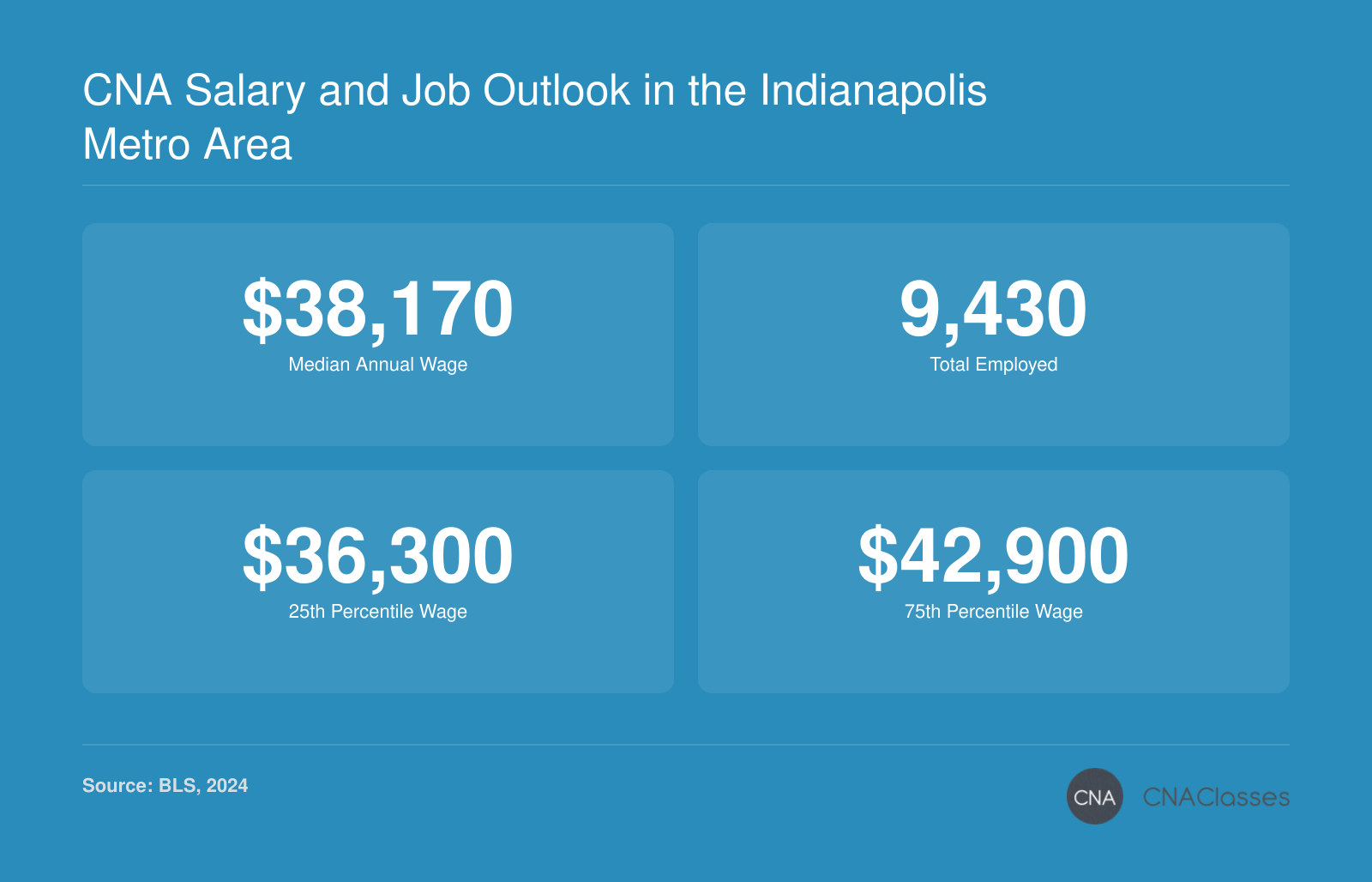
With a median annual wage of $38,170 and over 9,400 employed, CNAs in Indianapolis enjoy competitive pay relative to the area's cost of living. The narrow wage range signals entry-level stability and consistent demand across healthcare settings.
Indiana requires 105 total training hours in a state-approved program before you can sit for the competency exam and earn your certification.1 Below is a clear breakdown of every milestone, from prerequisites through registry placement.
Indiana does not set a single statewide minimum age or education requirement for CNA candidates, but most training programs enforce their own admission standards. In practice, expect to meet the following before you can enroll in an Indianapolis-area program:
CPR certification is not mandated by the state, though many employers and some programs require it.1 Check with your chosen school before your start date.
Your training must be delivered through a program approved by the Indiana Department of Health.1 The 105 hours break down into 30 hours of classroom instruction and 75 hours of supervised clinical practice in a healthcare setting. Clinical rotations are where you apply what you learn, practicing skills like vital-sign measurement, patient transfers, and infection control under the supervision of a licensed nurse.
Only programs with state approval will qualify you for the competency exam, so verify a program's status before enrolling.
Once you finish your approved program, you must pass a two-part competency evaluation administered by Ivy Tech Community College on behalf of the state. The exam includes:
If you do not pass on your first attempt, you have up to two years from your program completion date to retake the exam.5
After passing both parts of the exam, your name is added to the Indiana Nurse Aide Registry.1 This listing is what employers check before hiring, so you cannot legally work as a CNA in the state without it.1 Keep your registry information current, especially if you change your name or address.
Indiana recognizes a few additional routes to registry placement.1 Student nurses and recent nursing graduates may qualify without completing a separate CNA program.1 If you hold active CNA certification in another state, you can apply for reciprocity by passing Indiana's written exam.1 These options can save time if you already have healthcare training or are relocating to Indianapolis from out of state.
Below are the top CNA programs serving Indianapolis students, ranked by completion data, accreditation status, and alignment with Indiana's CNA certification standards. These schools offer state-approved training that prepares you for the competency exam and entry-level roles in long-term care, hospitals, and home health.
Indianapolis, IN · $7,000/yr
Best for: Indianapolis students aiming for immediate exam readiness
Ivy Tech Community College, with a campus in Indianapolis, is a cornerstone of CNA training in Indiana, offering state-approved programs that combine classroom, lab, and clinical experience. Its short-term CNA prep courses are designed to meet Indiana State Department of Health standards and allow students to sit for the state exam, often at Ivy Tech's own testing facilities. With multiple program formats and affordable in-state tuition, Ivy Tech provides a direct and cost-effective route into healthcare for Indianapolis-area residents.
Vincennes, IN · ~$11,000/yr (est.)
Best for: Busy adults balancing work and CNA training
Vincennes University delivers a CNA training option that is accessible to Indianapolis students through its local campus locations, offering both pre-nursing and direct-care tracks. Its 105-hour program meets Indiana certification requirements and features flexible scheduling, including part-time and evening classes, making it suitable for working adults. As a public, HLC-accredited institution, Vincennes provides a supportive pathway to CNA certification and further nursing education.
How much does CNA training cost in Indianapolis, and is there any way to get it for free?
The good news: costs vary widely, and several paths exist to reduce or eliminate what you pay out of pocket. Here is a breakdown of what to expect and how to make training more affordable.
Tuition across Indianapolis-area programs ranges from a few hundred dollars to a few thousand, depending on the school and what is included:
These figures reflect 2025-2026 pricing and may shift slightly. Always confirm current costs directly with each program before enrolling.
Some Indianapolis students pay nothing at all for CNA training. Large health systems like IU Health and Community Health Network have historically offered employer-sponsored programs where you train and work simultaneously, with the employer covering tuition in exchange for a service commitment after certification. Availability shifts based on hiring demand, so check each employer's careers page for current openings.
Workforce development grants through Indiana's WorkOne system can also cover or offset training costs for qualifying applicants, particularly those who are unemployed, underemployed, or transitioning careers. Nonprofit workforce programs sometimes partner with local healthcare employers to offer funded cohorts as well.
If you are attending a program through an accredited institution, you may qualify for federal Pell Grants, which do not require repayment. Shorter standalone CNA programs at private training centers typically do not qualify for federal aid, but many offer internal scholarships or sliding-scale pricing. Ask directly about both when you inquire.
Payment plans, like the one offered at Victory Training, are common and can make even lower-cost programs easier to manage on a tight budget.
Before you pay for any program, call the HR department at healthcare employers you are interested in working for and ask specifically: "Do you offer tuition reimbursement or a sponsored CNA training program?" Many facilities prefer to fund training for candidates who commit to joining their team, and you may be able to start earning before your certification exam is complete.
Employment of nursing assistants is projected to grow faster than the average for all occupations, driven by an aging population and rising demand for long-term care services.
Indiana CNA programs tracked through the Board of Proprietary Education have reported first-time pass rates ranging from 86% to 100% in recent years, which is a strong signal that many local programs are doing their jobs well. Understanding what goes into those numbers, and how to use them when choosing a school, can make a real difference in your preparation.
Every Indiana CNA candidate must pass two separate assessments before earning certification. The written portion is a computer-based, 100-question test with a 90-minute time limit. You need to score at least 80% to pass. The skills portion requires you to correctly demonstrate five randomly selected nursing skills in front of an evaluator. Both sections allow up to three attempts, so there is some room for a retry, but clearing both on the first try is always the goal.
Nationally, first-time pass rates on the written exam tend to fall between 87% and 93%. Skills exams are generally a bit harder, with first-time rates landing in the 78% to 85% range. Programs that consistently outperform those benchmarks are preparing students with more than textbook knowledge.
A high first-time pass rate, especially one near or at 100%, signals that a program is covering exam content thoroughly, giving students enough hands-on practice to perform skills under pressure, and not rushing graduates out the door before they are ready.
A lower pass rate does not automatically disqualify a school, but it is worth asking follow-up questions: How much clinical time is included? What support does the program offer students who struggle? Do instructors hold active nursing licenses?
Conversely, a program that cannot tell you its pass rate, or that does not track the data at all, is itself a warning sign.
Indiana does not publish a single statewide ranking of CNA program pass rates, but you can gather reliable information in a couple of ways. The Indiana State Department of Health maintains records on approved nurse aide programs and certification outcomes. Proprietary schools that report to the Indiana Board of Proprietary Education are required to publish student outcome data, including exam pass rates, so ask any school you are considering for their most recent figures before you enroll.
Here are answers to some of the most common questions about becoming a CNA in Indianapolis. These questions cover training length, costs, online options, and certification steps to help you make an informed decision.