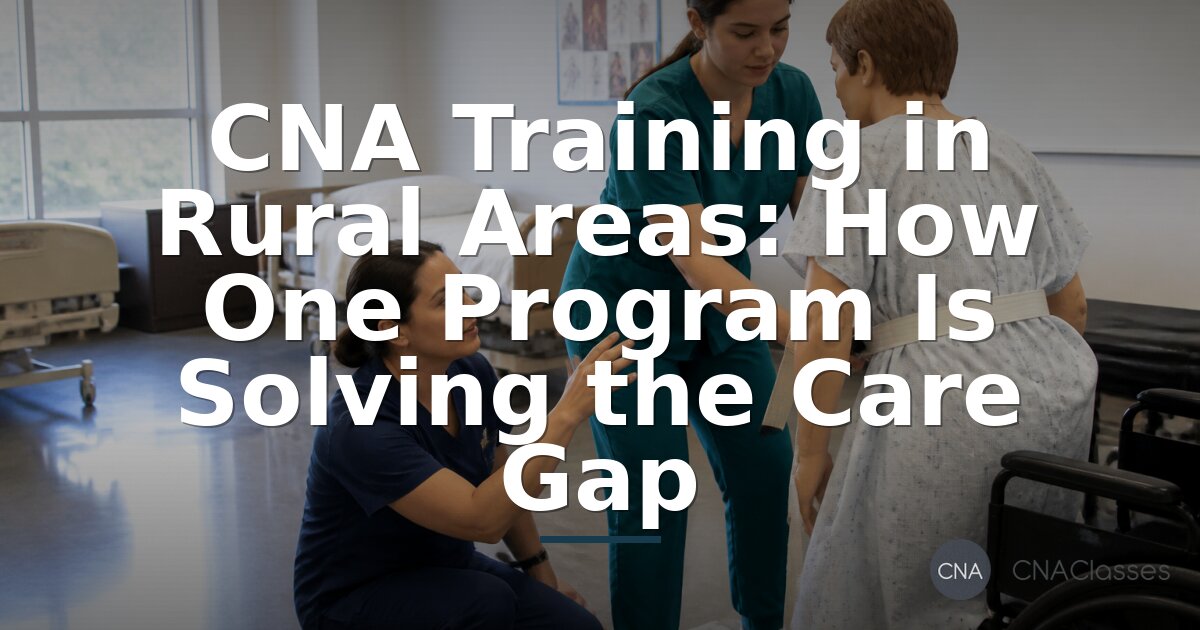
How a High School CNA Program Is Bridging the Rural Care Gap
See how a hospital-school partnership trains rural CNAs with hands-on acute care experience, early certification, and no tuition cost.
By Bryce HallReviewed by Editorial staffUpdated August 9, 20269 min read
Key Points
Monroe High School's CNA program enrolled 19 students in its first class.
Montevideo Medical Academy helped 25 students earn 170 credits and 55 certifications.
Rural communities have 17% fewer nursing assistants per older adult than cities.
For students in cities, aspiring CNAs can choose from multiple nearby programs. In rural areas, however, training options are sparse, sometimes nonexistent, creating a healthcare workforce crisis.
With only 20.9 nursing assistants per 1,000 older adults in rural counties compared to 25.3 in urban ones, patient care suffers. The Monroe High School CNA program in Washington shows a way out: a hospital-school partnership training students on-site, with acute-care clinical experience most programs lack.
That model tackles the challenges of distance, funding, and clinical placement all at once, giving rural students a clear path to a CNA career.
The Challenge of Accessing CNA Training in Rural America
How to become a CNA in a rural community often means overcoming a simple but stubborn barrier: you're miles from anywhere. Unlike cities where multiple training programs sit a short bus ride away, rural areas are training deserts. The nearest classroom might be an hour's drive each way, and public transit is rarely an option. For many students, the cost of fuel and vehicle wear-and-tear adds up fast, turning a free CNA training program into a financial strain.
Geographic Isolation and Transportation Hurdles
Distance isn't the only obstacle. Rural roads can be treacherous in winter, and many students also hold jobs or care for family members. When a single round trip eats up three hours, attending class three or four times a week becomes nearly impossible. Even motivated learners can get stuck. And because clinical site rotations are a required part of CNA training, students often face an extra commute to nursing homes or hospitals that may be in a different small town entirely.
How Training Gaps Deepen the Workforce Crisis
The result is a vicious cycle. Most rural counties are already designated as Health Professional Shortage Areas for primary care and nursing. There simply aren't enough qualified caregivers. When local residents can't access training, the workforce gap widens. Hospitals and long-term care facilities then rely on traveling staff, which is expensive and less stable. Building stronger CNA partnership programs isn't just a convenience; it's a necessity for community health.
A Model That Works: Inside the Monroe High School CNA Program
The most effective rural healthcare training programs today are built on direct partnerships between school districts and local hospitals, not distant community colleges. The high school CNA program launched at Monroe High School in Washington state proves how powerful that model can be.
A Unique Partnership
EvergreenHealth Monroe and the Monroe School District joined forces to create a semester-long Certified Nursing Assistant program housed right inside the high school. This collaboration directly supports the school district's five-year strategic plan, which prioritizes relationships with local employers to prepare students for livable-wage careers. Superintendent Shawn Woodward noted that the program creates career pathways that connect classroom learning with real-world opportunities. Instead of requiring students to commute to a community college or private training center, the partnership brings the hospital's expertise into the school.
Classroom Meets Clinical Floor
The program runs for one semester across two daily class periods, offering an elective credit to juniors and seniors. The CNA training curriculum blends traditional classroom instruction with something most aspiring CNAs never experience in training: hands-on clinical work led by acute-care hospital staff. EvergreenHealth Monroe's own nurses and educators deliver the clinical component, giving students direct exposure to the fast-paced hospital environment. Chief Nursing Officer Megan Wirsching emphasized that many conventional CNA programs do not offer clinical experiences in acute hospital-based care, making this arrangement especially valuable. Students learn skills like patient mobility, vital signs, and infection control not just in a lab, but on an actual medical-surgical unit.
A Direct Path to Certification
When students complete the course, they are eligible to sit for the National Nurse Aide Assessment Program (NNAAP) exam and earn Washington State CNA certification. The inaugural cohort included 19 students, with a similar number expected the following semester. By wrapping training, clinical hours, and exam eligibility into a single high school class, the program removes common obstacles rural students face, such as transportation, tuition, and scheduling conflicts.
A Blueprint for Rural Communities
The Monroe model demonstrates that rural schools can become incubators for the local healthcare workforce. Any community with a hospital or nursing home can replicate this approach by partnering directly with its school district. The keys are a semester-long commitment, dual-credit or elective integration, and clinical rotations led by facility staff. For rural areas struggling to attract and retain CNAs, embedding training in high school creates a homegrown pipeline of certified nursing assistants who are already familiar with the local hospital's culture and procedures.
Unlike typical CNA programs, Monroe’s direct acute-care clinical rotation gives students hospital-ready skills that immediately set them apart in the job market.
Why Hospital-Based Clinical Experience Matters for Rural CNAs
Most CNA programs place students in nursing homes or long-term care facilities for clinical rotations. While that setting teaches fundamental skills, it rarely exposes students to the fast-paced, high-acuity environment of a hospital. For rural CNAs, who often become the primary support in small critical-access hospitals, this gap can be significant. Hospital-based clinical simulation experience, like the one offered through the EvergreenHealth Monroe partnership, builds a broader clinical foundation from day one.
Sharpening Acute Care Skills
In a hospital, a CNA encounters a wider range of patient conditions, from post-surgical monitoring to managing acute illness. You learn to take vitals on unstable patients, assist with mobility in a constrained environment, and communicate with an interdisciplinary team under pressure. This sharpens assessment skills and builds the confidence to handle situations that a nursing home rotation may never present. For rural hospitals that operate with lean teams, a CNA who can jump into multiple roles without hesitation is invaluable.
The Monroe Model's Real-World Edge
Megan Wirsching, Chief Nursing Officer at EvergreenHealth Monroe, notes that "many traditional CNA programs do not offer clinical experiences in acute hospital-based care, making this collaboration unique." That distinct advantage means graduates don't just have a certification; they have hands-on familiarity with the same equipment, workflows, and patient turnover they'll face on the job. It's a direct pathway to becoming a versatile, confident team member in any rural healthcare setting.
Other Rural CNA Programs Making a Difference
Twenty-five students in Montevideo, Minnesota, have collectively earned 170 college credits and 55 healthcare certifications through a single rural CNA pipeline. The Montevideo Medical Academy demonstrates how a well-funded partnership can dramatically expand training access beyond a typical CNA program.
Montevideo Medical Academy: Building a Multi-Credential Pathway
Partners: Montevideo Public Schools, CCM Health, Minnesota River Area Agency on Aging, and Minnesota West Community and Technical College.
Credentials: CNA, medication aide, Pharmacy Technician, and First Aid/CPR, all embedded in a 22-credit college curriculum.
Funding: LYFT Career Pathways and the Southwest Initiative Foundation provided the financial backing, not student tuition.
Outcomes to date: 25 students, 304 clinical hours completed, 55 certifications awarded alongside those 170 credits.1
While CNA exam pass rates and job placement figures are not yet published, the sheer volume of credentials suggests students leave ready for multiple entry points into healthcare.
Expanding Pipelines in New York
Similar efforts are underway in upstate New York. Genesee Valley BOCES offers CNA training as part of a regional health workforce pipeline, often including paid learning opportunities. In western New York, Monroe 2-Orleans BOCES delivers CNA and Home Health Aide programs to both high school and adult learners through its WEMOCO career center.2 Though detailed outcome metrics for these programs aren't available, their existence alongside the Monroe High School program in Washington confirms a national pattern. Rural districts are embedding direct employer partnerships into secondary education, moving beyond tuition-dependent models toward career-pathway investments that benefit students, local health systems, and aging communities.
In rural America, there are only 20.9 nursing assistants for every 1,000 older adults, compared to 25.3 in urban areas. That means rural communities have about 17% fewer certified nursing assistants to care for their aging population.
CNA Salaries and Job Demand in Rural Vs. Urban Areas
Median annual wages for nursing assistants show significant variation across states, reflecting differences in cost of living and demand. In rural areas, pay is often 10 to 25 percent lower than in urban centers, though the cost of living may also be lower. The national median annual wage was $39,530 in 2024, according to the Bureau of Labor Statistics. The BLS also projects 4 percent job growth for nursing assistants from 2025 to 2035, and rural healthcare facilities frequently report staffing shortages, which can create steady employment opportunities for new graduates. The table below presents statewide median wages for selected states with substantial rural populations.