Key Points
- Southern State’s 8-week fall CNA program starts August 25, 2026.
- CNA jobs are projected to grow 2% with a $39,530 median salary.
- Apply early: fall CNA seats fill weeks before classes start.
Fall 2026 CNA registration is competitive. Here's your step-by-step guide to securing a seat.
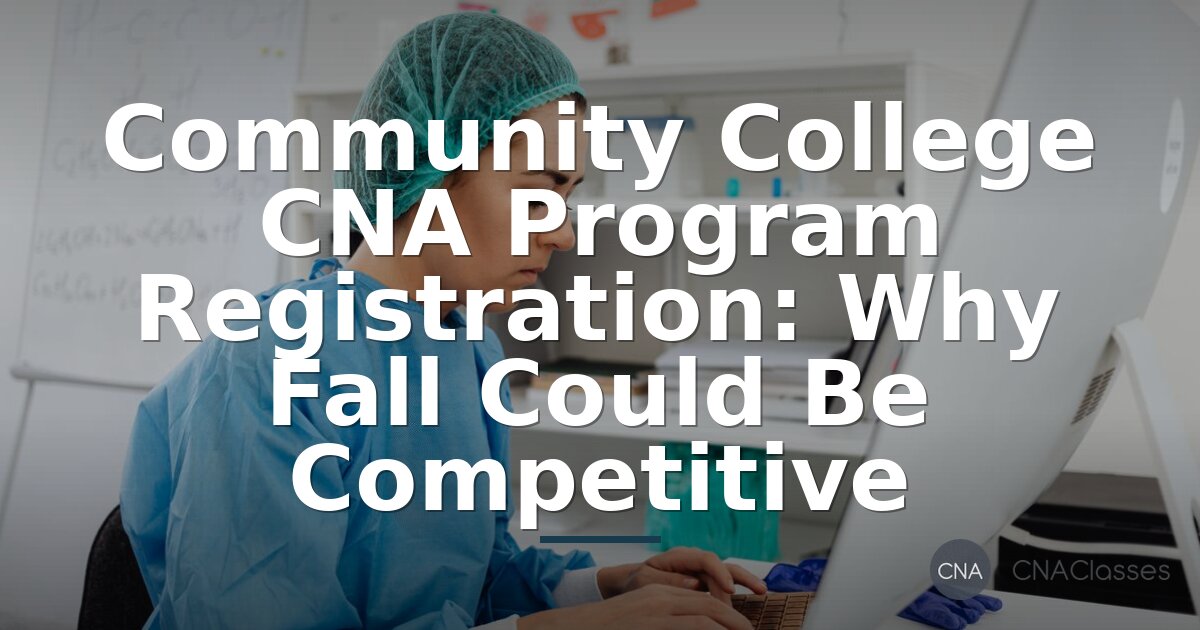
Fall 2026 CNA program registration is drawing more applicants than available seats. Southern State Community College, for instance, is accepting students for its eight-week course starting August 25, but spots are limited. The fast-track format, combining classroom and clinical training, attracts applicants seeking rapid entry into a field with steady demand. Graduates are immediately eligible for the state competency evaluation, making the credential a direct path to employment. Last-minute applicants increasingly find themselves deferred to the next enrollment cycle.
A structural shift is underway in nursing assistant education: community college CNA programs are seeing heightened selectivity as healthcare workforce demands grow. Unlike four-year degrees with published acceptance data, CNA program competition is rarely tracked in one place. Prospective students must piece together clues from multiple sources to gauge their odds and act early.
Start with the Bureau of Labor Statistics Occupational Outlook Handbook for nursing assistants. National projections remain strong, but regional breakouts tell the real story. States with rapidly aging populations or expanding hospital systems often show sharply higher employment growth forecasts, which can translate into more applicants per seat. Note which metropolitan areas appear as hotspots: these are the markets where program waitlists tend to be longest.
Because acceptance rates and waitlist lengths are not published centrally, a brief phone call or email to each program's admissions office can be the most reliable source of current competitiveness. Ask directly about recent application volumes, typical class sizes, cna program pass rates, and whether qualified applicants have been turned away. Staff may share internal numbers or offer a sense of how early seats filled in the last cycle.
State nursing boards, hospital associations, and community college consortiums sometimes release reports on healthcare workforce gaps and funding for new training slots. These initiatives can temporarily increase capacity, or signal that heightened demand is outpacing expansion. Monitoring press releases or meeting minutes from these bodies gives early warning of evolving selection pressures.
Compile the details yourself by building a simple spreadsheet of target programs. Include columns for prerequisites, application deadlines, clinical hour requirements, and any notes from archived web pages or digital fact books that hint at historical selectivity. This side-by-side view makes it easier to spot which programs have grown more restrictive over time, identify the best CNA programs, and see where your application has the best chance.
According to the Bureau of Labor Statistics, nursing assistant and orderly employment is projected to grow 2 percent from 2024 to 2034, adding roughly 34,200 new jobs. This steady growth, fueled by an aging population, makes fall 2026 CNA program seats highly competitive.
Some community college CNA programs set rigid application windows, while others admit students on a rolling basis, and recognizing which approach a school uses can mean the difference between starting classes this fall or pushing your plans to the next cycle.
State nursing boards and health departments often publish directories of approved nurse aide training programs. While these lists don't show real-time seat availability, they give you a verified starting point. For instance, the New York State Education Department lists all approved nurse aide programs with their approval dates2, and the Maryland Board of Nursing maintains a downloadable grid of provider statuses3. Begin your search here to ensure any program you find is state-approved and meets certification requirements.
Once you have a list of approved programs in your area, visit each community college's website. Look for phrases like "currently enrolling," "registration open," or "accepting applications." Programs that allow you to "register as you go," as Queensborough Community College does, typically use rolling admissions. Northern Essex Community College's CNA page explicitly advertises "Currently Enrolling: Summer & Fall 2026", while Suffolk County Community College's next class starts September 14, 2026. The University of West Georgia lists multiple fall start dates, including August 22 and September 14, indicating flexible entry points. If a page shows only a past application window (like Austin Community College's May 15, June 15 deadline), don't assume the class is full. Some colleges accept late inquiries or have waitlist options.
When a college website lacks clear enrollment status, pick up the phone or send an email. Many CNA programs are managed by a specific nursing coordinator who can tell you immediately whether seats remain. At Bristol Community College, for example, prospective students are advised to reach out directly to [email protected] or call 774.357.2499. A quick conversation can also uncover last-minute openings or upcoming information sessions. Southern State Community College in Ohio is actively seeking registrations for its Fall 2026 eight-week program, which starts August 25 (a prime example of a course that may still have availability if you inquire soon).1 Be prepared to ask about seat limits, as many programs cap enrollment and fill quickly. By combining state-approved lists, targeted website searches, and direct outreach, you can identify CNA programs that fit your schedule this fall.
Community college CNA programs share many common prerequisites, but requirements can differ by state and school. Collect these essentials early to avoid last-minute delays.
Some CNA students fund their training through federal grants they never have to repay, while others rely on employer-sponsored CNA tuition reimbursement that arrives only after they land a job. Knowing which path fits your situation (and how soon you must act) can mean the difference between a fully funded certificate and a missed opportunity.
Start by filing the Free Application for Federal Student Aid (FAFSA for nursing school) as soon as possible. For the 2026, 2027 award year, the Pell Grant maximum is $7,395, and it does not need to be repaid.1 If your CNA program is credit-bearing, you may also qualify for a Federal Supplemental Educational Opportunity Grant (SEOG), which awards $200 to $1,000 to Pell-eligible students with the greatest need.1 Not all community college CNA programs carry credits, so confirm with your financial aid office whether FAFSA applies.
Many states offer grants specifically for short-term healthcare training. In Connecticut, for example, the Roberta B. Willis Scholarship provides $500 to $4,500, and the CSU Grant offers up to $1,500 for qualifying residents. The state’s priority deadline for these programs is July 15.2 Workforce Innovation and Opportunity Act (WIOA) funds can cover tuition for eligible unemployed or underemployed individuals, often through American Job Centers. Career and Technical Education (CTE) funds, such as the Carl D. Perkins grant, sometimes support CNA training at participating colleges.
Hospitals, nursing homes, and healthcare foundations frequently award scholarships to CNA students. The Nebraska Health Care Foundation, for instance, offers $500 quarterly scholarships. Many community colleges provide their own payment plans or emergency grants. Reach out to the college’s financial aid office early; they can identify CNA-specific scholarships and work-study options you might miss otherwise.
Aid often runs out well before classes start. FAFSA processing can take weeks, and state grant pools deplete quickly after priority dates. Some workforce grants accept applications on a rolling basis, but seats in funded training cohorts fill fast. Contact your college right away to confirm deadlines and complete any required paperwork. A few phone calls now can secure thousands of dollars toward your CNA credential.
CNA training is a focused program that mixes classroom instruction with real-world clinical practice, typically wrapping up in a matter of weeks. The fast-paced format is designed to get you job-ready quickly, whether you choose a full-time, part-time, or accelerated schedule.
Most community college CNA programs last between 4 and 12 weeks, depending on the format.1 Accelerated daytime tracks can finish in as little as 4 to 6 weeks, while evening or weekend options often take 12 to 16 weeks. For example, Southern State Community College's Fall 2026 course runs for eight weeks, from August 25 through October 15. That timeline includes both in-class theory and hands-on practical training at a clinical site.
During the classroom portion, you will study foundational topics such as anatomy, communication, and residents' rights. The practical training covers the core skills you will use every day. At Southern State, students practice taking vital signs, assisting with personal care like bathing and dressing, supporting mobility and transfers, applying infection control techniques, and communicating effectively with patients. These competencies align with the standard CNA training curriculum that every state-approved program follows to prepare you for the certification exam.
Clinical hours give you the chance to apply what you have learned under supervision. The federal government requires a minimum of 16 hours of supervised clinical training within at least 75 total program hours,2 but state rules vary. Some states mandate 40, 80, or even 100 clinical hours.24 In Ohio, where Southern State operates, the bar is set at the federal floor: 16 clinical hours within 75 total hours.3 This means you will spend at least two full days in a clinical setting, though many programs exceed the minimum to build confidence.
After completing the program, you will sit for a state-approved certification exam. The test typically has two parts: a written (or oral) knowledge test and a CNA skills test where you perform tasks in front of an evaluator.1 In Ohio, this is called the Ohio Nurse Aide Competency Evaluation. While official national pass-rate data is not centrally tracked, many community college programs report that the large majority of their graduates pass on the first attempt, sometimes around 80 to 90 percent, thanks to thorough preparation.1
A major advantage of a community college CNA program is the career ladder it provides. At schools like Southern State, the coursework can count toward future Licensed Practical Nurse (LPN) and Registered Nurse (RN) degrees. That means the credits and clinical hours you earn as a nursing assistant are not just a standalone credential; they can be the first step toward a CNA to RN bridge program, making CNA training a smart long-term investment.
This program allows students to enter the workforce in just eight weeks.
Nursing assistants held over 1.3 million jobs in 2024, with a median annual salary of $39,530. The Bureau of Labor Statistics projects employment to grow 2.3% from 2024 to 2034, adding about 32,600 new positions, while also generating over 200,000 job openings each year, largely from workers retiring or leaving the field. Demand remains strong across hospitals, nursing homes, and home health care, driven by an aging population and rising rates of chronic conditions.
| Occupation | Total Employment | Median Annual Salary | 25th Percentile Salary | 75th Percentile Salary |
|---|---|---|---|---|
| Nursing Assistants | 1,388,430 | $39,530 | $36,260 | $46,070 |
| Nursing Assistants, Orderlies, and Psychiatric Aides | 1,476,350 | $39,470 | $36,200 | $46,070 |
Nursing assistant wages can differ dramatically from state to state, so where you work matters as much as what you do. The table below highlights the top-paying states based on 2024 median annual salaries from the Bureau of Labor Statistics. Keep in mind that a high salary often comes with a higher cost of living, so always check local wage data and living expenses before making a move.
| State | Employment | Median Annual Wage |
|---|---|---|
| Oregon | 12,800 | $48,390 |
| Washington | 28,080 | $48,260 |
| New York | 85,310 | $47,390 |
| District of Columbia | 2,550 | $46,860 |
| California | 102,380 | $46,420 |
| New Hampshire | 7,190 | $46,050 |
| Alaska | 1,660 | $45,840 |
| Maine | 8,590 | $45,640 |
| Minnesota | 26,970 | $45,580 |
| Massachusetts | 38,280 | $45,410 |