
Key Points
- Earn your CNA certificate in just 9.5 weeks at Lone Star College.
- Program costs $1,434 with financial aid available for eligible students.
- Houston adds 3,260 CNA jobs yearly with a median salary of $37,848.
Everything you need to know about Lone Star College's 9.5-week CNA program in Houston.
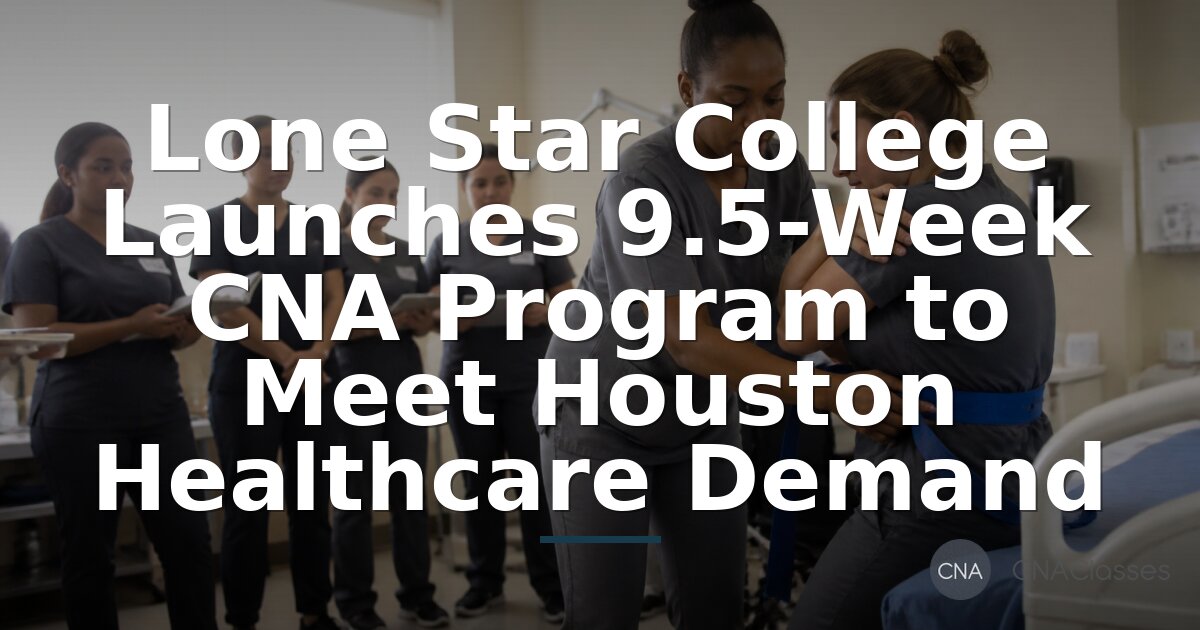
Houston's healthcare system employs 20,137 nursing assistants, yet still needs 3,260 more annually.1 Lone Star College-University Park has launched a 9.5-week Nurse Aide Certificate to help close that gap, priced at $1,434 with evening classes and no prior experience required. The short timeline and evening format fit into working adults’ schedules, making certification accessible when the region’s demand for qualified caregivers continues to outpace supply.
In just 9.5 weeks, Lone Star College, University Park prepares students for the state certification exam through a 108-hour Nurse Aide Certificate program. The accelerated format responds to Houston's growing need for skilled nursing assistants, a trend underscored by a strong CNA job outlook that shows approximately 3,260 new openings each year in the region.1 By condensing essential training into a short, evening-based schedule, the college makes it possible for working adults, career changers, and recent graduates to enter the healthcare field without putting their current obligations on hold.
Hospitals, long-term care facilities, and home health agencies across the Houston area report persistent staffing gaps for certified nursing assistants. Lone Star College, University Park designed this program specifically to help close that gap. Rather than requiring years of schooling, the certificate equips students with foundational patient care skills in under three months, allowing them to test for state certification and begin working quickly. The program’s launch reflects a broader effort by Texas community colleges to create direct employment pipelines into high-demand healthcare roles.
The 108-hour curriculum is divided into two complementary parts: 64 hours of classroom and lab instruction, plus 44 hours of supervised clinical experience. Classes meet every Monday and Wednesday from 5:30 p.m. to 9:30 p.m., giving students structured, predictable evenings. All sessions take place on the third floor of Lone Star College, University Park, allowing students to gain practical experience through modern nursing labs and simulation in CNA training. The blend of theory and hands-on practice means graduates are ready to perform essential CNA duties, such as taking vital signs, assisting with mobility, and maintaining a safe patient environment, from day one on the job.
No prior medical experience is required to apply, making the Nurse Aide Certificate an open door for anyone interested in healthcare. It appeals to a wide range of students: recent high school graduates exploring nursing careers, parents returning to the workforce, or professionals pivoting from other industries. Because evening classes accommodate daytime work or family responsibilities, the program fits easily into a busy life. Gail Smith, Director of Continuing Education at Lone Star College, University Park, captures the program’s impact: "I've seen this certificate program change lives," a testament echoed in real CNA success stories. For many graduates, it becomes the first step toward advanced nursing degrees or long-term careers in patient care.
Balancing a rigorous healthcare curriculum with a full-time job and family obligations can seem impossible, but the Lone Star College-University Park CNA program structures its schedule to fit into working adults' lives. The 9.5-week evening format packs 108 total hours1 of training into a fast-paced yet manageable timeline, allowing students to earn a Nurse Aide Certificate without quitting their day jobs.
The first portion of the program immerses students in classroom theory and hands-on lab practice. Over 64 hours1, you learn fundamental nursing concepts, from patient safety and infection control to measuring vital signs and assisting with activities of daily living. As you gain confidence, the second half shifts to a 44-hour clinical rotation at an approved long-term care facility2, where you apply your skills with real patients under instructor supervision. Classes are held Mondays and Wednesdays from 5:30 p.m. to 9:30 p.m.2, so your evenings are dedicated to building a new career while your days remain free for work or family.
The curriculum aligns with Texas Department of Aging and Disability Services requirements, preparing you for the state competency exam. Key competencies include:
The on-campus lab simulates a real clinical setting using full-sized patient mannequins, hospital-style beds, wheelchairs, walkers, canes, and daily care supplies1. This technology lets you practice everything from transferring a patient to making an occupied bed before you ever step into a facility. The clinical rotation then places you in an approved long-term care environment2, giving you the confidence that comes from working directly with residents and experienced nurses.
Before you commit to paying the full $1,434 out-of-pocket, explore the financial aid for nursing school options that can drastically reduce or eliminate your costs. Lone Star College, University Park sets its accelerated Nurse Aide Certificate at $1,434, but the final amount you pay depends on which aid avenues you qualify for.
The $1,434 fee covers the 108-hour program, but prospective students should confirm exactly what’s included before enrolling. At many CNA programs in Texas, this price may or may not cover textbooks, scrubs, lab supplies, and the state certification exam fee (approximately $125). Reach out directly to Lone Star’s continuing education office to get a line-item breakdown so there are no surprises.
TPEG is a state-funded, need-based grant available to Texas residents who demonstrate financial hardship.2 Because the CNA program is a continuing education certificate, it qualifies for TPEG when you submit a Free Application for Federal Student Aid (FAFSA). The FAFSA is your gateway; awards vary by funding availability and your Expected Family Contribution. While federal Pell Grants do not apply to non-credit programs like this one,3 TPEG fills that gap for many students.
At $1,434, Lone Star’s program sits in the middle of the Houston market. Budget-friendly CNA courses in Texas can sometimes be found at lower costs, but these are often longer or offered in smaller rural settings. Accelerated cna training programs houston typically range from $1,200 to $2,500 in the Houston metro. What sets Lone Star apart is the combination of a rapid 9.5-week timeline, evening classes, and access to state grant funding, making it one of the most cost-effective accelerated options in the region.
According to the most recent data, CNAs in the Houston metro area earn a median annual wage.
What does it take to get into Lone Star College’s accelerated CNA program? The process is straightforward and designed to get you into the classroom quickly, even if you have no medical background.
No prior healthcare experience is required to apply. However, like most state-approved nurse aide certificates, the program does ask for a few standard items:1 - Education: A high school diploma or GED is typically required. - Background check: A clear criminal background check is mandatory before clinical rotations. - Health screenings: A negative TB test and proof of up-to-date immunizations (such as MMR, varicella, and hepatitis B) are usually needed. - Drug screening: Some programs also require a drug screen; check with the Continuing Education office for the latest policy. Meeting these requirements early can speed up your enrollment, so it’s wise to gather documents as soon as you decide to apply.
The enrollment path for the Nurse Aide Certificate at LSC-University Park follows a clear sequence: - Select your program: Visit the Lone Star College Continuing Education website and browse the Nurse Aide Certificate option. - Attend an information session: Many programs offer a no-obligation info session to review expectations and answer questions. This is a great chance to learn about the 9.5-week format and evening schedule. - Apply to Continuing Education: Submit your application through the CE portal. You’ll need to provide proof of high school completion or equivalency. - Complete additional requirements: This may include the background check, TB test, immunizations, and any other program-specific forms. - Register for the cohort: Once accepted, you’ll register online for the upcoming start date. Classes fill on a first-come, first-served basis, so don’t delay.
The next cohort begins on September 21, 2026. For the latest schedule, check the CNA certificate start options. Classes run Mondays and Wednesdays from 5:30 p.m. to 9:30 p.m. at the LSC-University Park campus. While no formal application deadline is published, early submission is strongly encouraged because capacity is limited. Contact the CE office to confirm your spot and ask about any registration cutoffs.
For personalized help, reach out to Lone Star College-University Park Continuing Education. You can find up-to-date phone numbers and email addresses on the official LSC Continuing Education webpage. Prospective students are also welcome to explore program details and ask questions through cnaclasses.org for guidance on getting started.
The Houston metropolitan area employs over 19,500 nursing assistants, with a median annual wage of $36,940. According to Lone Star College, the region sees approximately 3,260 new CNA job openings each year, driven by an aging population and expanding healthcare facilities. Salaries can increase with experience, add-on certifications like medication aide, or specialization in settings such as hospitals or long-term care.
| Location | Total Employment | 25th Percentile | Median Annual Wage | 75th Percentile |
|---|---|---|---|---|
| Houston-Pasadena-The Woodlands, TX | 19,510 | $35,360 | $36,940 | $44,780 |
| Dallas-Fort Worth-Arlington, TX | 23,280 | $36,180 | $37,260 | $42,620 |
| San Antonio-New Braunfels, TX | 6,910 | $33,100 | $35,990 | $38,070 |
| Austin-Round Rock-San Marcos, TX | 5,920 | $36,060 | $37,460 | $43,190 |
Comparing accelerated CNA programs in Houston goes beyond simply scanning tuition or start dates; a thoughtful evaluation looks at scheduling, financial aid, accreditation, and the support each school provides on the path to state certification.
Because programs update their offerings frequently, the most reliable information comes directly from official school websites. Institutions like Houston Community College (hccs.edu), Legacy Career Institute (legacycareerinstitute.com), and Smithwood Medical Institute (smithwoodmedicalinstitute.com) publish current tuition, class schedules, and enrollment criteria. You can also find an up-to-date list of approved nurse aide training programs through the Texas Health and Human Services Commission’s Nurse Aide Registry , an essential step for confirming that a program meets state requirements.
For broader context, the Bureau of Labor Statistics website outlines typical training commitments and employment outlook for nursing assistants. However, the BLS does not endorse individual schools; use it as a general benchmark rather than a program-specific guide.
When you narrow your list, a phone call to each admissions office can reveal nuances that websites omit. Here are the most important details to ask about:
A program’s price tag and length mean little if it is not properly accredited or state-approved. The Texas Workforce Commission recognizes certain career schools, and national organizations like the National Association of Health Care Assistants (NAHCA) can serve as additional indicators of program quality. Always verify that a program is listed on the state CNA registry; graduates of unapproved programs cannot take the Nurse Aide Competency Exam in Texas.
Taking these steps ensures you compare programs on equal footing. While Lone Star College’s new 9.5-week Nurse Aide Certificate offers a specific blend of evening convenience, public-school pricing, and September enrollment, other schools in Houston may match or differentiate themselves on these exact factors. Armed with the right questions, you can find the accelerated track that fits your life and launches your healthcare career.
Here are answers to common questions about Lone Star College's new 9.5-week Nurse Aide Certificate program, from costs and class schedules to certification exam details and job prospects in Houston.