Key Points
- Houston CNAs earn a median $37,981 annually, above the national average.
- State law requires 100 training hours before taking the certification exam.
- About 19,000 CNAs work in Houston, with steady demand growth expected.
Compare CNA training in Houston: tuition, schedules, and job placement support.
Houston supports roughly 19,000 certified nursing assistants across its hospital systems, long-term care facilities, and home health agencies, and industry forecasts project that number climbing through the end of the decade. For anyone considering CNA training in Houston, the real question is not whether jobs exist but which program fits your budget, schedule, and career timeline.
With tuition ranging from under $2,000 to well above that mark, pass rates that vary widely by school, and Texas requiring 100 hours of combined classroom and clinical training, the details matter more than the headline demand.
Houston's healthcare sector is one of the largest in the country, and the demand for certified nursing assistants continues to grow faster than CNA classes in Texas can keep pace with it.
Four hospital networks define the backbone of CNA employment in the Houston metro area. Houston Methodist, Memorial Hermann, CHI St. Luke's Health, and HCA Houston Healthcare collectively operate dozens of facilities across Harris and surrounding counties. Houston Methodist alone had 58 nursing assistant positions listed on its careers site in 2024, and the system is recognized for offering competitive benefits and clear career ladder pathways. HCA Houston Healthcare runs multiple campuses, including its West and Northwest locations, with ongoing CNA postings throughout the year.1 These systems do not hire seasonally. They maintain continuous recruitment pipelines because patient volume and staffing needs rarely slow down.
Harris Health System adds another dimension to the picture. As the county's safety-net provider, it fills full-time clinic CNA roles in outpatient and community-based settings, which means steady employment options outside the traditional hospital floor.2
Hospitals are only part of the story. Houston's aging population is pushing significant demand into long-term care facilities, assisted living communities, and home health agencies. Brookdale Senior Living operates in the Uptown area and posts CNA and caregiver openings on a rolling basis.4 Facilities like Cypress Creek Rehab offer referral incentives to attract and retain staff.5 Across the long-term care sector, high turnover means that qualified CNAs are almost always in demand.3
Home health agencies are equally active. SYNERGY HomeCare advertises CNA roles with flexible scheduling, overtime opportunities, and holiday pay.5 Staffing platforms like Nursa list per-diem shifts at hospitals, senior communities, and home health agencies across the city, giving CNAs options that range from full-time salaried positions to shift-by-shift flexibility.4
In 2024, LinkedIn tracked over 200 active CNA postings in Houston at a single point in time, with total employment figures in the hundreds across the metro area.6
Choosing a Houston-area training program means you are entering one of the most active CNA job markets in Texas. Employers here are not just hiring, they are competing for credentialed candidates. That leverage belongs to you the moment you pass your certification exam, and our guide to landing your first CNA job can help you capitalize on it. A local program also gives you a chance to build clinical connections in the same facilities where you may eventually work, which is an advantage that matters when it comes time to apply.
Traditional CNA training requires daily classroom attendance, but a growing number of Houston students are choosing hybrid CNA training programs that deliver lectures online while reserving in-person hours for hands-on practice. For adults balancing work or family, this blend can be the difference between launching a healthcare career and putting it off.
Texas regulations do not allow fully online CNA training, but they do permit up to 60 hours of online classroom instruction. In a typical hybrid course, you complete theory modules, watch instructional videos, and take quizzes on your own schedule. Then you attend on-site labs and supervised clinical rotations, often at a hospital or long-term care facility, to practice skills like patient transfers, vital signs, and infection control. The state requires 40 hours of in-person clinical experience, so every program must still provide that direct patient contact. The online portion often covers all required classroom topics, while the clinical hours remain strictly hands-on.
Several schools near Houston have embraced this format. Uncharted Territory Nurse Aide in Houston runs a hybrid program that can be completed in 6.5 weeks. CNA Training Institute in Sugar Land combines online didactic work with on-site clinical rotations. Victorious Healthcare Academy in northwest Houston also pairs web-based lessons with in-person clinical experiences. These programs aim to cut commute time for classroom theory while keeping the essential hands-on practice intact.2 Always confirm that any program you consider is approved by the Texas Health and Human Services Commission and lists an active clinical site near you.
For working adults, parents, or those without reliable transportation, hybrid CNA classes remove a major barrier: the need to be physically present for every lecture. Instead, you can log in during evenings, weekends, or nap-time. That flexibility often shortens the overall timeline and reduces the stress of coordinating rigid schedules with family or employers. Many Houston students find that hybrid courses allow them to study around their existing work shifts, instead of giving up a paycheck. Some programs also offer accelerated cohorts: Uncharted Territory’s 6.5-week track, for example, lets students move quickly through the theory portion and into clinicals.
Before enrolling, verify two things: first, that the school has state approval to deliver the online portion of the curriculum; second, that it has a designated clinical site accessible to you. The Texas Department of Aging and Disability Services (now part of HHSC) maintains a list of approved programs. Also remember that even if you learn online, the state competency exam is taken in person at an approved testing center. Hybrid training is a powerful tool, but only when it meets all regulatory requirements.
Tuition for CNA programs in the Houston area varies widely, with some options costing under $2,000. Fees and materials may not be included, so always confirm total program cost before enrolling.
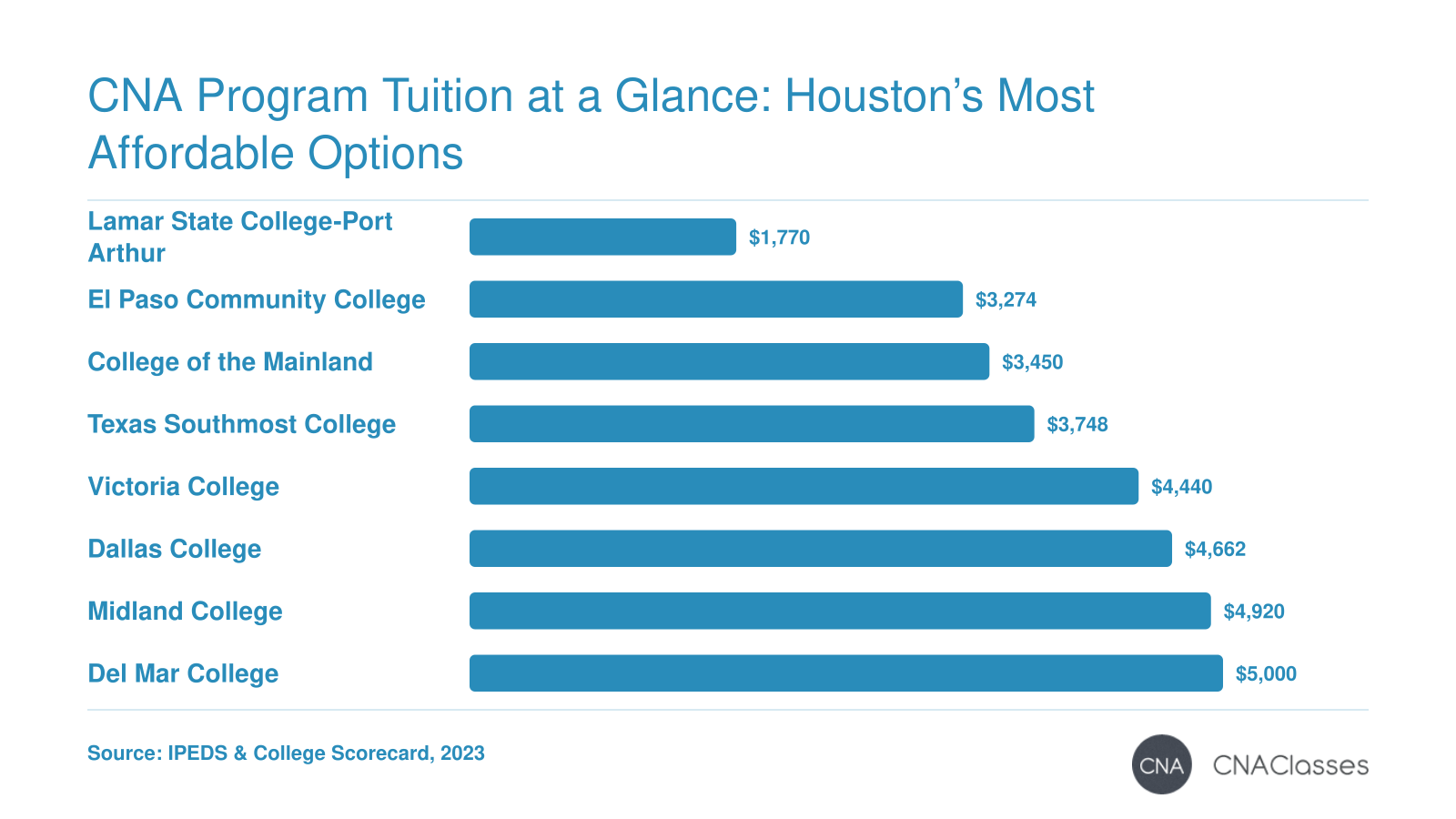
In addition to the top-ranked Houston programs, here are more Texas Workforce Commission-approved CNA training programs located throughout Texas. Many of these schools offer flexible schedules and affordable tuition.
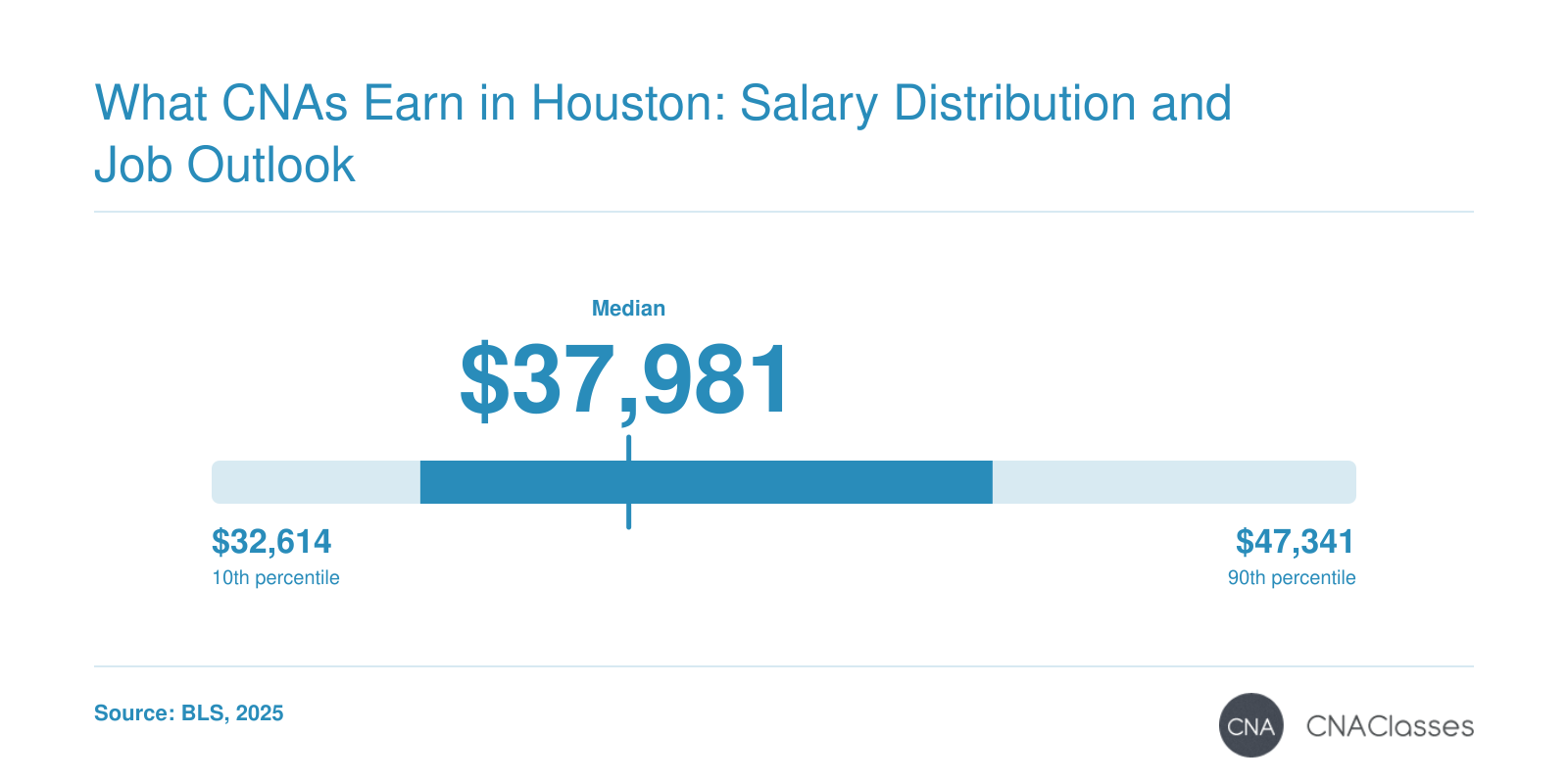
The earning potential for Certified Nursing Assistants in the Houston metropolitan area varies based on experience, employer, and work setting. According to the Bureau of Labor Statistics, the median annual wage for nursing assistants in Houston is $37,981, with top earners making over $47,000 per year.
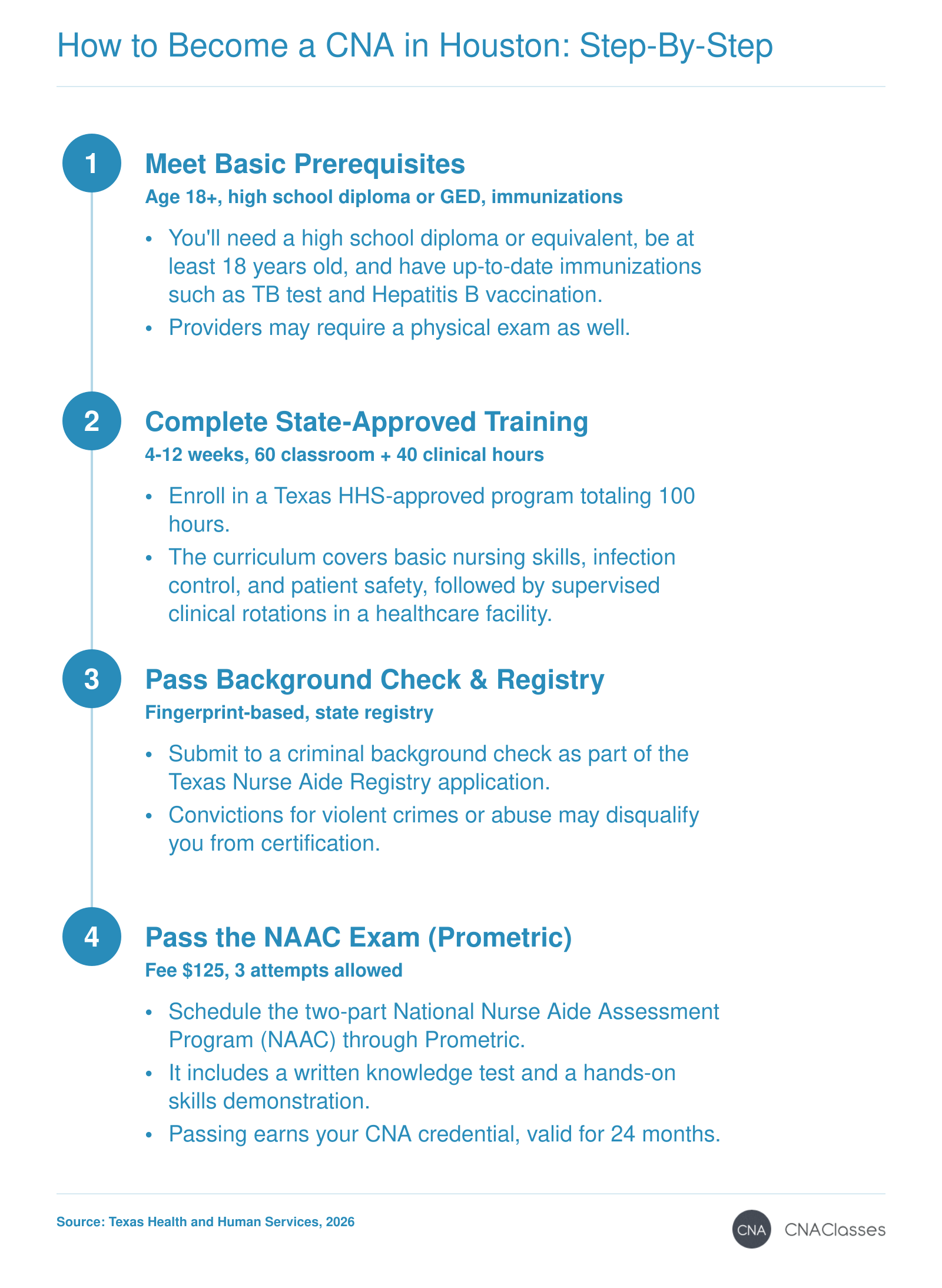
Becoming a Certified Nursing Assistant in Houston follows a clear process set by the Texas Health and Human Services Commission. As of 2026, the state mandates 100 total training hours, combining classroom instruction and clinical practice. Here's how to get your CNA credential, from prerequisites to exam day.
Nationally, first-time CNA exam pass rates range from roughly 70 to 87 percent, meaning the school you choose can genuinely affect your odds of passing. Texas does not publicly report program-level pass rates, so ask any Houston school you are considering to share their own completion and exam success data before you enroll.
The cost of CNA training in Houston has stayed relatively stable compared to other healthcare programs, but even a modest price tag can feel steep when you are just starting out. Understanding every line item, and knowing where to find help paying for it, can save you hundreds or even thousands of dollars.
Total out-of-pocket costs for a Houston CNA program typically fall between $600 and $2,000, though some private schools charge more. That headline number usually covers tuition and basic lab fees, but it does not always include everything you need. Budget for these additional expenses:
Always ask a program for a complete cost breakdown before you enroll. Some schools bundle supplies into tuition while others add them as separate line items, and those "hidden" extras can add up quickly.
The Texas Workforce Commission offers grants through the Workforce Innovation and Opportunity Act that can cover tuition, books, uniforms, supplies, and even your exam fee. Eligible applicants include unemployed, underemployed, low-income, or dislocated workers. Some participants also qualify for transportation stipends and childcare assistance, which can make attending class far more practical. To get started, contact your local Workforce Solutions office and ask for the Eligible Training Provider List to confirm that your chosen school is an approved provider.
If you enroll in a CNA program at a Texas community college, you may also be eligible for Pell Grants (complete the FAFSA to find out) or the Texas Public Education Grant, which can cover up to 50 percent of tuition.1 Veterans and eligible dependents should look into the Hazlewood Act, which provides a tuition and fee exemption at Texas public institutions.
Several major Houston hospital systems, including Memorial Hermann, Houston Methodist, HCA Houston Healthcare, and St. Luke's, have offered employer-paid CNA training programs. These programs typically cover your full tuition in exchange for a commitment to work at the sponsoring facility after you earn your certification. Nursing homes and long-term care facilities in the Houston metro area sometimes run similar arrangements. If earning while you learn appeals to you, ask prospective employers directly whether they sponsor CNA training before you pay out of pocket elsewhere.
CNA-specific scholarships in Texas tend to range from $500 to $2,000 per award. Schools like Pima Medical Institute have offered scholarships up to $5,000 for qualifying students. Texas Health School lists additional aid options such as AmeriCorps education awards, VA benefits, and Bureau of Indian Affairs assistance.2 Even smaller awards can offset the cost of your exam fee or supplies, so apply broadly.
Before signing an enrollment agreement, confirm three things: that the program is approved by the Texas Health and Human Services Commission, that it appears on the Workforce Solutions Eligible Training Provider List if you plan to use WIOA funding, and that the school's financial aid office can document every fee you will owe. Programs that are not Title IV eligible will not qualify for federal Pell Grants, so check that detail early if federal aid is part of your plan. A few minutes of verification upfront can prevent unexpected bills down the road.
Every CNA program you consider in Houston must appear on the Texas Workforce Commission approved training provider list. This is not optional. TWC approval is the gatekeeper; no program can legally prepare you to take the state competency exam without it. Before you pay a deposit or sign an enrollment agreement, visit the TWC website and verify that the school name and campus location match the official TWC roster. Programs that skip this step are either operating illegally or offering a certificate that holds no value in Texas.
You will rarely encounter national accreditation bodies such as CCNE or ACEN when researching CNA programs. Those organizations accredit nursing degree programs at the associate and bachelor level. For CNA training, state approval is the credential that counts. TWC reviews curricula, faculty qualifications, clinical site agreements, and pass-rate data. A TWC-approved program meets the minimum statutory and regulatory standards for nursing assistant education in Texas. If a school advertises national accreditation for its CNA track, that is either a misunderstanding or a red flag.
Texas mandates 100 total training hours, with at least 40 spent in a clinical setting. Clinical rotations typically take place in a skilled nursing facility or hospital, where you will work directly with residents or patients under the supervision of a registered nurse. You will practice skills you learned in the classroom: taking vital signs, assisting with hygiene and toileting, transferring patients, documenting care. The clinical environment is where theory becomes muscle memory. Expect early-morning or weekend shifts depending on the facility's schedule and the program's agreements. Some schools maintain partnerships with multiple sites, giving you exposure to acute-care and long-term-care settings.
State approval confirms a program meets the baseline, but quality varies. Look at student-to-instructor ratios during lab and clinical sessions. A 10:1 ratio allows for individualized feedback; a 20:1 ratio means you'll compete for the instructor's attention. Ask what equipment the lab includes: hospital beds, mechanical lifts, electronic vital-sign monitors, realistic mannequins. Tour the facility if you can. Finally, ask which clinical sites the program uses and whether those partnerships are long-standing. Stable relationships with quality facilities usually signal a well-run program with strong job-placement outcomes.
For new CNAs in Houston, the job hunt can take two forms: casting a wide net on your own or tapping into employer pipelines built right into your training program. The difference often comes down to how quickly you land your first shift, and where.
Employment for nursing assistants in the Houston area is projected to grow 4% from 2023 to 2033,1 reflecting steady demand across a healthcare landscape that never stands still. Hospitals, nursing homes, home health agencies, and assisted living facilities all rely on CNAs as the hands-on caregivers who keep daily operations moving.
Several major employers actively recruit graduates directly from local training programs. Some even embed hiring into the training experience itself.3
Many Houston-area programs go beyond clinical instruction to offer structured job placement support. Houston Community College’s Certified Nurse Aide program, for example, partners with Dwyer Workforce Development to supply local healthcare employers, helping fill roughly 500 CNA training seats each year with a clear employment pipeline.2 Schools like Smithwood Medical Institute organize career fairs, direct-hire events, and resume workshops tailored to entry-level healthcare roles. Even state-approved providers listed by Texas HHS, such as Silverline Medical Institute and Victorious Healthcare Academy, often maintain relationships with nearby facilities that interview graduates before they complete their certification exams.
The CNA credential is rarely the final stop. Working as a nursing assistant gives you a front-row view of patient care and builds experience that strengthens applications into Licensed Vocational Nurse (LVN) or Registered Nurse (RN) programs. Many Houston employers offer tuition reimbursement or flexible scheduling to support continuing education, making it practical to step up the career ladder without leaving the workforce. The result is a clear, proven route from entry-level aide to licensed nursing professional, right here in the Houston metro.
Choosing a CNA program in Houston means balancing location, schedule flexibility, and the confidence that your certificate will be recognized by Texas employers.
Houston's size works in your favor: the metro area offers dozens of approved nursing assistant programs, from community colleges to private career schools to hospital-based training centers. That variety also means you need a systematic way to compare them. The most reliable starting point is the Texas Nurse Aide Registry, which publishes exam pass rates by school. High first-time pass rates signal strong curriculum and effective instruction. Low rates may indicate rushed coursework or insufficient clinical preparation. Before you sign up, ask any program for its most recent pass rate and compare it to the statewide average.
Every approved program must meet the same state minimums: 75 hours of instruction, including at least 24 clinical hours in a long-term care facility. Beyond that baseline, programs differ in class size, instructor experience, clinical partnerships, and student support. Visit each school's website and look for a dedicated nursing assistant program page. Strong programs highlight instructor credentials (active RN or LVN license, years of clinical experience), describe their clinical site partners, and publish student testimonials or job placement outcomes.
Schedule flexibility matters. If you work full-time, evening or weekend classes may be your only option. Some schools offer accelerated tracks that compress training into three to four weeks; others spread the same hours over two to three months. Neither format is inherently better, but accelerated programs demand full-time commitment and leave less time for outside work or family responsibilities.
Texas requires that every CNA training program hold current approval from the Texas Health and Human Services Commission. You can confirm a school's approval status by contacting the Commission directly or by checking with your local Workforce Solutions office. These agencies also track complaints and can tell you if a program has had its approval suspended or revoked. Do not skip this step. Completing an unapproved program means you cannot sit for the state exam, and your tuition and time are lost.
Some programs also hold institutional accreditation from bodies like the Council on Occupational Education or regional accreditors. Accreditation is not required for CNA training, but it signals that the school meets broader quality standards and may make you eligible for federal financial aid.
The Bureau of Labor Statistics publishes general employment projections and wage data for nursing assistants nationwide and by metro area. Use BLS.gov to understand the job outlook in Houston, but do not expect school-specific placement rates or graduate earnings there. For that, you need state-level data. The Texas Nurse Aide Registry and the Texas Health and Human Services Commission are the authoritative sources. Cross-reference what schools tell you with what the state reports.
If a program claims a 95 percent job placement rate, ask for documentation. Reputable schools provide placement data broken down by employer type (hospital, nursing home, home health) and time frame (within three months, within six months). If a school cannot or will not share that information, consider it a red flag.
Once you have narrowed your list to two or three programs, visit in person or attend an information session. Tour the classroom and skills lab. Ask to observe a skills demonstration or shadow a current student during clinical hours. Speak with instructors and ask about their backgrounds. Strong programs welcome questions and give prospective students access to faculty before enrollment. If a program pressures you to enroll on the spot or discourages you from comparing options, walk away.
Your CNA certificate is the foundation of your healthcare career. Choose a program that meets state standards, fits your schedule, and prepares you not just to pass the exam but to succeed on the floor from day one.
Here are answers to some of the most common questions about CNA training and certification in Houston. For the most current information, always verify with official sources like the Texas Health and Human Services Nurse Aide Registry and local approved programs.