Key Points
- New York proposes cutting CNA training hours from 100 to 75.
- The policy targets a 42.34% annual turnover rate among nursing assistants.
- Students should verify programs meet current state certification requirements.
Breaking down the 75 vs. 100-hour debate and what the proposal means for your certification.
In July 2026, Crain’s New York Business reported that state policymakers proposed reducing nurse aide training from 100 hours to 75 hours.1 The move responds to a critical workforce shortage that has left nursing homes and hospitals struggling to fill shifts.
Proponents argue shorter training could channel new aides into facilities faster, but critics warn fewer clinical hours may weaken hands-on preparation. For students, the change promises a faster path to certification, yet raises practical concerns about whether a 75-hour program adequately builds the skills you need on day one.
The proposal captures the tension between staffing urgency and training rigor, one that mirrors ongoing debates across long-term care as demand for qualified CNAs continues to outpace supply.
Faced with a deepening shortage of nursing assistants, New York is weighing a policy that pits speed against depth: cutting training hours to get more aides into facilities faster versus preserving the education that underpins quality care. The proposal, reported by Crain’s New York Business on July 17, 20261, has sparked debate over how best to balance workforce needs with patient safety.
New York’s long-term care sector is grappling with severe staffing gaps that delay admissions, increase workloads, and compromise resident attention. While the Crain’s article by Amanda D’Ambrosio does not specify exact vacancy rates, the proposal’s driving force is unmistakable: a sustained hiring crunch that has facilities desperate for more aides. This mirrors a national pattern documented by the Center for Medicare Advocacy3, which noted that states have been relaxing nurse aide training standards since 2022 to bolster the workforce.
Proponents argue that trimming hours removes a barrier to entry without sacrificing essential skills. Currently, New York mandates 100 hours of training for CNA classes in New York, well above the federal minimum of 75. The proposed cut would align the state with that baseline, potentially shaving 25 hours off programs2. This quicker pathway could attract career changers and lower-income individuals who cannot afford lengthy schooling, accelerating the pipeline into understaffed facilities. The experience gained on the job, advocates suggest, can compensate for any reduced classroom time.
Not everyone is convinced. The Long Term Care Community Coalition (LTCCC) has formally opposed the measure1, calling it a step in the opposite direction of expert recommendations. In a policy brief, the group criticized the proposal for lacking an evidence-based rationale and warned that it risks weakening the quality of care at a time when resident needs are growing more complex. Their stance echoes broader concerns that faster training may leave aides less prepared for the realities of clinical work.
The official CNA training requirement in New York is 100 hours, but the persistent myth of a 75-hour minimum stems from overlapping federal and state guidelines that coexist in confusing ways.
New York’s nurse aide training programs must satisfy two sets of rules. The federal OBRA 87 mandate sets a floor of 75 total hours: 59 classroom and 16 clinical.1 In contrast, the New York State Department of Health (NYSDOH) has enacted a higher standard for nursing home-based programs: 100 total hours, divided into 70 classroom and 30 clinical.2 It is this 100-hour state regulation that represents the current requirement for most newly approved Nursing Home NATPs as of 2026, though the federal 75-hour option still technically exists for programs that align strictly with the national minimum.
Both the federal and state minimums separate instruction into theory and hands-on practice. Under the federal model, classroom time (59 hours) dwarfs clinical time (16 hours), whereas the state model shifts that balance: 70 hours of classroom and 30 hours of supervised clinical experience. The extra clinical hours under the state rule give students more real-world practice inside nursing homes, which backers argue produces aides who are better prepared for the demands of direct patient care.
Conflicting numbers circulate because not every program is governed by the same rule. Some training providers, especially those that only need to meet the federal minimum, still advertise 75-hour programs. Others, including many community colleges and BOCES programs, routinely exceed the minimum and market 100-hour or even 120-hour courses.3 The 100-hour figure, however, is the one the state’s own regulations anchor to when they speak of the required length; any proposal to “cut” training hours would use that 100-hour benchmark as the starting point.
When news reports mention a proposed reduction to CNA training hours in New York, the figure on the table is the state-regulated 100-hour requirement, the federal 75-hour minimum is not changing; the conversation is about whether New York should roll back its own additional 25 hours. Understanding this distinction is essential for students trying to gauge how any policy shift could affect the length and depth of their future training and cna certification.
Currently, aspiring CNAs in New York must complete a 100-hour training program and pass the state competency exam to earn certification. A proposed cut to 75 training hours would reshape how programs prepare students and how candidates approach the exam, but the fundamental steps to become a CNA remain the same.
If New York reduces the minimum training hours to 75, all state-approved CNA CNA training programs would need to update their curricula to match the new standard. That could mean condensing lectures, restructuring clinical rotations, or offering more targeted skills labs. Some schools might maintain longer programs voluntarily, but the baseline requirement would shift. For students, this means program formats could change abruptly, so it's wise to ask a coordinator how any proposal would affect upcoming cohorts.
A 75-hour program would still qualify graduates to sit for the New York state CNA exam, provided the program itself meets the revised minimum. The exam's two components, a written (or oral) knowledge test and a hands-on skills demonstration, are not expected to change under the proposal. However, with fewer hours of supervised practice, students may need to invest more time in self-study or additional skills repetition outside of class. Independent review of the state's clinical skills checklist becomes especially important.
The exam content, passing standards, and evaluator scoring rubrics would stay the same regardless of training hour adjustments. The written section tests infection control, resident rights, safety, and basic nursing concepts; the skills portion requires candidates to perform randomly selected procedures while a nurse evaluator observes. A shorter program doesn't make the test easier, so focused preparation is essential.
No matter what happens with training hours, students must always verify that their chosen program is approved by the New York State Department of Health (NYSDOH). An unapproved program cannot lead to certification, even if it claims to meet all other requirements. You can confirm a program's status on the NYSDOH website or by calling the program directly and asking for its approval code.
Will shorter training affect job readiness and patient care? This is a natural question for anyone considering a CNA career as New York considers reducing required training hours. While the proposal aims to fill staffing shortages quickly, potential trade-offs in skill development deserve careful thought.
CNA training blends classroom learning with supervised clinical practice. Those clinical hours are where students learn to perform vital tasks like transferring patients safely, monitoring vital signs, and preventing infections. If total training hours shrink, clinical time may also be compressed. Many nursing educators believe that hands-on repetition is the cornerstone of confidence and competence. With fewer hours, graduates might enter the workforce less practiced in critical bedside skills.
Data on how training hours directly impact patient outcomes remains limited. Some states that require more hours do not necessarily see higher CNA exam pass rates, hinting that instructional quality can offset shorter programs. Professional nursing associations stress that supervised practice is vital, but they also recognize that focused, outcome-driven curricula can prepare competent aides in less time. Without definitive studies linking hours to safety incidents, the debate often relies on expert opinion rather than hard evidence.
Many employers worry that graduates of shorter programs will need longer orientation periods, potentially straining seasoned staff. Patient safety advocates caution that rushing training could increase risks of errors like falls or improper hygiene. However, supporters of the cut argue that severe understaffing already compromises care, and getting more aides into facilities faster may improve overall safety by reducing caregiver burnout and patient neglect.
Regardless of the final rules, students should seek out programs known for strong clinical training, even if they graduate faster. Ask about the balance of CNA simulation training and real-world practice. After certification, take advantage of employer-offered mentorship and continuing education. In the end, a nurse aide’s dedication to learning on the job often defines their success just as much as the hours they logged in school.
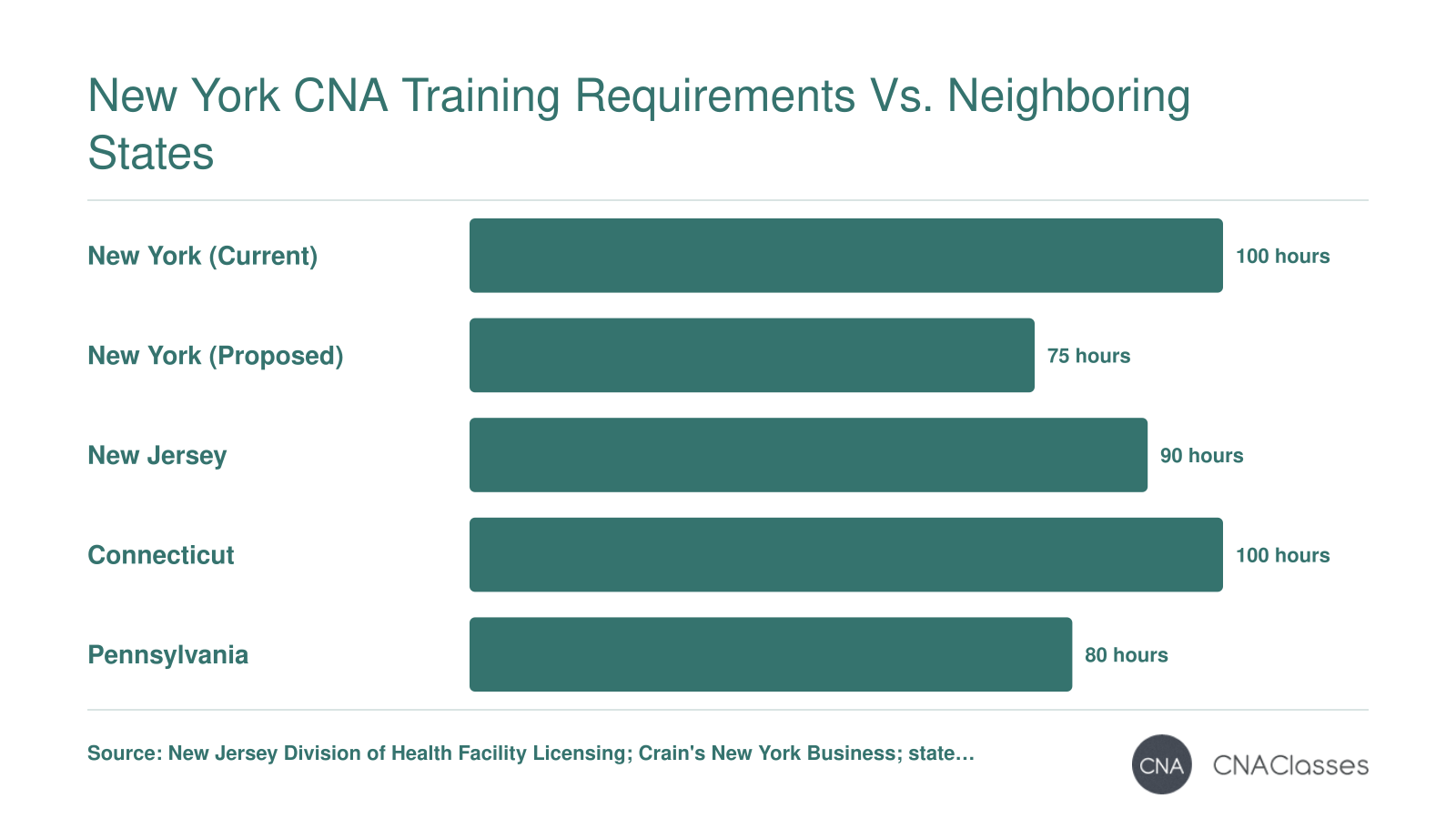
New York currently requires a minimum of 100 training hours, more than the federal minimum of 75. A new proposal aims to reduce this to 75 hours. Neighboring states have varying requirements; typical totals are shown below for comparison. Data for Connecticut and Pennsylvania represent commonly reported requirements as of 2026.
Did you know that the annual turnover rate for CNAs in nursing homes nationwide reached 42.34% in 2025? This staggering figure underscores the severe staffing shortages fueling debates like New York’s proposed cut to training hours, as facilities struggle to attract and retain enough nursing aides.
Some policy shifts happen quietly, with years of debate; others are hurried through in response to a crisis. New York’s 2022 emergency move to 75-hour training fell into the second category, while the 2026 proposal to make that change permanent now enters the more deliberate arena of formal rulemaking.
Any change to New York’s nurse aide training hours must follow the state’s rulemaking process. It starts with a published proposal, which triggers a public comment period, typically 30 to 60 days where stakeholders like training programs, nursing homes, and advocates submit feedback. After comments are reviewed, the state may revise the rule. A final version is then published, often with an effective date set 60 to 90 days out. For the 2026 proposal, announced in July, the earliest a final rule could take effect is late 2026, but early 2027 is more realistic if revisions are needed.
Federal law set a floor in 1987: the federal nurse aide training requirements required at least 75 hours of training, including 16 clinical hours, for nurse aides in nursing facilities. New York historically went beyond that, mandating 100 hours with 30 clinical hours per state regulations. In December 2022, citing severe workforce shortages, the state issued a temporary emergency waiver lowering the threshold to 75 hours. That waiver is still in place, and the new proposal aims to make the 75-hour standard permanent, but through a formal process rather than an emergency order.
If you’re enrolling in a CNA program today, you’ll train under the current temporary 75-hour rule. Even after a final rule is adopted, programs will need time to adjust curricula and secure state approval. So a permanent change likely won’t affect new students until mid-to-late 2027 at the earliest. In the meantime, schools may continue operating under the temporary waiver, and any future adjustments will likely include a phase-in period to avoid disrupting cohorts already in progress.
How can I find a CNA program in New York that will actually prepare me for certification and a job, especially with training hours possibly changing? With the 2026 proposal still unfolding, your best move is to focus on programs that go beyond bare-minimum requirements and have a track record of student success. Here’s what to look for.
Before you enroll, confirm that the program is currently approved by the New York State Department of Health (NYSDOH). Ask for their provider code and check the public registry. A program that is in good standing now is more likely to adapt smoothly if hours change. Avoid any school that seems unsure about its status or promises “automatic approval” under future rules.
The debate centers on cutting required hours, but a shorter program isn’t always better. Many 100-hour programs offer deeper clinical experience and more lab practice. Even if the minimum drops to 75 hours, a program that keeps the full 100 hours, or adds extra skills modules, will better prepare you for the state exam and the realities of patient care. Ask: “What are your total training hours, and how many are hands-on clinical?”
Programs affiliated with nursing homes, hospitals, or staffing agencies often have built-in job pipelines. Look for schools that advertise graduate placement rates, CNA training partnerships, or externship opportunities. These relationships can give you an edge in a competitive job market, regardless of how many hours you trained.
Regulations can shift quickly. Reach out to the NYSDOH’s Nurse Aide Registry or speak directly with program directors about how they’re preparing for the proposed changes. Ask whether they’ll adjust their curriculum mid-cohort or wait for final rules. Staying informed helps you avoid enrolling in a program that might lose approval or leave you underprepared.
No matter what training hours New York requires, you must still pass the Prometric state competency exam. A program that coasts on reduced hours might leave you struggling with the clinical skills test. Prioritize programs with high first-time pass rates and comprehensive exam-prep support.
With New York proposing to reduce CNA training hours, you probably have questions. Here are straightforward answers about what is changing, what it means for your certification, and how to navigate program options.