Key Points
- Peninsula College's 6-week CNA program includes evening and weekend clinicals.
- Olympic Medical Center and local facilities employ hundreds of CNAs.
- Financial aid and employer sponsorships often cover full CNA tuition.

Compare Port Angeles CNA programs, costs, and schedules to launch your healthcare career.
Demand for certified nursing assistants on the Olympic Peninsula is outpacing the local supply of trained workers, and Clallam County employers are actively recruiting. Washington State requires a minimum of 75 hours of state-approved training plus a competency exam before you can work as a CNA, so the certification step is non-negotiable regardless of prior caregiving experience.
Peninsula College is the primary in-town option, offering a structured 6-credit certificate that fits working adults through evening and weekend clinicals. Local care facilities including Crestwood and options through the regional skill center round out the in-person choices available without leaving Port Angeles.
Costs, start dates, and scheduling formats vary enough between programs to matter for your budget and timeline. Jump straight to the program list →
CNA training in Port Angeles is becoming more flexible to accommodate both high school students and career changers in 2026. The core provider remains Peninsula College, whose 6-credit, 6-week certificate program adapts to varied schedules with evening and weekend clinicals as well as a summer daytime track. Other training options exist on paper but lack confirmed activity this year. Students who complete a program enter a job market shaped by major local employers such as Olympic Medical Center and multiple long-term care facilities, though commuting to clinical sites can be a challenge for those without a car.
Peninsula College offers the only currently active, state-approved CNA training in Port Angeles, part of the state's CNA classes in Washington. The program is credit-bearing and sits under the college's workforce education umbrella. It covers 6 credits over 6 weeks, includes 40 hours of hands-on clinical experience, and is accredited by the Nursing Care Quality Assurance Commission, ensuring graduates meet Washington state certification standards.1 Two schedule formats are available: an evening class with weekend clinicals for those who work during the day, and a summer daytime option for students who can commit to a full-time schedule. This flexibility makes the program accessible to a range of student profiles, from recent high school graduates to adults changing careers.
State directories still list Crestwood Convalescent Center and Port Angeles High School as CNA program sites, but current 2026 schedules are not verified.2 The North Olympic Peninsula Skill Center, once a regional training option, is not active this year.2 For now, prospective students should consider these listings as inactive until further notice and focus on Peninsula College as the reliable pathway in Port Angeles.
Olympic Medical Center serves as the area's largest healthcare employer and frequently hires CNAs across acute care, rehabilitation, and outpatient settings. Long-term care facilities, including nursing homes and assisted living centers in and around Port Angeles, also maintain steady demand. Clinical rotations for the Peninsula College program take place primarily at these types of sites, giving students direct exposure to potential workplaces. Staff at clinical sites often notice strong students and can lead to job offers before graduation.
Clinical placements may require travel to facilities not located on the college campus or immediate city center. Students who rely on public transportation should review Clallam Transit routes early, as some sites have limited bus service. Carpooling with classmates is a common workaround. The Peninsula College campus itself is transit-accessible, but factoring in commute time to clinical sites is essential for those without a personal vehicle.
Fully online versus hybrid format: that is the central question for Port Angeles students exploring CNA training flexibility. While Washington State nursing assistant certification requires hands-on clinical hours that cannot be completed remotely, many programs now offer classroom theory components online, pairing them with local clinical placements for the required supervised practice.
The Washington State Department of Health maintains a registry of approved CNA training programs. Prospective students should begin by checking the department's website for schools that list online or hybrid options. The registry includes contact details for each approved program, allowing you to verify which portions of coursework can be completed online and where clinical rotations take place.
Community colleges across Washington, including Peninsula College and Olympic College (which offers CNA classes in Bremerton), along with schools providing CNA classes in Seattle, periodically update their program formats. Visit each college's website directly and search for terms like "CNA hybrid" or "online CNA" to find current offerings. Because not all schools advertise hybrid formats prominently, a thorough search of program details is worthwhile.
The Bureau of Labor Statistics (BLS.gov) provides general information about CNA training pathways nationwide. While the BLS does not maintain a state-specific program directory, it offers context for understanding the mix of classroom and clinical requirements. The National Association of Health Care Assistants (NAHCA) may also list hybrid programs, though you will need to cross-reference those listings with Washington's state approval registry to confirm eligibility for state certification.
Many schools offer scheduling flexibility that does not appear in online catalogs. Contact CNA program coordinators by email or phone to ask specific questions: Which courses can be completed online? Are evening or weekend clinical placements available in Port Angeles or nearby? Are there gaps between classroom and clinical phases that allow for work or family commitments? Direct communication often reveals options not fully detailed on program websites, and coordinators can clarify whether your geographic location supports the hybrid model each school offers.
What CNA programs can you reach within a reasonable drive of Port Angeles, and is the commute worth it?
If your preferred schedule or start date does not line up with a local program, expanding your search to nearby communities can open up additional options. Below is a directory-style overview of CNA training opportunities in and around Clallam County, organized by distance from Port Angeles.
Despite being only about 17 miles east of Port Angeles, Sequim does not currently have its own standalone CNA program.1 Residents of Sequim typically enroll in Port Angeles or Port Townsend programs.
Before committing to a commute, confirm a few details with each school or facility:
Driving distances listed above are approximate and based on typical routes along U.S. Route 101 and State Route 20. Winter weather on the Olympic Peninsula can add time, so factor seasonal road conditions into your planning. For help narrowing down the right program and start date, cnaclasses.org offers a free school-matching tool that connects you with CNA programs near me accepting students now.
Evening classes with weekend clinicals versus compressed summer weekday intensives: the two main paths Peninsula College offers illustrate how a single institution can serve both working adults and full-time students in Port Angeles. Understanding these differences in scheduling, cost, and time commitment helps you choose the format that fits your life.
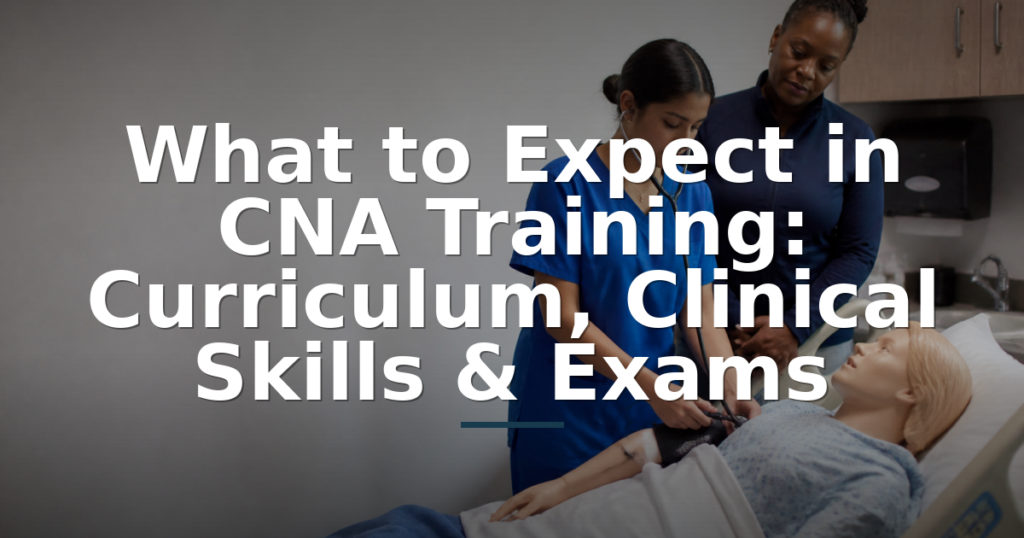
Peninsula College operates the state-approved CNA program in Port Angeles, holding Conditional Approval status from Washington's Department of Health.1 The program spans six to eight weeks and awards six college credits upon completion.2 Students complete 40 clinical hours3 in addition to classroom instruction, gaining hands-on experience in local healthcare settings.
The college runs two distinct schedule formats. The evening option meets on weeknights with clinical rotations scheduled for weekends, allowing students with daytime jobs to train without sacrificing income. The summer session shifts to weekday daytime hours, appealing to recent high school graduates or those who can dedicate consecutive weeks to full-time study. Both formats cover the same curriculum and clinical requirements but compress or spread the hours differently.
Tuition and fees at Peninsula College reflect the six-credit structure. Community college pricing typically keeps total program costs between $800 and $1,400, including textbooks, uniforms, background checks, and state exam fees. The college requires all applicants to pass a criminal background check before admission, a standard safeguard in healthcare training.3
Because Peninsula College is the primary state-approved provider in Clallam County, comparing costs means looking at regional alternatives in Sequim, Port Townsend, or even Kitsap County. Those programs, along with other Washington alternatives like CNA classes in Tacoma and CNA classes in Spokane, often carry similar tuition but add commuting time and fuel expenses that can exceed the initial savings.
The six-to-eight-week duration demands consistent attendance. Evening programs typically run three to four nights per week plus one full weekend day, totaling 15 to 20 hours weekly. Summer daytime sessions condense the schedule into four or five full days per week, finishing faster but requiring open mornings and afternoons.
Clinical placements occur at Olympic Medical Center and skilled nursing facilities in Port Angeles. Weekend clinicals suit students with Monday-through-Friday jobs, while weekday clinicals in the summer session let students complete training during school breaks. Neither format offers purely self-paced or asynchronous learning; both require in-person attendance for lectures, labs, and patient care.
Contact Peninsula College's admissions office to confirm the next start date for your preferred schedule format. Ask about current tuition, whether financial aid applies to non-degree workforce programs, and whether the college offers payment plans. Verify clinical site assignments and whether transportation to those sites is provided or expected. Understanding these details before you register prevents surprises and helps you budget both time and money accurately.
Certified Nursing Assistants in Port Angeles earn competitive wages in a healthcare market shaped by coastal geography and a growing senior population. Understanding local pay scales and employer demand helps you set realistic expectations as you plan your training.
CNA hourly wages in Port Angeles typically range from $18 to $21.50 for entry-level positions1, with experienced assistants earning $23.39 to $34.22 per hour2 depending on employer, shift, and specialty setting. Olympic Medical Center, the region's largest hospital, advertises CNA positions starting around $20 per hour3. Home health agencies in Clallam County report starting rates in the $18 to $19 range4, while memory care facilities and skilled nursing centers often pay slightly higher to attract candidates willing to work evening or weekend shifts.
Washington State CNA wages average higher in metropolitan areas like Seattle and Tacoma, but Port Angeles offers a lower cost of living that helps offset the pay differential. Housing, transportation, and daily expenses in Clallam County run well below Puget Sound levels, making a $20 hourly wage stretch further than the same rate would in urban King County.
Olympic Medical Center anchors CNA employment in Port Angeles, hiring nursing assistants for medical-surgical floors, emergency departments, and outpatient clinics. The hospital maintains a career pathways program that supports CNAs pursuing LPN or RN advancement3.
Long-term care facilities represent another significant hiring pool. Highland Court Memory Care regularly posts openings for CNAs trained in dementia and Alzheimer's care. Skilled nursing centers throughout Clallam County advertise both full-time and part-time CNA roles, often offering sign-on bonuses during seasonal hiring peaks.
Home health agencies have expanded rapidly in response to Medicare policy shifts favoring in-home services. Rainshadow Home Services5 and Olympic Peninsula Home Care6 both recruit CNAs willing to travel to client homes across the county, offering flexible schedules that appeal to students and parents.
Job posting volume remains steady year-round, with modest spikes in spring and late summer when facilities prepare for flu season and holiday staffing needs.
Clallam County's population skews older than the Washington State average, driving sustained demand for nursing assistants in hospitals, assisted living, and home care. The 65-plus cohort continues to grow as retirees relocate to the Olympic Peninsula, and long-term care operators are expanding capacity to meet projected needs through 2030.
National and state workforce projections forecast nursing assistant employment growing faster than the economy-wide average, indicating a favorable cna job outlook, and Port Angeles reflects this trend. CNAs who complete training in 2026 enter a market where employers compete for qualified candidates, offering tuition reimbursement, flexible schedules, and clear pathways to advanced nursing roles.
The process of how to become a CNA in Washington is straightforward, but each step builds on the last, so knowing the sequence before you enroll saves time and prevents surprises.
Washington requires prospective CNAs to complete a state-approved training program covering at least 85 clock hours. That total is split between classroom instruction and hands-on clinical practice. The good news for local students: the programs available to Port Angeles residents covered earlier in this guide all meet this state requirement, so you do not need to worry about vetting that detail on your own.
Programs typically run anywhere from four weeks to a few months depending on whether you enroll full-time or part-time. Choose a schedule that gives you enough time to absorb the clinical skills without burning out.
After completing your program, you sit for the National Nurse Aide Assessment Program (NNAAP) exam, which has two parts: a written portion and a hands-on skills demonstration. Both portions must be passed to move forward.
A few tips that genuinely help:
Once you pass both exam portions, you apply for registration through the Washington Nursing Care Quality Assurance Commission. The application requires proof of your completed training, your exam results, and a background check. Processing times vary, but most applicants receive their registration within a few weeks.
After registration, your name appears on the Washington State Nurse Aide Registry, which employers check before hiring. Keep your registration current by meeting renewal requirements every two years, which include documented work hours in a nursing role.
Out-of-pocket tuition versus fully funded training: the gap between those two realities is often what decides whether someone starts CNA classes this month or keeps postponing. The good news for Port Angeles residents is that several programs exist specifically to close that gap.
WorkSource Clallam County is the most practical first stop for many students. The office administers several funding streams, including WIOA training vouchers, Worker Retraining, the Opportunity Grant, WorkFirst, and BFET.2 WIOA funding is available to adults who are unemployed, underemployed, or dislocated workers, provided they are at least 18, authorized to work, and have household income at or below 200 percent of the federal poverty level.1 If you do not meet WIOA income limits, Worker Retraining or the Opportunity Grant may still apply depending on your situation. WorkSource can also connect you with a payment plan if you need to manage any remaining costs over time.2
At the federal level, completing the FAFSA can unlock a Pell Grant of up to $7,395 for the 2026 award year.1 Peninsula College accepts both FAFSA and WASFA (the state alternative for students who do not qualify for federal aid), and the college's NAC program is eligible for scholarships and Worker Retraining funds as well.
Olympic Medical Center offers one of the most compelling options in the region. Eligible employees, including trained observers, patient care aides, dietary staff, and environmental services workers, can receive 100 percent reimbursement covering tuition, fees, and textbooks. If you can secure a position at Olympic Medical Center before or during training, your out-of-pocket cost could effectively be zero.
Beyond that specific employer, Washington State law requires any Medicaid-contracted facility to reimburse CNA training and testing costs for employees who remain with the facility for at least one year.3 That means many local nursing homes and assisted living communities are obligated, not just willing, to cover your costs.
The Washington Center for Nursing maintains a scholarship database that includes awards for students entering nursing assistant and nursing career pathways. Eligibility criteria vary by award, but many target first-generation college students, students demonstrating financial need, or those committing to work in rural or underserved areas, both of which apply to Clallam County.1
The most actionable step you can take right now is to visit WorkSource Clallam County in person or call ahead to schedule an intake appointment. Bring documentation of your income, employment status, and residency. Staff there can map your specific situation to the programs you qualify for and help you apply before the next Peninsula College enrollment window opens.
Below are the top CNA programs serving Port Angeles students, ranked by IPEDS completion data, accreditation status, and program fit. The list includes Washington state approved programs available through online, hybrid, or in-state options for Port Angeles learners. While none of these programs is located in Port Angeles itself, they offer flexible entry points and clinical training that may work for Clallam County residents.
Renton, WA · $5,000 – $10,000/yr
Best for: Career changers wanting quick certification
This five-week certificate gets students job-ready quickly, with start dates in fall, winter, spring, and summer. The curriculum covers patient care foundations, safety, and communication, and meets Washington State and federal certification requirements. Admission requires a background check, BLS certification, TB test, and COVID and flu vaccinations.
Tacoma, WA · ~$6,000/yr (est.)
Best for: Daytime learners needing structured clinical experience
A five-week, 10-credit certificate blends classroom lessons, skills labs, and supervised clinical shifts so students practice real patient care before finishing. The program is Washington Department of Health approved and prepares graduates for the state written and manual skills exam. Financial aid and scholarships are available, and clinical rotations are split into two cohorts.
Moses Lake, WA · $5,000 – $6,000/yr
Best for: Rural students seeking small cohort training
This one-quarter campus-based certificate prepares students for the National Nurse Aide Assessment Examination and Washington State NAC licensure. The program is approved by the Washington State Nursing Care Quality Assurance Commission and includes classroom, lab, and clinical experience. Admission is competitive with a points-based selection system that admits the top 24 applicants in fall quarter.
Bellingham, WA · ~$6,000/yr (est.)
This 12-credit Nursing Assistant Certificate includes classroom instruction, CPR certification, and clinical practicum experience in hospitals and extended care settings. The program is ACEN accredited and approved by the Washington Department of Health, with an estimated tuition and fees of $1,700 plus tools and clothing. Multiple quarterly start dates are available.
Bellevue, WA · $11,000/yr (net price)
Bellevue College offers a 176-hour Nursing Assistant Certified Certificate of Completion with theory, lab, and clinical rotations in nursing homes and hospitals. The program is Washington State approved and prepares students for the NNAAP exam. Day or evening clinical shifts and I-BEST support provide flexibility for working learners.
Mount Vernon, WA · $5,000 – $10,000/yr
A 10-credit, one-quarter certificate prepares students for the Washington State exam with hands-on clinical sites in local counties. The program offers fall, winter, and spring entry terms and first-come, first-served admission. Clinical requirements include background check, immunizations, TB test, BLS certification, and flu vaccine.
Auburn, WA · $14,000/yr
This 15-credit Nursing Assistant Certificate combines classroom learning, labs, and clinical experience with a focus on safety, infection control, and patient communication. The program requires students to be 18 or older and complete background checks and immunizations. Workforce Education funding may be available, and the approximate cost is $2,450.
Shoreline, WA · $5,000 – $8,000/yr
Shoreline's hybrid CNA certificate combines online coursework with campus skills labs, offering 16-18 credits across fall, winter, spring, and summer quarters. Washington residents pay about $126 per credit plus $690 in program fees, and federal aid and scholarships can help cover costs. Students may choose Non-I-BEST or I-BEST options for additional support.
Kirkland, WA · $6,000 – $12,000/yr
This one-quarter certificate includes classroom instruction, laboratory work, and supervised clinical practicum at local healthcare facilities. Graduates are eligible to take the National Nurse Aide Assessment Program examination and pursue Washington certification. Admission is available in all four quarters, and I-BEST support can help students meet prerequisites.
Lakewood, WA · $10,000/yr (net price)
This one-quarter certificate includes the state certification exam in tuition and combines classroom, laboratory, and clinical experiences. The program focuses on patient safety, communication, infection control, and clinical techniques, with no prior experience required. Financial aid and information sessions support career changers and first-time students.
Below are answers to the most common questions about CNA classes in Port Angeles. Whether you're considering training options, scheduling, or career advancement, find the details you need to take the next step.
At Peninsula College, the evening CNA training takes 6-8 weeks, while the summer intensive runs 3 weeks during the day. Both exceed Washington's 85-hour minimum2 with 111 total training hours, including 40 hours of clinical experience1.
Yes, if you enroll in the evening program at Peninsula College, which meets a few evenings per week over 6 weeks. This schedule allows for daytime employment. The intensive daytime option is full-time and better suited for those not working.
Peninsula College offers an evening CNA class that runs for 6 weeks, typically meeting on weeknights. Weekend-only classes are not currently available, but the evening track provides flexibility for those with daytime commitments.
Absolutely. The Peninsula College program includes 40 hours of supervised clinical training at a local healthcare facility1, integrated into the 111-hour curriculum. This practical experience is required for certification and builds essential patient care skills.
After completing the state-approved program, you become eligible to register for the Washington State CNA/NAC Competency Exam. Peninsula College staff will guide you through the process1, which involves submitting proof of training and paying a fee to the exam vendor.
Yes. Peninsula College accepts federal and state financial aid, plus workforce development funding for eligible students1. Contact the college's financial aid office to explore grants, loans, and scholarship opportunities specifically for the CNA certificate program.
Yes. Earning your CNA certification is a stepping stone to advanced nursing roles, and leveraging CNA career information can clarify the pathways. Many graduates gain experience and then pursue LPN or ADN/RN programs at Peninsula College or other institutions1, building on their foundational skills for career growth.
While the program prepares you for immediate employment as a CNA, formal job placement services may vary. Peninsula College's career services can connect you with local healthcare employers and resources to support your job search after certification.