Key Points
- Carroll Community College’s net CNA price is just $2,725 after aid.
- Dwyer Workforce Development’s free CNA program boasts 93% job placement.
- Employer-sponsored and grant-funded programs can fully cover CNA tuition.
Compare state-approved CNA training options across Maryland—from Salisbury to Gaithersburg—using real data on cost, quality, and graduate success.
Twelve community colleges across Maryland currently offer Board of Nursing-approved CNA programs, with tuition as low as $1,700 and completion timelines as short as five weeks. That range gives you real options, but it also makes comparison harder. Programs differ in clinical hours, scheduling flexibility, and whether they bundle Geriatric Nursing Assistant preparation into the same certificate.
The real challenge is matching a program to your circumstances. A $2,178 option in Westminster and a $1,909 option in Baltimore serve very different commuters, and evening availability varies by campus. Maryland's aging population continues to push CNA hiring across hospitals, skilled nursing facilities, and home health agencies, so the credential carries weight statewide, from Cumberland to Salisbury.
Maryland's community colleges offer some of the most affordable and accessible CNA training in the nation, with program costs ranging from $1,609 to $2,856. Our ranking evaluates schools based on affordability, program structure, and student outcomes to help you find the right fit. Whether you need evening classes, accelerated timelines, or a pathway to advanced nursing roles, there's a program here for you.
Westminster, MD · $3,000/yr
Best for: Career changers wanting a thorough clinical foundation
Carroll Community College's CNA/GNA program stands out for its 132-hour curriculum, exceeding Maryland's minimum requirements. Students gain hands-on experience through classroom and clinical training, preparing for both state certifications. With a total cost of $2,178, it's an affordable launchpad into healthcare, supported by spring, summer, and fall start dates.
Hagerstown, MD · $5,000 – $10,000/yr
Best for: Cost-cautious students needing scholarship support
Hagerstown Community College provides a comprehensive CNA/GNA program with a focus on scholarship availability to help cover costs. Training includes medical terminology, infection control, and personal care skills, along with clinical experience in hospitals or long-term care. It's a solid choice for learners who need financial assistance to enter the healthcare workforce.
North East, MD · $10,000/yr
Best for: Evening learners needing multi-state clinical exposure
Cecil College offers a 150-hour evening/weekend CNA program ideal for working adults. Its unique NC-SARA approval allows supervised clinical experiences in Maryland, Delaware, and Pennsylvania, making it perfect for border commuters. Graduates gain eligibility for both Maryland certification and Delaware reciprocity.
La Plata, MD · $5,000 – $10,000/yr
The College of Southern Maryland's CNA program is designed as a workforce training pipeline, directly aligned with local employer needs. With a total cost of $2,389, it includes two required courses and mandatory orientation. Students must be 18 or older and complete a Work Keys Assessment, ensuring readiness for the rigors of patient care.
Columbia, MD · ~$11,000/yr (est.)
Howard Community College's hybrid CNA program combines online theory with in-person labs and 40 hours of clinical training, totaling 145 hours. At $1,700, it's a cost-effective pathway that grants 14.5 CEUs and a digital badge, making it attractive for students who want flexibility and a recognized credential in just five weeks.
Largo, MD · $5,000 – $10,000/yr
Prince George's Community College provides a multi-campus CNA program with day and evening cohorts across Largo, University Town Center, and Laurel. With a combined theory and clinical cost of $1,600, it's an accessible option for commuters. The program uses standardized materials like Hartman's Nursing Assistant Care and CastleBranch background checks to ensure quality.
Cumberland, MD · $9,000/yr
Allegany College of Maryland offers a credit-bearing, one-semester Nursing Assistant/Geriatric Aide certificate that transfers smoothly into LPN/RN pathways. As part of the Health Manpower Shortage Program, it targets rural healthcare needs with daytime and evening options. Financial aid is available, and the 16-credit curriculum includes 45 hours of clinical experience.
Arnold, MD · $4,000 – $12,000/yr
Anne Arundel Community College's noncredit CNA/GNA program requires no college application, just registration. At $2,856 for county residents, it includes 136 hours of training and uses college-level texts. While a high school diploma isn't required for enrollment, it may be needed for employment, opening doors for adult learners. The program also links to an Advanced Patient Care Technician pathway.
Baltimore, MD · $4,000 – $11,000/yr
Community College of Baltimore County offers multiple CNA/GNA tracks across three campuses, making it highly accessible for Baltimore-area students. The 143-hour program, priced around $2,194, includes theory, lab, and clinical components with a 75% grade requirement. It emphasizes physical readiness for job demands in hospitals, long-term care, and home health settings.
Rockville, MD · ~$8,000/yr (est.)
Montgomery College's CNA/GNA program is embedded in a needs-based scholarship framework, helping lower-income students in the DC suburbs access training. The campus-based program includes classroom, lab, and clinical experience under RN supervision. A structured application process with information sessions and assessments ensures students are well-prepared for state exams and employment.
Bel Air, MD · $9,000/yr (net price)
Harford Community College's CNA program costs approximately $1,953 and includes 66 to 75 clinical hours, depending on the track. The 3-month program integrates CPR certification and NNAAP exam fees, providing a complete certification package. It's approved by the Maryland Board of Nursing and serves as a stepping stone to nursing careers.
Frederick, MD · $4,000 – $10,000/yr
Frederick Community College's CNA program is a campus-based continuing education option that combines classroom and clinical training. It offers scholarships, payment plans, and free tuition for qualifying FCPS students through dual enrollment. While detailed cost and hour data are limited, its strong graduate earnings potential makes it a competitive choice in the region.
Cost and quality pull in opposite directions more often than most ranking systems admit. A program priced low enough to be accessible might offer fewer clinical hours. A program with strong graduate outcomes might be offered only during hours that rule out anyone with a day job. Building this list meant sitting with that tension and making judgment calls transparent enough for you to override them.
Every school on this list was evaluated across four main areas: net price (what students actually pay after aid, not the sticker price), graduation or completion rates, earnings potential for graduates, and program format. Format matters because a program only offered Monday through Friday at 9 a.m. effectively excludes caregivers, second-job holders, and anyone without reliable transportation during peak hours.
Where available, we drew on federal datasets including IPEDS and the College Scorecard to anchor the numbers. These sources give us a consistent, government-collected baseline so the comparisons are apples-to-apples rather than each school's self-reported marketing figures.
Federal data covers colleges and career schools that participate in Title IV aid programs, but not every CNA training site does. Community hospital programs, Red Cross chapters, and some private training centers operate outside that reporting structure. For those programs, we researched cost, duration, and format directly, pulling from program pages and state registry records as of mid-2026.
In cases where program-level earnings data had not yet been published or was not available for a specific site, we noted that plainly rather than substituting a number that might not reflect the actual program.
Neither cost nor outcomes was treated as a dealbreaker on its own. A free program with a poor completion record does not serve you well. A program with excellent graduate employment rates that costs three times more than alternatives requires a financial rationale. The final ranking reflects CNA programs where affordability and outcomes reinforce each other, with format and scheduling flexibility used as tiebreakers.
If your situation differs from the typical student profile, the comparison table later in this article lets you sort by whichever factor matters most to you.
Getting started as a CNA in Maryland comes with many questions. Here are straightforward answers to the most common ones, so you can make informed decisions about your training and career path.
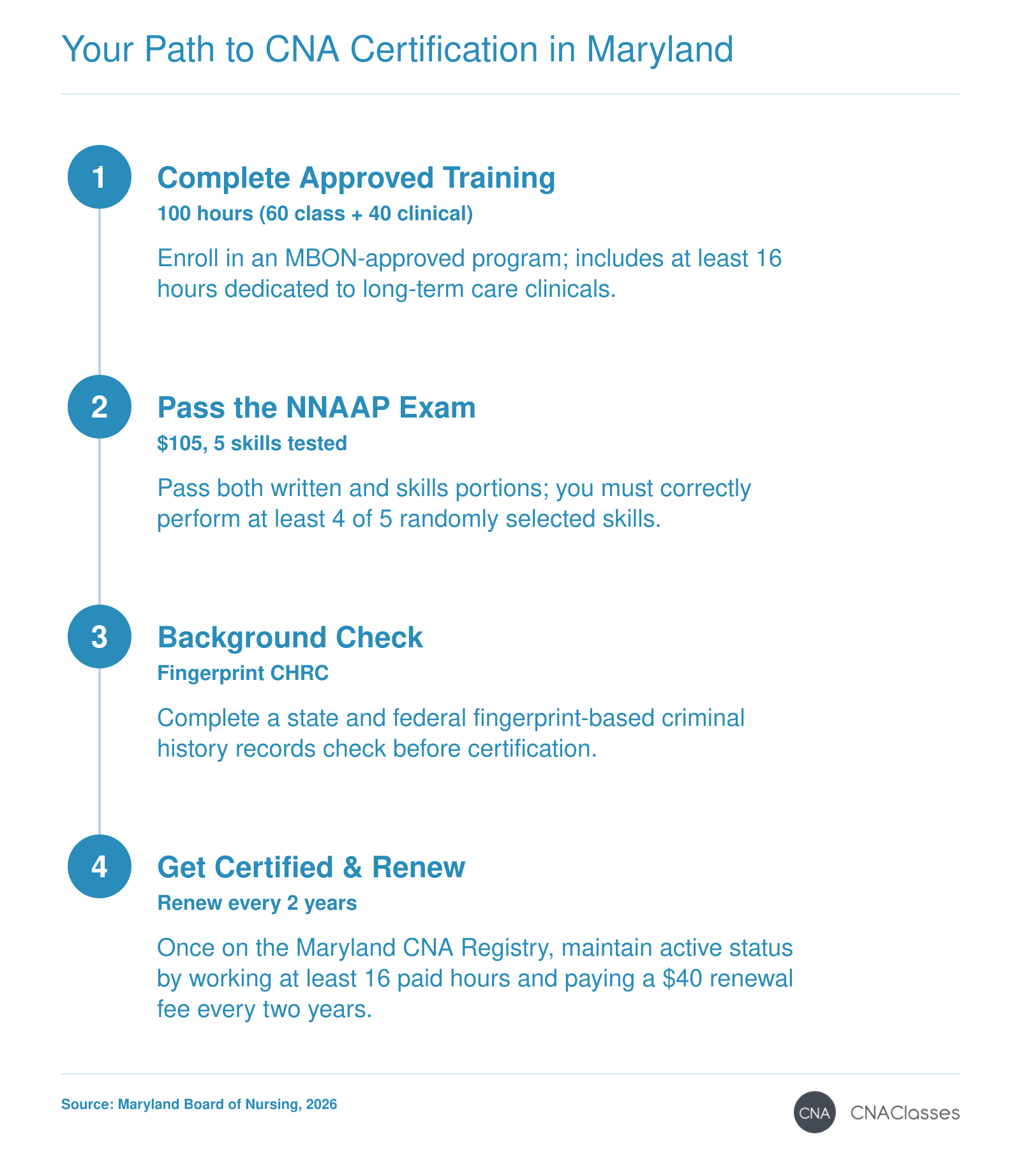
Becoming a Certified Nursing Assistant in Maryland follows a clear, state-defined process. Here is your step-by-step guide.
How much does it actually cost to become a CNA in Maryland, and can you get trained for free? The short answer: most programs run between $900 and $3,750, but several employer-sponsored and grant-funded pathways bring the cost down to zero.
Maryland CNA tuition falls into a predictable range for 2025-2026. Private training centers tend to sit at the lower end, while community colleges cluster in the middle, and hospital-affiliated programs sometimes push higher.
Most of these costs cover tuition only. Expect to budget another $200-$400 for scrubs, textbooks, background checks, health screenings, and the state certification exam.
Several programs in Maryland cost nothing out of pocket if you qualify:
Community colleges like Montgomery College and Carroll Community College offer needs-based scholarships and tuition assistance for their CNA/GNA tracks. Ask the continuing education office about payment plans, workforce development vouchers, and Pell-adjacent funding for noncredit healthcare programs.
Even at the top of the tuition range, the math works in your favor. Paying $2,000-$3,000 for a program that takes two to three months, then stepping into a full-time healthcare role, is one of the fastest tuition-to-paycheck turnarounds in the state. That's why CNA training remains a practical entry point, whether you plan to stay bedside or use it as a stepping stone toward LPN or RN work.
Dwyer Workforce Development in Maryland offers free CNA training and reported a 93% job placement rate in 2024, according to Help Baltimore's Homeless. That means nearly all graduates moved directly into paid healthcare positions, proving that a tight budget does not have to stand between you and a rewarding career.
Here's a side-by-side look at four of Maryland's highest-rated CNA programs. Costs range from under $2,000 to over $2,200, and durations span from about one month to three months, so you can find a program that fits your budget and schedule.
| Howard Community College | Community College of Baltimore County | Carroll Community College | Harford Community College |
|---|---|---|---|
| $1,700 - $1,720 | $1,909 - $2,274 | $2,178 | $1,953 |
| 1.15 months | 1-3 months | 2-3 months | 1.38 months |
| Hybrid | Campus | Campus | Campus |
| Maryland Board of Nursing | Maryland Board of Nursing | Maryland Board of Nursing | Maryland Board of Nursing |
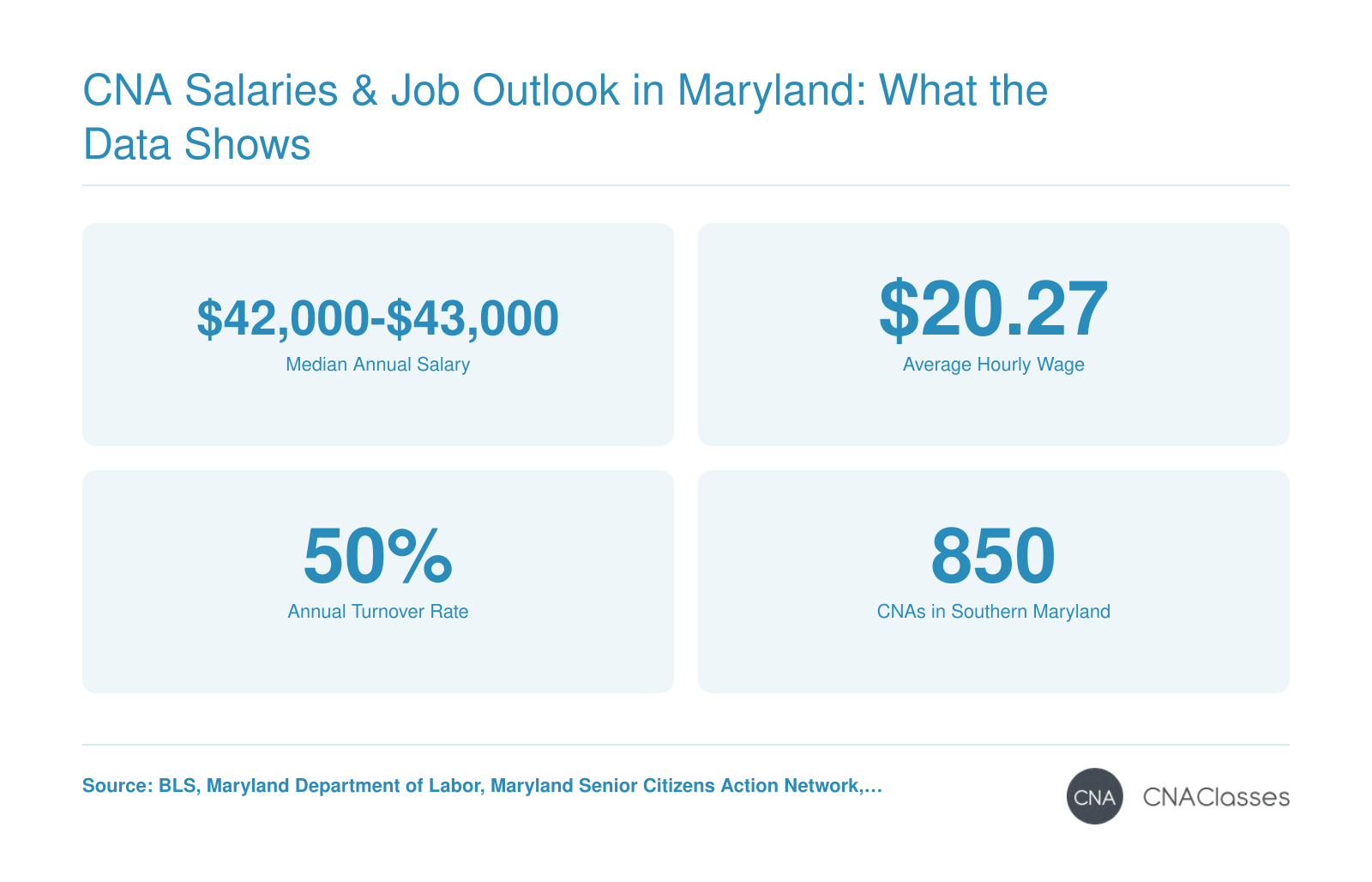
Finding CNA classes near your community can make training far more manageable, since commuting time and local clinical placements both matter. Whether you're on the Eastern Shore, in Montgomery County, or in central Maryland, there are accredited programs that fit different budgets and schedules.
Salisbury offers several paths to certification. Wor-Wic Community College, located at 32000 Campus Drive, runs a Nursing Assistant / Geriatric Nursing Assistant program that is completely free for eligible residents through the state's EARN Ready to Care initiative.1 This program covers all instructional costs, making it the most budget-friendly route in the area. Private academy Cambridge Nursing Assistant Academy charges approximately $975 for its CNA program3, and other providers such as Shore Up! Inc. and Deer's Head Hospital Center also offer training at affordable rates.
In Gaithersburg, Morning Star Academy delivers CNA training at 101 Lakeforest Boulevard, Suite 402. The program's total cost is $1,1003, and it provides the theory and clinical hours needed to sit for the Maryland certification exam. While it's the primary in-city option, nearby Rockville is home to Montgomery College, which runs a combined CNA/GNA program on a campus-based schedule with needs-based scholarships available.
The Baltimore area has several established providers. The American Red Cross offers a CNA class at 4700 Mt. Hope Drive, with total costs typically between $1,400 and $1,800. The Community College of Baltimore County (Essex campus at 7201 Rossville Blvd) runs a 1, 3 month program costing around $1,909. In Frederick, Frederick Community College at 7932 Opossumtown Pike provides a comprehensive CNA training that includes clinical skills, health screening requirements, and certification preparation.
When comparing nearby CNA classes, focus on a few practical details:
By picking a program near your home or work, you reduce travel expenses and can more easily juggle training with your other responsibilities. Whether you enroll at a community college, a Red Cross site, or a private academy, the proximity factor helps you stay consistent and graduate job-ready.