Key Points
- North Dakota's CNA median wage is $44,190, topping national pay.
- Low-cost community college CNA training starts below $700.
- The state employs 6,920 nursing assistants across rural and urban areas.
Top CNA programs in North Dakota: compare costs, schedules, and certification requirements.
Employer-sponsored training or a community college course: that is the first fork prospective nursing assistants in North Dakota face, and it shapes everything from out-of-pocket cost to how quickly you can start working. Programs at schools like Bismarck State College and North Dakota State College of Science run 75 to 80 hours and charge between roughly $650 and $1,200, while many long-term care facilities across the state will train you for free in exchange for a work commitment.
With a median CNA wage of $44,190 in North Dakota and steady demand driven by an aging rural population, the return on even a modest training investment is hard to beat. The real question is which program format, location, and price point fits your situation.
Our 2026 rankings evaluate North Dakota CNA programs based on return on investment, factoring in graduate earnings, debt, and program cost. We also considered flexibility, career support, and unique pathways to help you choose the right fit. Here are the top programs for launching your healthcare career.
Devils Lake, ND · $14,000/yr
Best for: Career changers seeking funded RN progression
Lake Region State College stands out as the lead institution in North Dakota's Registered Nursing Apprenticeship pathway, allowing CNA students to progress to RN at no cost through employer sponsorship. Its TrainND Northeast program offers flexible hybrid and classroom options, and training can be customized for healthcare facility staff. Graduates earn a median $49,502 with manageable debt of $10,293, making it a strong choice for career advancement.
Bismarck, ND · $10,000 – $15,000/yr
Best for: Cost-conscious students in central North Dakota
Bismarck State College offers the lowest-published-cost CNA program among North Dakota community colleges at just $689, with hybrid online options available. The 76-hour program includes clinical practice and monthly start dates for quick entry. Graduates see median earnings of $54,277 and median debt of $11,533, reflecting excellent value.
Wahpeton, ND · $6,000 – $7,000/yr
Best for: Flexible learners valuing hybrid and self-paced study
North Dakota State College of Science offers a flexible CNA program through its Workforce Affairs division, with hybrid and self-paced formats to accommodate busy schedules. The 75-hour state-approved curriculum includes 16 hours of hands-on skills training and prepares students for the state certification exam. With course fees between $650 and $750 plus a $250 exam fee, it provides a solid return, as graduates earn a median $50,513 and carry only $12,000 in median debt.
Williston, ND · $5,000 – $10,000/yr
Williston State College's CNA training blends self-paced online instruction with a two-week hands-on lab and clinical period at TrainND Northwest. The total cost is $1,200 plus $200 for testing, and the program serves the Williston area's healthcare needs well. Graduates earn a median $44,017 with $10,099 in median debt.
Valley City, ND · $12,000/yr (net price)
Valley City State University offers a 2-credit Nursing Assistant Training course with clinical practice as part of its broader health sciences offerings. While earnings data is strong at $52,725, median debt is higher at $20,369, which may influence the cost-benefit analysis for some students.
New Town, ND · ~$10,000/yr (est.)
Nueta Hidatsa Sahnish College's CNA program, delivered through the NACTEP framework, provides extensive support for Native American students, including tuition at $900 per semester, stipends, and childcare and mileage assistance. Graduates benefit from strong wraparound services, though program-level earnings data is not available for this institution.
Nursing assistants in North Dakota earn a median wage of $44,190 per year, well above the national median for this role.
Many North Dakota CNA programs offer flexible scheduling options for students balancing work, family, or other commitments. The key is knowing where to look and what to ask. Start with official resources and then reach out directly to training providers to find a schedule that works for you: day, evening, weekend, part-time, or hybrid.
The North Dakota Board of Nursing maintains a current list of approved CNA programs on its website. That list is your first stop; it confirms which programs meet state standards. While the list may not spell out every schedule type, it provides the contact points you need.
Use the approved list to identify community colleges and technical schools near you. Then, call their admissions offices or program coordinators. Specifically ask about: - Evening and weekend cohorts: Many schools run sessions outside typical work hours. - Part-time tracks: Some programs break the curriculum into smaller chunks spread over a longer term. - Online or hybrid formats: Didactic (classroom) portions may be offered remotely, but all North Dakota programs require a hands-on clinical component; nobody can complete CNA training entirely online.
Federal guidelines require formal training plus supervised clinical practice, as noted by the Bureau of Labor Statistics (BLS.gov). Calling schools directly is the best way to confirm how they package that for non-traditional learners.
The North Dakota Health Care Association (NDHCA) often provides training directories and can connect you with long-term care facilities that sponsor or host flexible CNA programs. Because many employers need CNAs, they may offer in-house training with schedules built around shift work. Checking the NDHCA site can reveal options you would not find through a simple web search.
If you find a program advertising hybrid online CNA classes, email the coordinator to ask two questions: (1) How are clinical hours arranged locally? (2) What are the application requirements for part-time or hybrid enrollment? A legitimate online component will still require an in-person clinical rotation at a partnering facility, often arranged near your community. Reputable programs will spell this out clearly and help you plan accordingly.
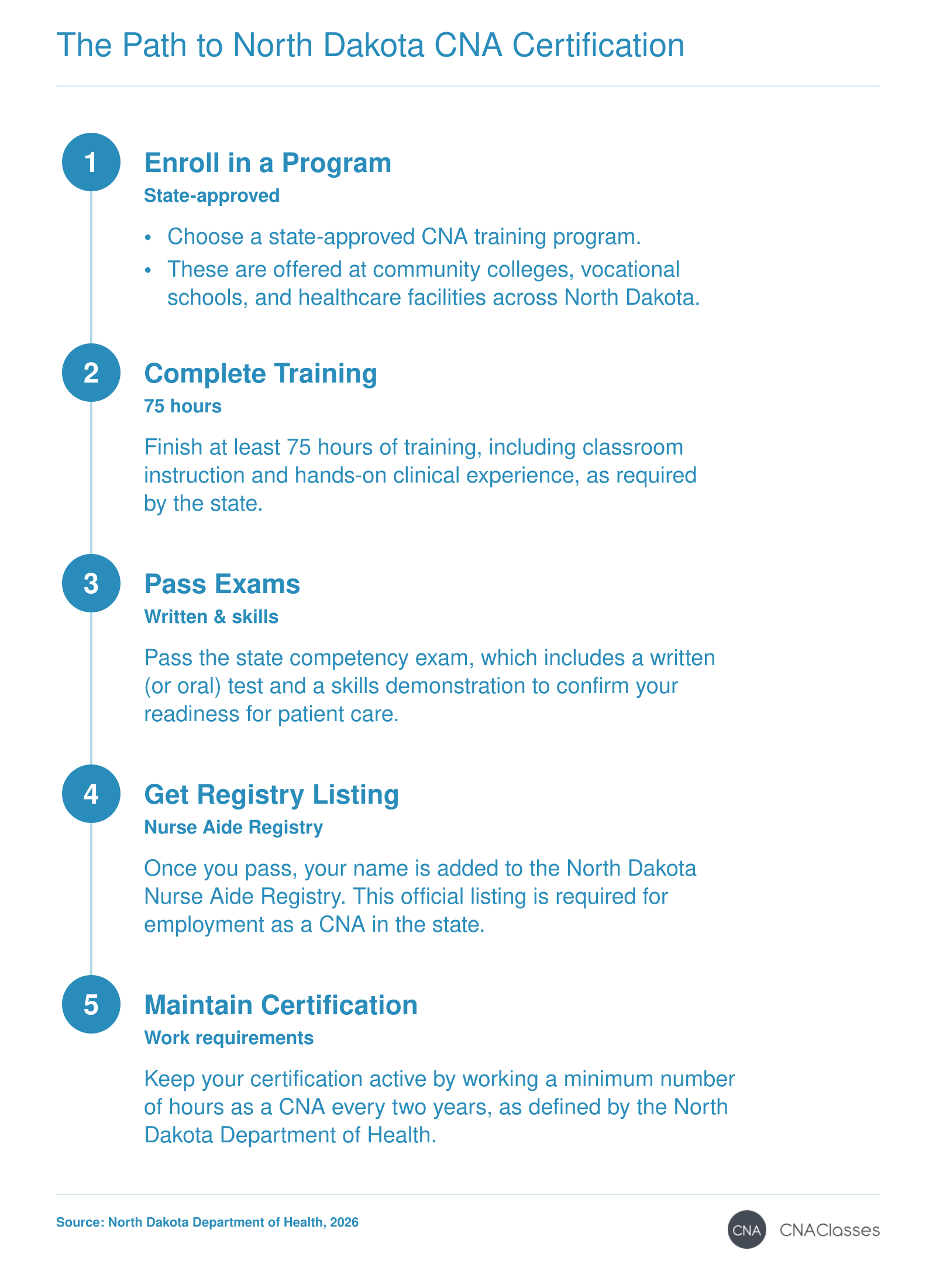
Once you complete a state-approved CNA training program in North Dakota, the next step is passing the certification exam and getting listed on the state Nurse Aide Registry. The process is straightforward, but it helps to know what to expect before you start.
Before you can schedule your exam, you must finish a program that meets North Dakota's minimum training standards: 75 total hours, including at least 16 hours of hands-on clinical experience in a patient care setting. This aligns with federal regulations and ensures you have both the knowledge and practical skills to test confidently.
The certification exam is administered by Headmaster (D&S Diversified Technologies). It has two parts: - Knowledge test: A 72-question written or oral exam covering essential nursing assistant concepts. You need at least 75% to pass.3 - Skills demonstration: You perform randomly selected CNA skills in front of an evaluator. This is graded pass/fail based on proper technique and safety.
You must pass both sections to qualify for the registry. If you don't pass one section, you can retest later, just that portion, with additional fees.
The standard exam fee is $220, which covers both parts.1 Opting for an audio version of the knowledge test raises the cost to $240. If you test at an external site instead of a designated Headmaster location, the fee is $260 (or $285 for audio). Retest fees are $110 for the knowledge portion and $160 for skills.1 Registration is handled through your training program or in person at a regional testing center. Test sites are available in cities across North Dakota, including Bismarck, Fargo, Grand Forks, Minot, Dickinson, and several others.
After passing both exam sections, your name is placed on the North Dakota Nurse Aide Registry. This confirms your CNA certification status and is required for employment. To stay active, you must renew every two years by providing proof that you worked as a paid CNA for at least eight hours during that period. There is no fee to renew, but failure to meet the work requirement means retesting.3
Many long-term care facilities and hospitals in North Dakota will cover your exam fees if you commit to working for them after certification. Ask about this during the hiring process, it can save you over $200 right when you're starting out.
Becoming a Certified Nursing Assistant in North Dakota follows a clear, five-step path. Here is what you need to do to earn and keep your certification.
CNA training in North Dakota costs far less than many people assume, with community college programs starting under $700 and free employer-sponsored pathways readily available.
In North Dakota, tuition for CNA programs is affordable compared to many other states, such as CNA classes in South Dakota. Community colleges and technical centers usually charge between $500 and $1,000, while private training providers may run from $1,000 up to $2,500. Here's a snapshot of current prices based on available 2026 data: - Bismarck State College (non-credit, in-person): $6891 - Bismarck State College (non-credit, hybrid): $7191 - Trinity Training Center (tuition-based, Minot): $1,2502 - Trinity Health (employer-sponsored): $03 Other community colleges, such as Dakota College at Bottineau, typically fall within the $500 to $1,000 range, though exact figures should be confirmed directly with the school.
Tuition is not the only expense. Plan for these common add-ons: - Textbooks and supplies: $100, $200 - State competency exam fee: $100, $150 - Background check and fingerprinting: $50, $100 - Scrubs and medical equipment: $50, $100 Some programs include books or exam vouchers in their published price, while others charge separately. Bismarck State College, for example, requires a TB test and background check; its for-credit track also carries a $35 application fee (non-credit students may not pay this).1 Always request a line-item cost breakdown before committing.
Many healthcare employers in North Dakota cover the full cost of CNA training for new hires. Trinity Health runs a no-cost, employer-sponsored program that lasts about one month; participants train on-site and then begin paid employment3, a key step toward landing your first CNA job. Other major systems such as Sanford Health and CHI St. Alexius frequently offer similar arrangements, especially in long-term care and hospital settings. The typical process: you apply for a CNA trainee position, complete the employer's in-house course, and sign a work commitment, often six months to a year. Leaving before that term ends may require repaying a portion of the training cost. Check hospital and nursing home career pages directly for current openings, as these programs can fill quickly.
If you don't qualify for employer sponsorship, public funding sources can bridge the gap. Contact Job Service North Dakota to ask about workforce development grants or scholarships for in-demand healthcare careers. Some local workforce boards have dedicated healthcare training funds, and many schools offer payment plans to spread out tuition. A brief call to a program advisor can uncover options you didn't know existed.
North Dakota’s healthcare employers are investing directly in CNA training pipelines, so class availability now hinges more on hospital systems than standalone schools.
Fargo offers the widest variety of CNA training programs in the state, ranging from free employer programs to private academies.
The capital region balances college-based training with free employer tracks.
Minot’s primary offering comes through a major health system, making it one of the most cost-effective routes in the region.
Williston State College serves the northwest corner with a fast-paced hybrid option.
Smaller communities often host CNA classes through local medical centers or community college outreach. Examples include:
If you live in Grand Forks, Dickinson, Jamestown, or other smaller towns, check with the community college nearest you, as many offer satellite CNA classes at regional sites. Schedules shift frequently, especially in less populated areas, so always confirm start dates, costs, and any evening or weekend options directly with the program. Planning a few months ahead is the best way to secure a seat in the city with a schedule that fits your life.
CNA jobs in North Dakota offer stable wages and a positive outlook. According to the Bureau of Labor Statistics, nursing assistants in the state earn a median annual wage of $44,190, with entry-level workers typically earning around $36,060 and experienced CNAs making up to $46,880. National projections indicate a 2% increase in nursing assistant positions from 2024 to 2034, but North Dakota's aging population and healthcare expansion are likely to fuel even stronger local demand. Fargo, with over 3,200 employed CNAs, is the state's largest metro employer, while Bismarck offers the highest average wages at $41,160 per year. Though many CNAs work in long-term care facilities, hospitals and home health agencies can provide more competitive pay and benefits.
| Metric | North Dakota |
|---|---|
| Median Annual Wage | $44,190 |
| Entry-Level Wage (25th Percentile) | $36,060 |
| Experienced Wage (75th Percentile) | $46,880 |
| Total Employment | 6,920 |
North Dakota employs 6,920 nursing assistants who earn a median wage of $44,190 per year, significantly higher than the national average. With healthcare employment expanding across the state's rural communities and urban centers, demand for CNAs continues to grow, making it one of the most stable entry-level healthcare careers available in North Dakota today.
We answer North Dakota's most common CNA training questions. While details vary by school, the North Dakota Board of Nursing (NDBN) is your official source for state requirements and approved programs. Always verify specifics with the NDBN or your chosen provider.
How do you get started as a CNA in North Dakota without overpaying or wasting time?
The answer is simpler than you might think. Training costs start under $700 at community colleges, employer-sponsored programs can bring that cost to zero, and the certification process follows a clear, manageable path. Once certified, you'll enter a field where North Dakota's median wage for nursing assistants sits at $44,190, backed by growing demand in both urban centers and rural communities.
Your next step: contact two or three programs from the rankings or city listings, compare total costs, and ask directly about financial aid or employer partnerships. A CNA credential is one of the fastest routes into healthcare, and from there, the door to advancement stays open.