Key Points
- Lansing hospitals and nursing facilities are actively hiring new CNAs.
- Low-end CNA pay in Lansing is about $31,900 per year.
- Free employer-sponsored training exists but requires a work commitment.
Compare tuition, program lengths, certifications, and job outcomes for CNA classes in Lansing, MI to make an informed choice.
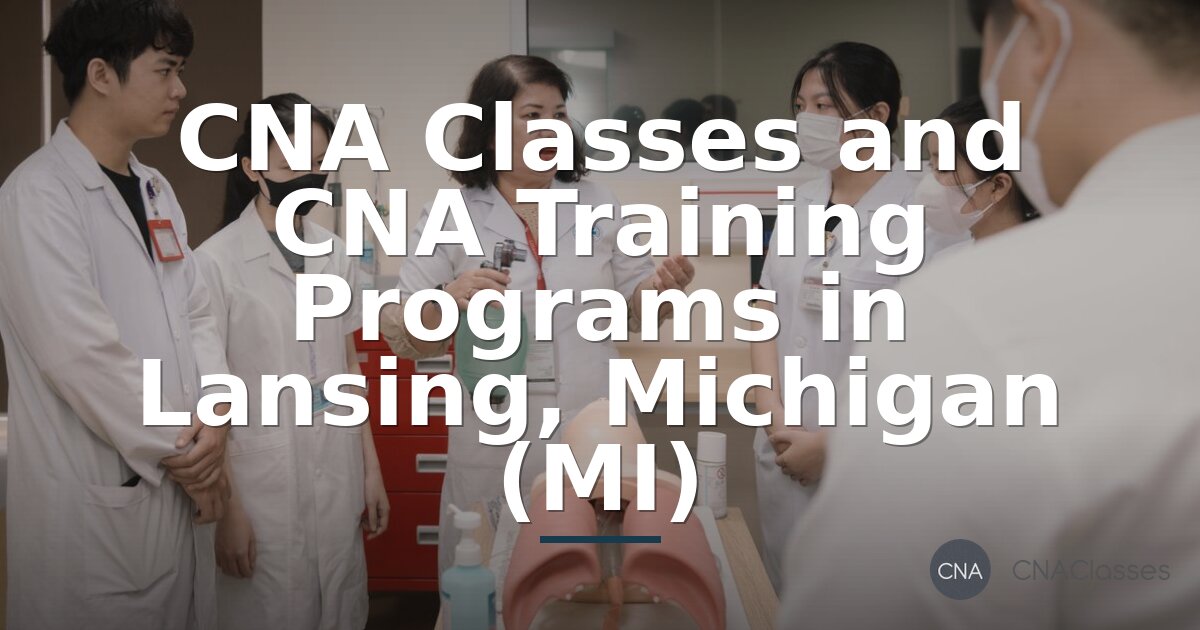
Sparrow Health System and McLaren Greater Lansing employ over a thousand nursing assistants combined, and both are competing for the same limited pool of newly certified CNAs in 2026. Lansing's healthcare sector has grown steadily even as other regional industries have contracted, and certified nursing assistants remain among the fastest hires across skilled nursing facilities, hospital floors, and home health agencies.
This guide compares local CNA programs by cost, schedule flexibility, state-exam pass rates, and clinical placement quality. You will see real tuition figures, training timelines, and employer-sponsored opportunities that can eliminate out-of-pocket costs entirely. Lansing programs range from two-week accelerated tracks to eight-week part-time schedules, and knowing which structure fits your calendar can cut weeks off your path to licensure.
Lansing's healthcare sector is one of the largest and most stable employment engines in mid-Michigan, and certified nursing assistants sit at the center of that growth. The combination of major hospital systems, skilled nursing facilities, and a rapidly expanding home health market means CNA positions are consistently available across the region.
The anchor of Lansing's medical landscape is University of Michigan Health-Sparrow, the largest private employer in the region with roughly 9,000 employees and 845 licensed beds12. Sparrow operates hospitals, outpatient centers, and specialty clinics that rely on CNAs across departments from med-surg floors to rehabilitation units. McLaren Greater Lansing, part of a 14-hospital statewide network3, employs over 1,400 workers1 and offers CNAs exposure to acute care, surgical recovery, and emergency services.
Beyond hospitals, long-term care facilities like MediLodge of East Lansing actively recruit nurse aides, with posted hourly wages in the range of roughly $21.90 to $30.044. Eaton Rapids Medical Center and the Ingham County Health Department add public-sector and community-hospital options. Home health agencies such as Home Instead round out the picture, employing between 51 and 200 caregivers locally5 and serving a growing population of seniors who prefer to age in place.
Michigan's 65-and-older population continues to grow faster than the state average, and the Lansing metro area reflects that trend. More residents entering their senior years means increased need for long-term care in nursing homes, assisted living communities, and home-based settings. CNAs provide the hands-on daily support these patients require, from mobility assistance to vital-sign monitoring, making the role essential to every level of the care continuum.
Few healthcare careers let you move from classroom to paycheck as quickly as CNA training does. Most CNA classes in Michigan can be completed in a matter of weeks, not years, giving you a professional foothold while you decide on next steps. Many CNAs use the role as a springboard, gaining clinical experience that strengthens applications for LPN, RN, or other allied health programs. Employers like Sparrow and McLaren frequently offer tuition assistance to CNAs who want to advance, turning an entry-level position into a long-term career pathway.
Can you complete CNA training entirely from home in Michigan? Not fully. State law requires every certified nurse aide to complete supervised clinical training in a healthcare facility, typically a nursing home or hospital. That hands-on component is non-negotiable. However, many Michigan programs now offer hybrid formats that let you complete the classroom portion online, reducing the number of times you need to drive to campus.
Hybrid CNA programs split coursework into two parts. The didactic (lecture) component, covering topics like infection control, patient rights, and vital signs, can be delivered through live Zoom sessions or self-paced video modules. The skills lab and clinical rotations remain in person. For Lansing-area students, this model cuts commute time by half or more, especially if you live in a rural part of Ingham, Eaton, or Clinton counties.
Even when a program advertises online coursework, expect to attend scheduled labs at a specific campus. You'll practice bed making, transfers, and catheter care on mannequins under instructor supervision before moving to a real clinical site. The clinical phase alone ranges from 40 to 100 hours depending on the program.
Most of the top-ranked programs serving Lansing students are campus-based only. Lansing Community College, Kellogg Community College, and Delta College all require in-person attendance for both classroom and clinical hours. The same holds true for St. Clair County Community College, Grand Rapids Community College, and Washtenaw Community College.
If flexible delivery is a priority, contact the program directly and ask whether they offer live remote instruction for theory hours. Some schools pilot hybrid formats in response to student demand but do not advertise them widely. Be prepared to travel for labs and clinicals regardless of the classroom format you choose.
Beyond the top-ranked programs, many other reputable CNA training options are available within commuting distance of Lansing. Below is a directory of additional programs organized by region.
How much can you realistically earn as a CNA in Lansing right after getting certified?
Current wage data places the lower end of cna salary in the Lansing-East Lansing area at roughly $31,900 per year, while workers in the middle of the range earn closer to the mid-$30,000s. Those with more experience or working in specialized settings can reach $42,100 or higher, and top earners in the area approach $50,000 annually.1 The statewide mean hourly wage for nursing assistants in Michigan currently sits around $15 per hour.2
Nationally, the median annual wage for nursing assistants runs approximately $42,260, which puts Lansing wages below the U.S. midpoint.3 That gap partly reflects Michigan's lower cost of living compared to coastal markets where wages are inflated by local expenses.
In Michigan, demand for nursing assistants remains steady, supported by projections through 2032. Nationally, steady growth continues, with annual job openings driven primarily by retirements and turnover rather than entirely new positions. The primary driver in both the state and the Lansing region is an aging population that increasingly needs long-term and in-home care. For anyone entering the field in 2026, the demand side of the equation looks favorable.
Becoming a licensed CNA in Michigan means completing a state-approved training program, passing a two-part certification exam, and getting your name added to the Michigan Nurse Aide Registry. Each step builds on the last, so understanding the full sequence before you enroll saves time and prevents surprises.
Michigan requires aspiring CNAs to finish a training program that meets the state's minimum standards for classroom instruction and hands-on clinical practice. Programs at community colleges, vocational schools, and some long-term care facilities all qualify, provided they hold state approval. Curriculum and prerequisite requirements can shift from one enrollment period to the next, so always confirm directly with your chosen school for the most current details.
After completing training, you will schedule your competency exam through Prometric, the testing provider contracted by Michigan. The exam has two components: a written (or oral) knowledge test and a hands-on skills demonstration. Prometric's Michigan page is the authoritative source for approved testing sites, scheduling procedures, and current fees. You must pass both components before practicing as a CNA.
Michigan requires a background check as part of the licensure process. Once you clear that requirement and pass your exam, your credentials are submitted to the Michigan Nurse Aide Registry, maintained through the Department of Licensing and Regulatory Affairs (LARA). Employers verify your standing through that registry, so keep your information current throughout your career.
CNA certification in Michigan is not a one-time event. The state has a renewal cycle that typically involves documenting ongoing work in a nursing role. Requirements can be adjusted through regulatory or legislative action, so it is worth checking LARA's website periodically. Industry groups such as the Michigan Health Care Association and LeadingAge Michigan also track policy changes and often communicate updates to members and the broader workforce. Consulting those resources alongside official state channels gives you the most complete picture of any 2026 changes affecting your renewal timeline.
Sticker tuition versus true out-of-pocket cost: those are two different numbers, and confusing them is how prospective CNAs end up short a few hundred dollars right before the state exam. Every Lansing-area program publishes a tuition figure, but the real budget includes textbooks, scrubs, background checks, a TB test, BLS/CPR certification, and the Michigan certification exam itself, which runs $125 to $175 in 2026.
Here is what students can expect to pay at the main options in and around Lansing this year:
When you request quotes, ask each school one question: what is the total dollar amount I will pay from enrollment through sitting for the Michigan CNA exam? That single number, not the advertised tuition, is what you should compare across programs.
CNA training in Lansing can take as little as two weeks for accelerated daytime programs or extend up to eight weeks for part-time evening schedules. Most students complete their training within three to eight weeks, with multiple schedule options to fit your availability. Start dates vary by school, with some offering rolling admissions and others having set cohort dates.
| Program | Duration | Schedule Options | Next Start Date |
|---|---|---|---|
| DRM International Learning Center | 2 weeks | Daytime (8am-4pm) | N/A |
| H2H Health Accelerated Day | 2 weeks | Daytime (Tuesday-Thursday 9am-5pm) | N/A |
| H2H Health Evening | 8 weeks | Evening (Mondays 5pm-9pm) | N/A |
| H2H Health Weekend | 5 weeks | Weekend (Saturdays 9am-5pm) | N/A |
| Michigan Healthcare Academy | 3 weeks | Monday-Friday | January 5, 2026 |
Most Lansing CNA programs share a core admissions checklist, but the fine print varies from school to school. Understanding these differences before applying saves time and money on application fees.
Across Michigan, expect to meet the following before you can start clinicals:
Application logistics differ too. DRM International Learning Center, for example, accepts applications in person or by email.
Michigan sets a floor of 75 total training hours, including a minimum of 16 hours of supervised clinical practice. Most Lansing programs comfortably exceed that clinical minimum, and attendance is strict: NMHTS notes that students must attend every scheduled session to meet the state hour requirement1. A few schools, like Career Quest, offer stackable credentials such as phlebotomy alongside the CNA track.
Free CNA training and certification programs are opportunities where the cost of tuition and fees is covered by an employer, a state workforce grant, or a nonprofit organization, often in exchange for a work commitment after you earn your certification. Finding these programs takes a bit of research, but several reliable paths can lead to zero-cost training.
When evaluating free training, be sure to understand the commitment: most employer-sponsored programs require you to work for the organization for at least six months to a year after certification. State regulatory resources and local community college sites offer authoritative information on certification requirements and additional affordable training options.
The following programs represent the top CNA training options for students in Lansing, Michigan, based on a comprehensive evaluation of institutional quality, program outcomes, and student support features. Each entry has been carefully assessed to help you find a program that fits your career goals and budget.
Lansing, MI · $5,000 – $10,000/yr
Best for: Lansing residents wanting dual CNA/PCT training
Lansing Community College, located right in downtown Lansing, offers a combined Certified Nurse Aide/Patient Care Technician program that can be completed in less than one semester. This rapid-entry pathway is designed with working students in mind, providing flexible scheduling and hands-on training approved by the Michigan Department of Licensing and Regulatory Affairs. Students gain versatile skills that open doors in both long-term care and acute settings, all while benefiting from the college's strong local employer connections.
Port Huron, MI · ~$6,000/yr (est.)
Best for: Career changers needing quick no-prerequisite entry
St. Clair County Community College in Port Huron provides a streamlined 96-hour Certified Nurse Aide program with no prerequisites required, making it an excellent choice for those seeking an immediate start. The college's strong graduate earnings and low net price point to solid return on investment, while the structured curriculum efficiently prepares students for the Michigan CNA exam.
Battle Creek, MI · ~$5,000/yr (est.)
Best for: Working adults needing flexible scheduling options
Kellogg Community College stands out for its highly flexible Nursing Assistant Training, available in 11-week, six-week, or three-week formats across multiple campus locations. An additional iACT CNA Training program offers free tuition, career coaching, and job placement assistance to eligible participants, making it an accessible ladder into healthcare for those who qualify.
Scottville, MI · $2,000/yr
West Shore Community College's Nurse Assistant program emphasizes multi-skilled healthcare preparation, combining CNA fundamentals with additional competencies for a broader patient-care role. The program focuses on safety, communication, and HIPAA compliance, and boasts an exceptionally low net price and strong graduate debt-to-earnings ratio, making it a financially wise choice.
Grand Rapids, MI · ~$9,000/yr (est.)
Grand Rapids Community College delivers an accelerated four-week Certified Nurse Aide program with small class sizes and curriculum that exceeds state requirements. Students benefit from dedicated career coaching, financial support options, and robust partnerships with local healthcare employers, positioning them for immediate job placement upon certification.
Ann Arbor, MI · $3,000/yr (net price)
Washtenaw Community College in Ann Arbor offers a state-certified four- to five-week Nursing Assistant Skills Training program that combines classroom, lab, and clinical experiences. The affordable in-district tuition and strong post-graduation median earnings make this a practical, high-value route to CNA certification and entry into diverse healthcare settings.
University Center, MI · $5,000/yr (net price)
Delta College near Saginaw provides two distinct Healthcare Foundations pathways: a comprehensive 24-credit Advanced Certificate that includes BLS Provider certification and medical terminology, and a 116-hour Certified Nursing Assistant program that exceeds Michigan's minimum training requirements. With a blended online/in-person format and a curriculum that covers dementia care and safe patient transfers, Delta prepares students for acute and long-term care roles.
Midland, MI · $15,000 – $20,000/yr
Ross Medical Education Center in Midland offers a fast-paced two-week Nursing Assistant program with 6.5 clinical hours, giving students hands-on patient care experience in local facilities. The campus-based training thoroughly covers essential skills from vital signs to end-of-life care and prepares graduates to sit for the Michigan Nurse Aide Certification Examination.
Grand Rapids, MI · $20,000/yr
Ross College in Grand Rapids North provides a two-week Nursing Assistant program that includes 6.5 clinical hours and comprehensive preparation for the Michigan certification exam. Students learn through real-world scenarios covering patient rights, infection control, feeding assistance, and range-of-motion exercises, with experienced instructors and strong facility partnerships.
Portage, MI · $20,000/yr
Ross Medical Education Center in Portage delivers an intensive two-week Nursing Assistant program featuring 6.5 clinical hours and hands-on training in patient hygiene, infection control, and body mechanics. The program prepares students for immediate entry into hospitals, nursing homes, and assisted living facilities, with virtual advising available for new students.
Lansing-area CNA programs vary widely in their state exam pass rates, and finding accurate numbers takes some digging.
To pass Michigan's two-part competency exam, candidates need at least 70% on the written portion and 80% on the skills portion, with 100% completion of all critical steps. You get three attempts.1
For context, pass rates among Lansing-area providers can vary significantly. MTEC's CNA programMTEC's CNA program reports first-time pass rates around 74%, while PES School of NursingPES School of Nursing's CNA program reports rates around 88%. Ask each Lansing program directly, most will share their numbers if you request them.
Picking the right program comes down to a handful of factors that only you can weigh against your own situation.
Start with the basics:
Contact each school directly to confirm current tuition, start dates, and class availability. Programs update these details frequently, and what was accurate a few months ago may have changed. While you have an admissions coordinator on the phone, ask specifically about job placement support. Many Lansing-area programs maintain active relationships with local healthcare employers, which can translate into a faster path to your first position.
Healthcare hiring in the Lansing region continues to grow, and the demand for CNAs shows no sign of slowing. Training is short, entry wages are competitive for the level of education required, and the role opens doors to further advancement in nursing and allied health. Taking the step now, rather than waiting, puts you ahead of a field that is only getting more competitive for new talent.