Key Points
- Dayton CNAs earn a median $38,950 annually, or $18.73 per hour.
- Ohio home health grew 50.7% from 2016-2026, increasing CNA demand.
- Ohio CNA training requires 75 hours and takes 4-8 weeks.
State-approved CNA & STNA programs in Dayton—compare tuition, schedules, and certification requirements.
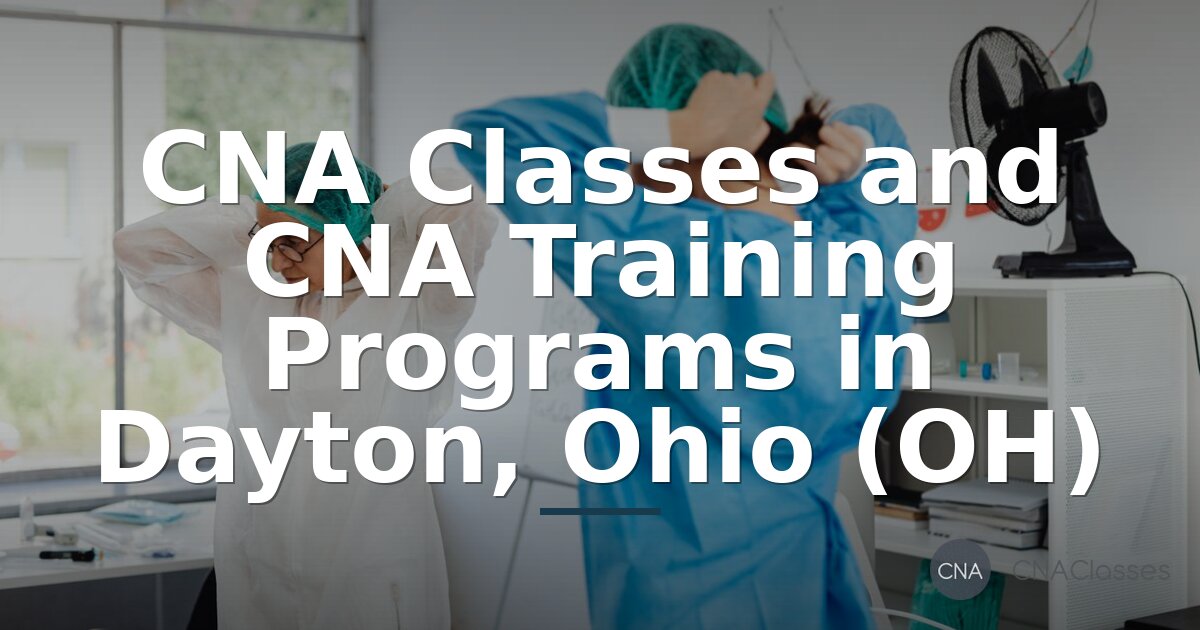
Dayton's two largest health systems, Kettering Health and Premier Health, operate more than a dozen hospitals and care facilities across the metro area, and both actively recruit certified nursing assistants year-round. That demand means CNA training, which runs just 75 hours in Ohio and can be finished in as few as four weeks, remains the fastest entry point into a clinical healthcare role.
Local programs range from under $500 to around $1,500, and options include evening, weekend, and hybrid formats. Median CNA pay in the Dayton metro sits near $38,950 per year, competitive with neighboring Ohio cities.
Which employers are hiring CNAs in Dayton right now? The answer covers a wide range of healthcare settings, from major hospital networks to home care agencies.
Dayton's healthcare landscape is anchored by large health systems. Kettering Health and Premier Health are two of the top employers actively recruiting nursing assistants across multiple campuses and specialty clinics. These hospitals frequently post openings on general job boards and their own career sites, with roles in medical-surgical units, emergency departments, and rehabilitation services. Beyond hospitals, long-term care facilities and skilled nursing homes are steady employers. Many students find their first job in a nursing home, where CNAs provide daily hands-on care to residents. Home health agencies are another growing source of jobs. FirstLight Home Care and similar providers hire CNAs to support clients at home, often with flexible schedules. For those seeking variety, staffing agencies offer PRN shifts and travel contracts, allowing you to work at different facilities throughout the Dayton area.
The demand for CNAs in the Dayton metro area is described as both strong and stable. Statewide, Ohio employed over 61,000 nursing assistants in 2024, and the numbers are holding. Nationally, the Bureau of Labor Statistics projects 211,800 nursing assistant job openings each year over the next decade, driven by an aging population and workforce turnover. While the overall growth rate is modest at about 2 percent, certain sectors are expanding much faster. For example, Ohio's home health care services were projected to grow by over 50 percent from 2016 to 2026, a trend that continues to fuel CNA hiring. A quick scan of recent job postings on platforms like Indeed confirms dozens of active listings for CNAs and STNAs across Dayton, covering full-time, part-time, and per diem roles.
In Ohio, a Certified Nursing Assistant is officially called a State Tested Nurse Aide, or STNA. The scope of practice is defined by the Ohio Nurse Practice Act and has not seen any major regulatory expansions in 2025 or 2026. STNAs provide delegated basic nursing care and activities of daily living under the supervision of a registered nurse or licensed practical nurse. You'll be assisting patients with bathing, dressing, eating, toileting, and mobility, as well as taking vital signs and reporting changes in a patient's condition. You cannot administer medications, perform sterile procedures, or make independent clinical decisions. Understanding your boundaries is key to working safely and legally.
CNAs are often called the backbone of patient care, and for good reason. You spend more direct time with patients than almost any other member of the healthcare team, forming the frontline of daily support. This role offers stable employment in a field that rarely sees downturns. In Dayton, hourly wages for CNAs average around $19.50, with experienced workers earning up to nearly $22 per hour. Beyond the paycheck, CNA experience is a powerful stepping stone. Many use it as a foundation to become an LPN, RN, or pursue other healthcare careers. With tuition reimbursement programs available from employers like Kettering Health and Premier Health, your first job can fund your next degree.
Ohio State Career Training Center serves Dayton and Beavercreek with a hybrid STNA program that combines online theory modules with 16 hours of in-person clinical practice, totaling 75 hours over 2.5 weeks. While Ohio does not permit fully online CNA certification (state law requires a minimum of 16 clinical hours in a supervised healthcare setting), several approved CNA classes in Ohio now offer hybrid formats that deliver classroom instruction online and reserve hands-on training for local clinical sites.
Dayton-area students have access to multiple hybrid options. Ohio State Career Training Center operates locations in both Dayton and Beavercreek and offers testing on site after program completion. Warren County Career Center in Lebanon (about 30 minutes south of Dayton) runs a 76-hour hybrid STNA course with 40 hours of online coursework and 16 hours of clinical training.2 For students willing to commute, 1st Choice Career Center in Cincinnati and Columbus offers a two-week hybrid program, and Heart to Heart Health Care Center in Cleveland provides a similar format.
Hybrid online CNA classes offer clear advantages for working adults, parents, and students with irregular schedules. Online theory modules can be completed evenings or weekends, and the condensed clinical portion (often completed over a few consecutive days) reduces the total number of trips to campus. The trade-off is less supervised hands-on practice. Fully in-person programs typically spread clinical hours across several weeks, giving students more opportunities to refine skills like transfers, vital signs, and patient communication under instructor observation. Hybrid students must be disciplined self-learners who can master anatomy, infection control, and documentation principles without daily classroom interaction.
Before enrolling in any online or hybrid STNA program, confirm that it appears on the Ohio Department of Health's current approved-program list.1 Only graduates of state-approved programs are eligible to sit for the Ohio STNA competency exam. Check the program's approval status, verify that clinical sites are within commuting distance, and ask whether the school provides testing services on site or refers students to external Pearson VUE locations.
The following programs are also approved by the Ohio Department of Health and offer CNA/STNA training. While this list is updated periodically, it's always best to confirm details directly with each school.
In the Dayton metro area, nursing assistants earn a median annual wage of $38,950, which works out to roughly $18.73 per hour. The region employs 4,230 CNAs, reflecting a steady local job market. Compared to nearby Ohio metros, Dayton wages fall in the middle range, while employment is lower than in larger cities like Columbus or Cleveland. Nationwide, the profession is projected to grow faster than average, supporting strong entry-level prospects.
| Location | Employment | Median Annual Wage | Median Hourly Wage |
|---|---|---|---|
| Dayton-Kettering-Beavercreek, OH | 4,230 | $38,950 | $18.73 |
| Cleveland, OH | 12,310 | $38,060 | $18.30 |
| Cincinnati, OH-KY-IN | 11,280 | $39,150 | $18.82 |
| Columbus, OH | 10,270 | $39,830 | $19.15 |
75 hours of training stands between you and your Ohio nurse aide certification. The state keeps requirements clear and achievable, with most students completing training and testing within four to eight weeks. Here is exactly what you need to do to get certified and start working.
Ohio requires all nurse aide candidates to finish a training program approved under Ohio Administrative Code Chapter 3701-18. The minimum structure includes:
Your training must be delivered by an approved provider. Community colleges, career centers, and some nursing homes offer qualifying programs in the Dayton area.
Once you complete training, you must pass the state competency evaluation administered by D&S Diversified Technologies (HEADMASTER). The exam has two parts and takes up to six hours total1:
The exam fee is 95 dollars. Your training program will provide registration details, or you can schedule directly through the D&S Diversified Technologies testing portal. Testing sites are available throughout the Dayton region.
Ohio requires both Bureau of Criminal Investigation (BCI) and FBI fingerprint background checks before you can be listed on the state registry.2 The background check fee runs 57 dollars. Results typically come back within two to four weeks. Certain criminal convictions may disqualify you from certification.
After passing your exam and clearing your background check, the Ohio Department of Health adds your name to the state registry. Only individuals on this registry can legally work as nurse aides in Ohio facilities.
Your Ohio STNA certification remains valid for two years. To renew, you must:
If you hold an active CNA certification from another state, Ohio offers reciprocity. You will need to submit proof of your current certification, pass the Ohio background check, and apply through the Ohio Nurse Aide Registry. Some states have additional documentation requirements, so contact the registry early to confirm what you need.
For official forms and program lists, visit the Ohio Department of Health NATCEP page. Exam scheduling and candidate information are available through D&S Diversified Technologies.
CNA training in Dayton is one of the most affordable ways to enter healthcare, but the price tag still matters when you're weighing your options. Here's a realistic look at program costs and funding options.
Based on the programs listed above, most CNA and STNA courses in the Dayton area run between $600 and $1,500 total. That figure typically covers tuition, textbooks, uniforms, background checks, and the state competency exam fee. Community college programs and career centers tend to sit at the lower end, while accelerated private programs and hybrid options often price higher. A handful of long-term care facilities offer no-cost training in exchange for a work commitment, discussed below.
The Workforce Innovation and Opportunity Act (WIOA) is the single biggest funding source for CNA students in Dayton, and OhioMeansJobs Montgomery County (the Job Center on West Third Street) administers it locally. WIOA can cover tuition, books, supplies, and exam fees, and may also include supportive services such as transportation or childcare.1
Two main tracks apply:
To apply, schedule an eligibility appointment at the Job Center and bring documentation: photo ID, work authorization, recent pay stubs or benefit award letters, a termination letter if applicable, and a DD-214 for veterans.2 Your chosen school must appear on Ohio's Eligible Training Provider List3, so confirm that before enrolling. Programs like the Ohio State Career Training Center in Dayton are already WIOA-approved.4
Veterans can use GI Bill benefits and VA tuition assistance at approved CNA programs. Contact the school's veteran services coordinator to confirm approval status and get help routing paperwork through the VA. Most Dayton-area schools also offer in-house payment plans that split tuition into two or three installments, which can bridge the gap if aid takes time to process.
Both Kettering Health and Premier Health run tuition reimbursement or employer-sponsored training programs for aides and support staff.5 In practice, this can mean the hospital pays for your CNA course upfront in exchange for a service commitment (often 6 to 12 months), or reimburses tuition after you complete training and stay employed for a set period. Ask about these programs during any interview at a local hospital or long-term care facility, since they aren't always advertised publicly.
If you want to avoid tuition entirely, consider these paths:
Before you pay out of pocket, spend an afternoon at the Job Center or call two or three local employers. It's common for Dayton students to combine WIOA funding with an employer commitment and pay nothing themselves.
Below are the top CNA programs serving Dayton students, ranked by IPEDS completion data, accreditation status, and program fit. This authoritative list highlights schools that combine quality training, affordability, and strong student outcomes to prepare you for Ohio’s STNA certification exam.
Dayton, OH · $4,000 – $9,000/yr
Best for: Dayton residents seeking affordable public option
Sinclair Community College is Dayton’s primary public community college, offering a Nurse Aide short-term certificate that prepares students for the state exam. The program combines 75 hours of classroom and clinical training, and it also provides a low-cost non-credit option designed for quick entry into the workforce. Graduates can pursue roles in long-term care and hospitals, with strong local employer connections.
Groveport, OH · $16,000/yr (net price)
Best for: Budget-conscious students wanting proven outcomes
Eastland-Fairfield Career and Technical Schools offers a State Tested Nurse Aide (STNA) program with campus-based training in Groveport. The curriculum emphasizes hands-on clinical experience and prepares graduates for the state certification exam. With a high student-faculty ratio and strong completion rates, it provides a solid foundation for healthcare careers.
Niles, OH · $14,000/yr
Best for: Career changers needing a fast, low-cost start
ETI Technical College in Niles provides an intensive STNA program with a low tuition of $850 and a payment plan option. The 10 classroom days plus 2 clinical days offer a rapid pathway, and financial aid may be available through local agencies. Known for high retention and graduation rates, it efficiently launches students into healthcare roles.
Lisbon, OH · $12,000/yr
Columbiana County Career and Technical Center offers an 86-clock hour CNA program meeting Ohio Department of Health requirements. Students gain hands-on clinical experience at nursing facilities with flexible day or evening schedules. The program boasts high completion and placement rates, making it a dependable choice for adult learners.
Newark, OH
Career and Technology Education Centers of Licking County provides a certified nurse aide program that emphasizes practical skills and Ohio certification readiness. The campus-based training includes vital signs monitoring and infection control. With a perfect retention rate, it ensures students stay on track toward employment in nursing homes and hospitals.
Jefferson, OH · ~$10,000/yr (est.)
Ashtabula County Technical and Career Campus offers an 80-hour STNA program for only $645, covering textbooks, background check, and the state exam fee. Evening classes and Saturday clinicals accommodate working students. With strong graduate earnings, this program delivers excellent return on investment.
Sandusky, OH
Sandusky Career Center’s three-week, 76-hour STNA program combines classroom and clinical training for quick entry into healthcare. At $810 total cost, it includes the state exam fee. With a 4:1 student-faculty ratio, students receive personalized instruction and graduate ready for nursing home and hospital roles.
Mansfield, OH · $5,000/yr (net price)
North Central State College offers a streamlined 6-credit STNA certificate that can be completed flexibly. Students earn Ohio Board of Health certification plus first aid and CPR credentials. The program partners with local career centers for clinicals and provides a clear pathway to associate degrees in health services.
Cleveland, OH · $4,000/yr (net price)
Cuyahoga Community College District provides an Ohio Department of Health-approved non-credit CNA program at Metro and Westshore campuses. Combining classroom instruction with clinical practice, it prepares students for immediate employment in Cleveland-area hospitals and long-term care facilities. Workforce scholarships may be available.
Newark, OH · $5,000 – $8,000/yr
Central Ohio Technical College offers a 3.5-credit Basic Healthcare Skills certificate leading to CNA certification. Open enrollment and multiple campus locations (Newark, Knox, Pataskala) provide accessibility. Eligible students can apply for a Talent Ready Grant up to $2,000, making this an affordable springboard into nursing.
Perrysburg, OH · $10,000/yr
Owens Community College’s 75-hour Nurse Assistant Training/Home Health Aide Certificate combines 59 hours of lecture and lab with 16 hours of clinical. Approved by the Ohio Department of Health, it prepares students for the state competency exam and opens doors to employment in long-term care, hospitals, and home health settings.
Lima, OH · $5,000 – $10,000/yr
James A. Rhodes State College in Lima delivers a one-semester Nurse Assistant Certificate with a 16-hour clinical component. The program meets Ohio Department of Health standards and leads to eligibility for the state CNA exam. With a strong graduation rate and median earnings, it offers a solid return on investment.
Cleveland, OH · $30,000/yr
Valley College-Cleveland offers a career-focused Nursing Assistant certificate that omits general education courses for efficiency. With programs as short as six weeks, it caters to students seeking rapid entry into healthcare. Financial aid and job placement assistance further support graduates, though net price and earnings may vary.
Columbus, OH · $5,000 – $11,000/yr
Columbus State Community College’s 76-hour Nurse Aide Certificate combines classroom, lab, and clinical training to prepare students for Ohio’s CNA exam. The program serves as a gateway to further nursing education at the college. With competitive registration and multiple campus options, it remains a solid public choice.
Springfield, OH · $4,000 – $8,000/yr
Clark State College’s 84-hour Nurse Aide Short-Term Technical Certificate covers patient care, documentation, and communication. Regulated by the Ohio Department of Health, it requires 100% attendance and a background check. Graduates can test for state certification and use the certificate as a stepping stone to LPN or RN programs.
Ohio's home health care services sector grew by 50.7% from 2016 to 2026, far outpacing the average occupation. This rapid expansion, driven by an aging population, means strong and growing demand for CNAs in Dayton and across the state. For students pursuing CNA classes in Dayton, this trend signals a promising career path with lasting opportunity.
Here are answers to some of the most common questions about becoming a nursing assistant in Dayton. If you don't see your question listed, feel free to reach out to our team for personalized guidance.