What you’ll learn in this article…
- Demand for CNAs surged 38% in 2026, with over 211,800 annual job openings.
- Count your 120+ clinical hours as work experience and list patient numbers on your resume.
- Nursing homes and skilled nursing facilities provide the best mentorship and highest hiring demand for new CNAs.
- Hiring managers value compassion and eagerness to learn more than technical skills in CNA interviews.
Introduction: Landing Your First CNA Job Starts Here
What steps should you take after passing the CNA exam to actually land your first job?
The Bureau of Labor Statistics projects over 137,800 CNA openings annually through 2032, and healthcare staffing surveys from 2026 show demand spiking even higher in certain regions. That volume of opportunity is real, but so is the competition from fellow new graduates entering the field at the same time.
Your clinical training hours, accumulated during the Becoming a CNA process, already count as hands-on experience. Translating them into a resume that hiring managers notice, and then choosing the right facility type for your learning style, requires a focused approach. Entry-level hourly wages range from roughly $14 to $22 depending on setting and geography, and where you start often shapes how quickly you build the skills that lead to raises or advancement.
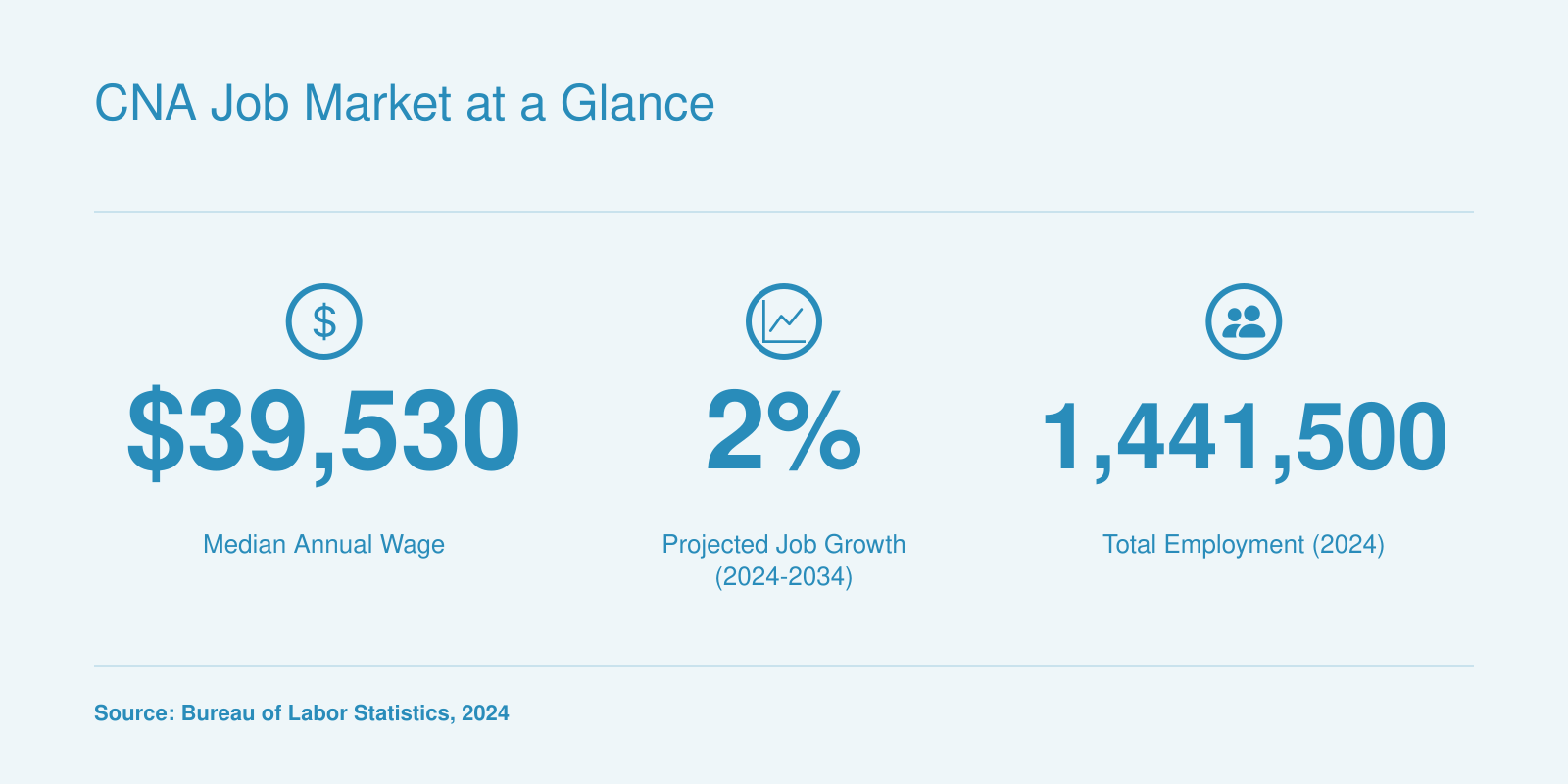
CNA Job Market at a Glance
Here is a quick look at the national landscape for nursing assistants, based on the latest federal data.
Where Are CNAs Needed Most? Hiring Trends by Facility Type in 2026
In 2026, demand for CNAs surged 38% year-over-year1, with over 211,800 annual job openings projected across the country2. That jump, reported in healthcare staffing surveys, highlights the urgency felt across care settings. While the Bureau of Labor Statistics expects 137,800 new CNA jobs to be added over the next decade3, the real story is where those opportunities are concentrated. Nursing and residential care facilities remain the most common employers2, but a closer look at CNA employment trends by facility type reveals clear winners for job-seeking CNAs.
Where Demand Is Highest
Demand varies dramatically by setting. Here is a snapshot of 2026 hiring activity:
- Nursing Homes: Demand is very high1, driven by an aging population and ongoing staffing shortages. These facilities are aggressively recruiting, and many offer sign-on bonuses or shift differentials.
- Hospitals: High demand persists1, especially for medical-surgical and telemetry units. However, hospitals often prefer CNAs with some experience, so competition can be stiffer.
- Home Health: Demand is high and growing4, fueled by the shift toward at-home care. But new graduates may find fewer postings as agencies often require independent work experience.
- Assisted Living: Demand is high1, with many communities expanding their care wings. These settings frequently hire multiple CNAs at once.
- VA Facilities: Demand remains high2, with the VA actively recruiting to care for veterans. Hiring processes can be lengthy, but the benefits are exceptional.
Where Are New Graduates Most Likely to Be Hired?
If you are holding a fresh certification, some doors open wider than others. Based on 2026 hiring patterns:
- Nursing Homes are the most new-graduate-friendly environment. They offer extensive orientation programs and are accustomed to training CNAs from day one. You are very likely to secure a position here.4
- Assisted Living communities also hire new CNAs at a high rate4, often pairing them with experienced mentors.
- Hospitals hire new graduates at a moderate level5. While some run nursing assistant residency programs, many prefer six months of prior experience.
- Home Health Agencies tend to hire new graduates at a moderate-to-low rate4, as they look for candidates who can work autonomously. VA Facilities hire at a moderate-to-low rate6, seeking candidates who can navigate complex clinical settings.
What About On-the-Job Training and Growth?
Your first job can also accelerate your skills. Nursing homes and hospitals boast strong training programs5, with structured preceptorships and continuing education. Assisted living offers moderate-to-strong training5, while home health agencies provide moderate support4 but expect faster independence. VA facilities are known for top-tier training6 for those who qualify. Many nursing homes also now offer tuition reimbursement if you want to advance to LPN or RN, making them a strategic launchpad into related healthcare careers.
Bottom line: if you want to land your first CNA job quickly, target nursing homes or assisted living. If you can wait and want hospital experience, apply to both but be prepared for a longer search. The demand is there. You just need to aim for the settings that match a new graduate's profile.
Where Should New CNAs Apply? Comparing Job Settings
Where you apply first matters more than most new CNAs realize, because each care setting offers a different mix of patient load, skill development, and support for someone just starting out.
Nursing Homes and Skilled Nursing Facilities
For many new graduates, skilled nursing facilities and nursing homes remain the most accessible entry point. These employers hire in high volume, often run their own orientation programs, and tend to be more willing to bring on CNAs who are fresh from training. The trade-off is that patient-to-CNA ratios can be higher than in other settings, which means you will stay busy and build hands-on endurance quickly. That experience carries real weight when you eventually interview elsewhere.
Before you apply anywhere, pull up the state health department's inspection reports for facilities in your area. Most states publish these online, and they give you a candid picture of staffing levels and care quality that no job listing will. Employee reviews on sites like Indeed and Glassdoor add another layer of insight, particularly around how management treats new staff and whether onboarding is structured or thrown together.
Hospitals and Assisted Living Communities
Hospital positions are competitive for entry-level CNAs, but they do exist, especially on long-term care units, rehabilitation floors, and overnight shifts where demand is steady. Hospitals often offer stronger benefits packages and more defined career ladders, which can make the extra effort to land one worthwhile. Assisted living communities sit somewhere between a nursing home and a private home environment. Resident acuity is generally lower, the pace can feel more manageable, and the relationship-building side of the job tends to be more prominent.
Home Health and Government Settings
Working as a Home Health Aide is very different. You are largely on your own in a client's home, which rewards CNAs who are self-directed and comfortable with less supervision. Pay can be competitive, but new grads should weigh whether that independence feels like freedom or isolation. VA medical centers and other government employers often provide excellent pay and benefits, though the application process through federal hiring systems takes longer and requires patience.
How to Research Before You Apply
A few practical steps can sharpen your search considerably.
- BLS.gov: The Bureau of Labor Statistics publishes average pay ranges for CNAs broken down by industry and region, along with national job outlook data. It is a neutral, reliable baseline before you compare offers.
- Employer career pages: Go directly to the websites of hospitals, nursing homes, and home health agencies in your area. Many post information about new-grad training programs and orientation timelines that do not appear on job boards.
- Your school's career services office: Instructors and advisors often know which local employers regularly hire new graduates and which facilities have reputations for solid onboarding.
- Professional associations: The National Association of Health Care Assistants (NAHCA) publishes salary surveys and offers networking opportunities that can connect you with facilities known for supporting newer CNAs.
Taking an hour to research a facility before you apply puts you ahead of most applicants and helps you walk into any interview with informed, specific questions.
Questions to Ask Yourself
Related Articles
How to Build a Standout CNA Resume With No Paid Experience
Most CNA Training programs require at least 120 hours of supervised clinical practice, which means you already have hands-on patient care to showcase, even if you have never held a paid healthcare position.1 The key is structuring your resume so that clinical work reads like professional experience, not just coursework.
Start with a Focused Professional Summary
Your summary sits at the top of the page and gives a hiring manager a reason to keep reading. In two to three sentences, state your certification, your clinical hours, and the skills that matter most. For example:
"State-certified Nursing Assistant with 120+ hours of clinical experience providing direct care to 8 to 12 residents per shift. Skilled in ADLs, vital signs monitoring, infection control, and safe patient transfers. Known for compassionate communication, reliability, and strong teamwork."
Notice the formula: credential, quantifiable detail, key skills, and a soft-skill anchor. That compact statement tells a reviewer exactly what you bring.
Arrange Your Sections in the Right Order
Keep the resume to one page with a clean, ATS-friendly layout. Avoid graphics, text boxes, or multi-column designs, because applicant tracking systems often cannot parse them. List your sections in this order:2
- Contact information: name, phone, email (use a professional address), city and state.
- Professional summary: the short paragraph described above.
- Certifications: CNA license (include state and expiration date), CPR/BLS, and any additional credentials.
- Clinical experience: treat this like a job entry with the facility name, dates, and bullet points.
- Work experience: any previous jobs, even outside healthcare.
- Education: CNA program name, school, and completion date.
- Skills: a concise list of clinical and soft skills.
- Volunteer experience: unpaid caregiving, community service with older adults, or hospital volunteering.
Turn Clinical Rotations into Job-Ready Bullet Points
Use a simple formula for each bullet: action verb, plus task, plus context, plus a measurable result. Pull action verbs like "assisted," "monitored," "documented," "maintained," and "collaborated" to open each line. Here are examples you can adapt:
- "Provided direct personal care, including bathing, dressing, and grooming, for 8 to 12 residents per shift during a 120-hour clinical rotation."
- "Measured and documented vital signs (blood pressure, pulse, respiration, temperature, SpO2) for assigned residents, reporting abnormal findings to the charge nurse promptly."
- "Assisted residents with safe transfers using gait belts and mechanical lifts, maintaining zero fall incidents during the rotation."
- "Followed infection control protocols, including proper hand hygiene, PPE use, and isolation procedures, to promote resident safety."
- "Supported residents with range-of-motion exercises, catheter care, nutrition assistance, and wound observation while documenting care activities accurately."
Numbers make a difference. Quantifying your patient load, the length of your rotation, or a safety outcome transforms a vague task list into a credible record of performance.
Add Keywords from the Job Posting
Many employers use applicant tracking systems to screen resumes before a human ever sees them. Mirror the language in the job description. Common terms to weave in naturally include ADLs, vital signs, long-term care, resident safety, dementia care, empathy, and teamwork. Do not stuff keywords into a block at the bottom of the page; instead, embed them inside your bullet points and skills section where they make sense.
Leverage Non-Healthcare Work and Volunteer History
If you worked in retail, food service, or childcare, highlight transferable strengths: working in a fast-paced environment, communicating with diverse groups, managing time across competing tasks, and solving problems on the fly. Volunteer caregiving experience, especially with older adults or individuals with disabilities, belongs in its own section and shows genuine commitment to the field.
Handle References the Right Way
Prepare a separate reference sheet rather than listing references on the resume itself. Your clinical instructor is often the strongest reference a new CNA can offer, because they observed your patient care firsthand. Include their name, title, facility, phone number, and email. Ask permission before sharing anyone's contact information, and let your references know what types of positions you are applying for so they can speak to relevant skills.
Avoid the most common pitfalls: downplaying your clinical rotation as "just school," writing generic descriptions without numbers, using an unprofessional email address, or cramming the page with every skill you can think of. A concise, well-organized, one-page resume that treats your clinical hours as real experience will stand out far more than a cluttered document twice its length.
CNA Job Search Strategies: Where to Look and How to Get Noticed
Job boards remain one of the most common starting points for new CNAs, with platforms like Indeed, Monster, and HospitalCareers.com hosting thousands of listings nationwide. When searching, use multiple keywords beyond just "CNA" to surface additional opportunities that might fit your training. Terms like "nursing assistant," "patient care technician," "resident aide," "patient care assistant," and "direct support professional" are all used by employers to describe similar entry-level roles. Each search variation can uncover listings you might otherwise miss. The Bureau of Labor Statistics website (BLS.gov) also provides state-specific employment data and highlights which industries are hiring the most nursing assistants, helping you target your search geographically and by sector.
Apply Directly to Local Facilities
While job boards are convenient, many CNAs land their first position by applying directly to facilities in their area. Identify hospitals, nursing homes, assisted living communities, and home health agencies within your commute radius, then visit their careers pages or stop by the human resources office in person. Bringing a resume and completing an application on-site signals initiative and allows you to ask questions about openings, orientation schedules, and shift availability. Your CNA training school's career services office is another valuable resource. Many programs maintain relationships with local employers, post exclusive job leads, and can connect you with alumni who recently navigated the same job search. Ask your instructors and classmates for facility recommendations and referrals, particularly if they already work in healthcare.
Network Through Professional Channels
Networking expands your reach beyond posted openings. Joining a professional association like the National Association of Health Care Assistants (NAHCA) provides access to job boards, regional chapters, and continuing education events where hiring managers and recruiters often attend. Your state's nurse aide registry may also list employer resources or job placement assistance. Healthcare job fairs are particularly effective for new CNAs. Check with your training school, local workforce development centers, and hospital systems for upcoming dates. Before attending, research which organizations will be present, note their facility types and locations, and prepare a brief 30-second introduction that covers your recent certification, clinical experience, and availability. Bring multiple copies of your resume in a folder or portfolio, dress professionally, and be ready to fill out applications or schedule interviews on the spot.
Follow Up and Stay Organized
After applying or attending a job fair, follow up within a few days by phone or email to express continued interest and confirm your application was received. Keep a simple spreadsheet or notebook tracking where you applied, the date, contact names, and any next steps. Persistence matters in a competitive job market, and staying organized ensures you do not miss interview invitations or callback opportunities.
Questions to Ask Yourself
Ace Your CNA Interview: Common Questions and How to Prepare
Your CNA interview is less about proving you know everything and more about showing you have the heart for this work. Hiring managers consistently rank compassion, reliability, and eagerness to learn above technical perfection when evaluating entry-level candidates. That means a well-prepared new CNA can absolutely outshine someone with more experience but a lukewarm attitude.
Common Questions You Should Expect
Most CNA interviews blend general, behavioral, and scenario-based questions. Prepare thoughtful answers for each type:1
- Tell me about yourself: Keep it focused on why healthcare appeals to you and what led you to CNA training. Example: "I've always been drawn to helping others, and caring for my grandmother during her recovery showed me how meaningful hands-on patient care can be. That experience pushed me to pursue CNA certification."
- Why did you become a CNA?: Be genuine. Mention a specific moment, person, or realization that sparked your interest.
- Tell me about a time you dealt with a difficult patient or situation: Draw from clinical rotations, volunteer work, or any caregiving experience. Focus on how you stayed calm and found a solution.
- What would you do if a patient refused care?: Demonstrate respect for patient autonomy while explaining how you would communicate concerns and involve the nursing team.
- How do you handle stress or heavy workloads?: Give a concrete example of prioritizing tasks and staying organized under pressure.
- Where do you see yourself in five years?: Show ambition without sounding like you plan to leave immediately. Mentioning interest in LPN or RN advancement is perfectly acceptable.
- Why should we hire you?: Highlight your soft skills, your commitment to learning, and your genuine desire to provide excellent care.
Answer Behavioral Questions with the STAR Method
When an interviewer asks about past experiences, structure your response using STAR:
- Situation: Briefly set the scene.
- Task: Explain your responsibility in that moment.
- Action: Describe exactly what you did.
- Result: Share the outcome, ideally with a positive resolution or lesson learned.
For example, if asked about a difficult patient interaction during clinicals, you might say: "During my clinical rotation, I cared for a resident who became agitated when I tried to assist with bathing. My task was to help her while respecting her dignity. I paused, spoke softly, and asked what would make her more comfortable. She agreed to a partial bath with extra privacy. The result was that she thanked me afterward, and my instructor praised my patience."
Professional Appearance and Body Language
First impressions happen fast. Arrive in clean, professional attire, typically business casual or scrubs if the facility prefers. Keep jewelry minimal and hair pulled back.
During the interview, maintain eye contact without staring, sit up straight, and avoid crossing your arms. A genuine smile and calm demeanor signal that you will be pleasant to work alongside and reassuring to patients.
What to Bring
Come prepared with:
- Multiple copies of your resume
- Your CNA certification and state ID
- Any CPR or BLS cards
- A list of references with current contact information
- A notepad and pen for jotting down details about the role
Having everything organized in a folder shows professionalism and saves awkward fumbling if the interviewer requests documents.
Demonstrating What Matters Most
Technical skills can be taught on the job. What cannot be taught is genuine empathy, dependability, and a willingness to grow. Let those qualities shine through your answers. If you lack paid experience, lean into your clinical hours, volunteer work, or personal caregiving stories. Hiring managers know that attitude often predicts success better than years on the job, so let yours speak clearly.
CNA Salary and Benefits: What Entry-Level Pay and Shifts Look Like
Your first CNA paycheck is a milestone, but it helps to know what the job offers before you accept it. Entry-level pay for nursing assistants can vary widely based on facility type, location, shift, and even the demand for workers in your area. This section walks through the compensation landscape so you can compare offers realistically.
How Pay Structures Vary by Facility Type
Different healthcare settings set their own wage scales, and each has trade-offs. Nursing homes often hire many new CNAs and may offer steady hours with opportunities for overtime, though base hourly rates might sit on the lower end of the spectrum. Hospitals tend to pay more per hour and frequently provide richer benefits packages, but they may also expect greater schedule flexibility or prefer candidates with some experience. Assisted living facilities and memory care units can fall somewhere in the middle, often blending a comfortable pace with competitive wages. Home health agencies might pay by the visit or by the hour, sometimes adding mileage reimbursement, which can boost your total take-home pay.
Your local job market also plays a big role. In regions with severe staffing shortages, facilities use higher starting wages and sign-on bonuses to attract and keep CNAs. When reviewing job postings, note whether the listed rate is a base wage or includes estimated shift differentials, because that can change the comparison.
Why Shift Differentials Matter for New CNAs
Shift differentials, extra pay for working evenings, nights, weekends, or floating between units, can noticeably increase your earnings. Many new CNAs start on the evening or night shift because those are the hardest to fill, and the premium can add several dollars per hour to your base rate. Weekend differentials often stack on top of the evening or night premium, making weekend shifts some of the best-paid. Float positions, where you move between units based on need, may also carry additional hourly incentives.
Before accepting an offer, ask what shift you would work and exactly how the differential is calculated. Some facilities apply a flat dollar amount, while others use a percentage of your base wage. Either way, the difference can turn a modest starting rate into a much more attractive paycheck.
Beyond the Paycheck: Benefits to Look For
Benefits often make up a silent portion of your total compensation. When comparing two job offers, weigh the value of health insurance (medical, dental, and vision), paid time off (PTO), and retirement plans like a 401(k) with employer-matching contributions. Some employers also offer tuition reimbursement programs that can help with paying for nursing school if you decide to become an LPN or RN later. Loan forgiveness programs exist for CNAs who work in underserved facilities or rural areas; ask during the interview whether the employer participates in any such initiative.
Other practical perks include uniform allowances, free or discounted meals during shifts, on-site childcare, and employee wellness programs. Even if a facility’s hourly wage is slightly lower, a strong benefits package may save you thousands of dollars a year in out-of-pocket expenses and should factor into your decision.
How to Research Local Pay and Benefits
National snapshots can orient you, but local numbers, including salaries by state, tell the real story. The Bureau of Labor Statistics Occupational Outlook Handbook publishes national median pay and percentile wages for nursing assistants, a useful benchmark when you begin your search. For area-specific ranges, check job boards like Indeed and Glassdoor, and filter by city or zip code. Many employers now post starting wages directly in their job ads.
Contact local nursing homes, hospitals, and home health agencies directly. Their human resources departments or career pages often list entry-level pay scales and shift differentials. State board of nursing websites and professional associations, such as the National Association of Health Care Assistants, occasionally release industry surveys or benefit benchmarks that are specific to your region. Finally, if you completed a training program, the school’s placement office and alumni network are goldmines: recent graduates can tell you exactly what starting pay and shift options look like right now.
What to Expect After You’re Hired: Onboarding, Schedules, and First Day Tips
Landing the job offer is a milestone, but the gap between that initial yes and your first solo shift can feel like a maze of paperwork, health screenings, and new rules. Understanding the onboarding process ahead of time helps you move from candidate to confident CNA without unnecessary delays.
Confirm Your Licensing Timeline
Even after you pass the state exam, the formal licensing step can take days or weeks depending on where you live. Each state’s board of nursing processes applications differently, so avoid guessing based on secondhand timelines. Call your state board directly to ask about current processing times and whether employers in your area commonly offer conditional employment while the license is pending. Many healthcare facilities will extend a conditional job offer, allowing you to complete orientation and even begin supervised work before the official credential arrives, but this varies widely. The Bureau of Labor Statistics site (BLS.gov) can give you a reliable picture of typical CNA job duties and statewide employment growth, but for license-specific details, your state board’s website is the only authoritative source. Expect to complete a fingerprint-based background check as part of the process, often at a designated site arranged by your employer or the state.
Health Screenings and Orientation Basics
Most employers require a pre-employment physical, a recent TB test (usually a two-step skin test or a blood test), and up-to-date immunizations such as MMR, varicella, hepatitis B, and often a seasonal flu shot. Some may also ask for a COVID-19 vaccine. Check with your hiring manager about which tests they accept and whether they have an onsite employee health clinic to handle these screenings. Once you clear the health checks, you will likely start a facility-specific orientation program. These can range from a few days of classroom-style review to several weeks of supervised floor training, depending on the employer. Many CNA schools maintain detailed guides for new graduates on what to expect during onboarding; reach out to your program office for a sample orientation schedule or a checklist of common health requirements. Your instructor may also have connections with local facilities and can give you a realistic sense of how quickly new hires are put on the schedule.
Your First Month on the Job
The first few shifts can be overwhelming, but a practical mindset goes a long way. Arrive early on your first day, wear comfortable non-slip shoes and scrubs as specified in the dress code, and bring a small notebook to jot down door codes, names, and unit routines. Seek out a buddy or an experienced CNA who can answer questions as they come up; formal preceptor arrangements are common and you should lean on that support. At many facilities, the first week or two are considered a working orientation, during which you gradually take on a full patient load under guidance. For real-world survival tips: how to manage a chaotic morning shift, how to communicate with difficult residents, what to carry in your pocket, turn to online communities like the National Association of Health Care Assistants (NAHCA) forums or active CNA groups on social media. Hearing from peers who have been in your shoes offers reassurance that feeling unsure is normal and that your confidence will build quickly. If anything about your schedule, pay period, or uniform policy remains unclear, speak up during orientation or contact human resources; employers expect new hires to have questions, and clarifying them early prevents larger headaches later.
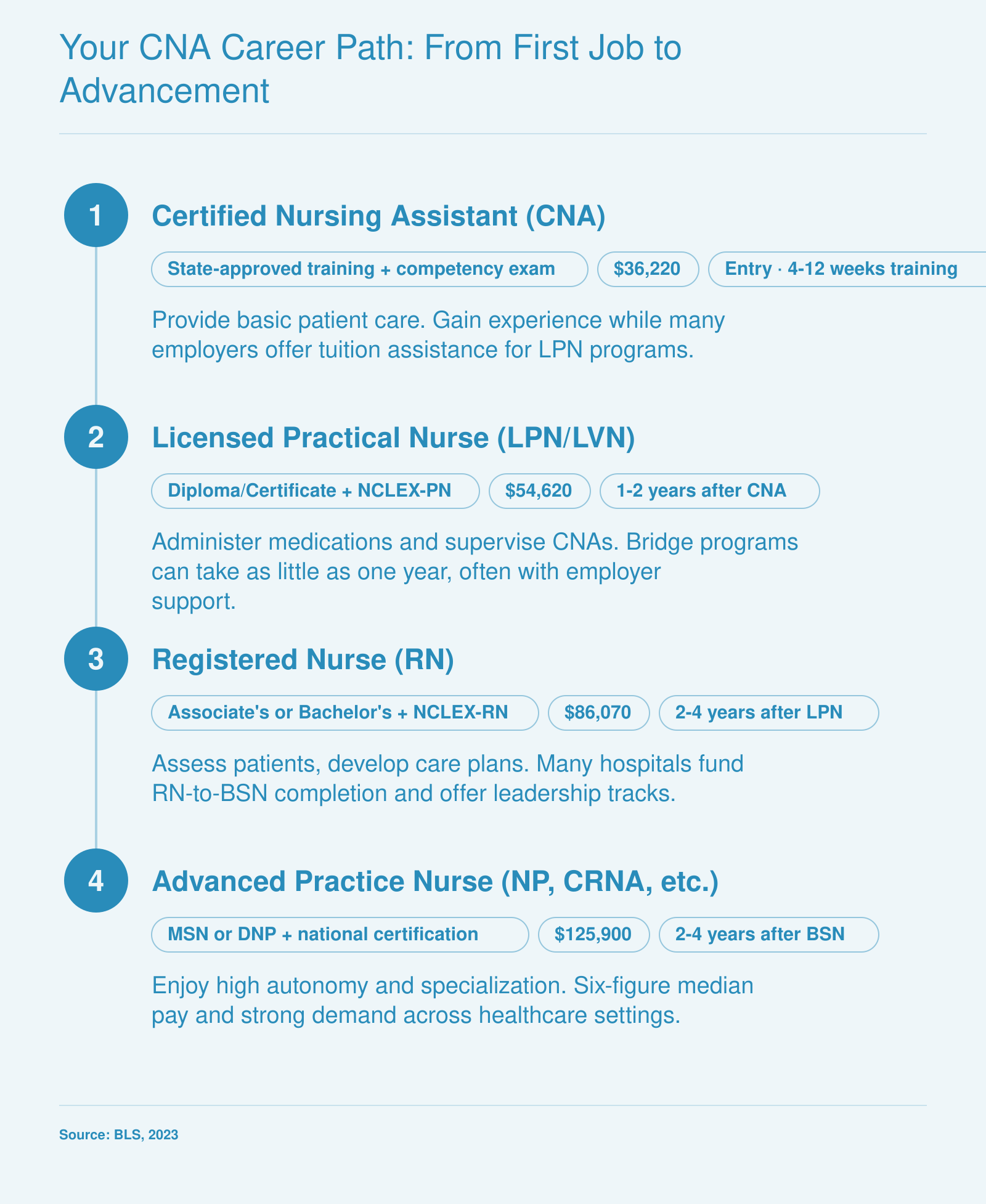
Your CNA Career Path: From First Job to Advancement
The CNA role is a launching pad, not a destination. With experience and further education, you can climb the nursing ladder into higher-paying and more specialized roles. Here’s a typical career trajectory, including timelines and salary growth at each stage.