Key Points
- Nursing assistants in Des Moines earn a median $39,790 annually.
- The Des Moines metro area employs 4,870 nursing assistants.
- Iowa-approved hybrid programs offer online coursework and in-person training.
Compare local CNA programs by cost, format, and career outcomes to start your healthcare career.
Des Moines healthcare employers need hundreds of certified nursing assistants each year, and the metro's nursing homes, hospitals, and home-health agencies compete for newly certified workers. The question for prospective CNAs is not whether jobs exist but which training path delivers certification fastest and at the lowest total cost while still meeting Iowa Board of Nursing approval standards.
You can complete state-approved CNA training through community colleges like DMACC, hospital-sponsored tracks at Mercy or UnityPoint, or private career schools. Tuition in Des Moines ranges from around $600 to $1,800, and most programs finish in four to eight weeks. All state-approved programs prepare you for the Iowa Direct Care Worker Registry exams, but class schedules, financial aid, and employer partnerships vary.
Where will you work as a CNA in Des Moines, and what will your day-to-day look like after you finish your CNA classes in Iowa? The metro area hosts a robust healthcare ecosystem anchored by several major employers, each offering distinct opportunities for newly certified nursing assistants.
UnityPoint Health operates the region's largest health system, including Iowa Methodist Medical Center and Blank Children's Hospital, employing hundreds of CNAs across acute care, outpatient clinics, and specialty units. MercyOne Des Moines Medical Center, part of the CommonSpirit Health network, is another leading employer with openings in medical-surgical floors, emergency departments, and transitional care. Broadlawns Medical Center, the county safety-net hospital, frequently recruits CNAs for its inpatient and long-term care wings. Beyond hospitals, long-term care facilities such as Iowa Jewish Senior Life Center, The Northridge, and Symphony Manor hire the majority of CNAs in the metro, offering skilled nursing and assisted living roles with schedules ranging from traditional shifts to weekend-only options.
Iowa regulations permit CNAs to perform tasks under the supervision of a licensed nurse, including vital signs monitoring, basic wound care, catheter care, repositioning and transferring patients, assistance with activities of daily living, and documentation of intake and output. Delegation rules require that an RN or LPN directly assign and oversee tasks that fall outside routine personal care, such as glucose monitoring or sterile dressing changes. Compared to neighboring states, Iowa's scope is moderately broad: Illinois CNAs have similar responsibilities, while Nebraska permits slightly expanded duties for CNAs working in home health settings.
Employer demand remains strong across Des Moines. Many nursing homes and hospital systems advertise sign-on bonuses ranging from $500 to $1,500 for full-time CNAs, and tuition reimbursement programs are common for employees who commit to one or two years of service. Weekend and night-shift differentials add 10 to 20 percent to base pay at several facilities.
Des Moines Area Community College and Mercy College of Health Sciences both offer CNA-to-LPN bridge programs that grant credit for foundational skills gained during your CNA training, shortening the path to Licensed Practical Nurse licensure. Several area hospitals also sponsor CNA-to-RN partnerships, pairing tuition assistance with guaranteed employment for CNAs willing to pursue an associate or bachelor's degree in nursing.
Each year, the U.S. healthcare system needs to fill over 200,000 nursing assistant positions nationally, according to the Bureau of Labor Statistics. In Iowa, an aging population and steady demand for long term care keep CNA opportunities plentiful. If you are considering this career path, Des Moines offers a strong job market with room to grow.
The Iowa Board of Nursing maintains a public list of state-approved CNA training programs, many of which now include online theory or hybrid formats. For prospective students in and around Des Moines, these flexible options can help you balance training with work, family, or other commitments.
Start your search by visiting the Iowa Board of Nursing website. The board publishes a directory of approved CNA programs across the state, including those that deliver classroom instruction online or through a blended model. This resource is updated regularly and ensures that any program you consider meets Iowa's regulatory standards for nurse aide training.
Des Moines Area Community College (DMACC) is one local institution that often provides hybrid CNA training. Their programs typically combine online coursework with in-person clinical labs held at partner healthcare facilities. Many community colleges in Iowa design these hybrid options with working adults in mind, with evening or weekend clinical rotations available. When reviewing programs, check total required hours, clinical placement procedures, and prerequisites like background checks or immunization records.
The U.S. Bureau of Labor Statistics (BLS) website offers broader context on CNA training requirements and can point you toward state-specific licensing boards or training directories. While the BLS does not endorse individual programs, its Occupational Outlook Handbook outlines the typical education path and provides links to professional organizations that may have additional program-finding tools.
Since even online or hybrid CNA classes require hands-on clinical experience, many programs partner with hospitals, nursing homes, and long-term care facilities in the Des Moines metro area. Contacting these facilities directly can uncover training opportunities or employer-sponsored programs that aren't widely advertised. Ask about partnerships with local colleges and whether they host students for evening or weekend clinical shifts. Building these connections early can ease your transition from training to employment.
By combining online convenience with local clinical placements, Iowa's hybrid CNA programs let you earn certification without putting life on hold.
According to the U.S. Bureau of Labor Statistics, nursing assistants in the Des Moines-West Des Moines metro area earn a median annual wage of $39,790, with a total of 4,870 employed. The table below provides wage and employment data for additional Iowa metros for context. With such robust employment numbers, the demand for CNAs in the region remains strong.
| Metro Area | Total Employment | Median Annual Wage |
|---|---|---|
| Des Moines-West Des Moines, IA | 4,870 | $39,790 |
| Davenport-Moline-Rock Island, IA-IL | 2,030 | $37,870 |
| Cedar Rapids, IA | 1,670 | $39,260 |
| Waterloo-Cedar Falls, IA | 1,400 | $38,090 |
| Iowa City, IA | 1,200 | $37,900 |
| Sioux City, IA-NE-SD | 1,020 | $38,320 |
| Dubuque, IA | 890 | $40,460 |
| Ames, IA | 760 | $39,110 |
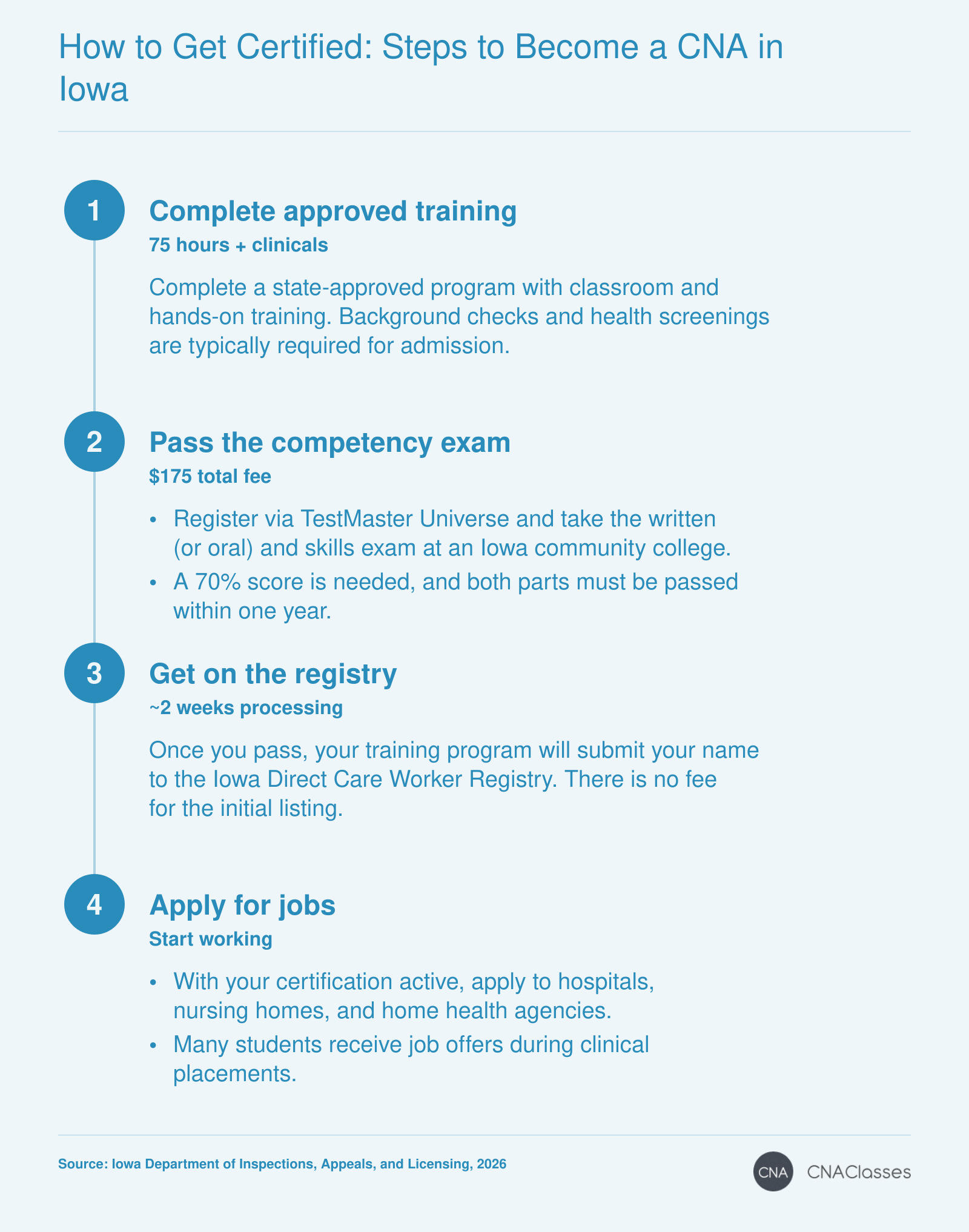
Becoming a Certified Nursing Assistant in Iowa follows a straightforward four-step process. From approved training to the state registry, here is what you need to do.
CNA training in Des Moines is genuinely affordable compared to most healthcare credentials, but the sticker price on tuition rarely tells the whole story. Once you add up books, uniforms, exam fees, and required health screenings, your out-of-pocket total can look quite different. Here is a realistic breakdown so you can plan ahead.
Tuition across Des Moines programs typically falls somewhere between $500 and $2,000, depending on the school and what the fee covers. DMACC's Basic Nurse Aide program, for example, lists a total program cost of around $770, but factor in the state certification exam ($175 to $190)2, a required physical exam ($240), BLS certification ($60), textbook ($100), uniform and shoes ($115), a flu vaccine ($30), and a small class fee ($15), and your real all-in cost climbs considerably.1 Mercy College of Health Sciences bundles things differently: its program runs approximately $1,500, but that price includes tuition, the textbook, BLS certification, and a background check, which can actually simplify budgeting.
The takeaway: always ask programs for a complete cost breakdown before you enroll. Ask specifically about background check fees, immunization requirements, and whether the exam fee is included. These charges are easy to overlook and can add hundreds of dollars.
Several paths exist for students who cannot afford even modest tuition.
Many Des Moines area employers will pay for your training outright or reimburse tuition after hire. UnityPoint Health and MercyOne are among the larger health systems in the metro that have offered paid training or tuition reimbursement for CNA candidates. Inquire directly with a recruiter before enrolling on your own, since employer-sponsored training can eliminate your out-of-pocket costs entirely.
On the scholarship side, DMACC awarded up to 100 students full tuition, fees, and books through its CNA Scholarship in 2025.5 Molina Healthcare has also offered a $2,000 scholarship specifically for Iowa high school seniors entering a healthcare pathway.6
Between employer programs, state grants, and school-based scholarships, a motivated student can often complete CNA training with little to no personal expense. Start by contacting the financial aid office at your chosen program and asking which workforce funding options they accept.
These Des Moines area CNA programs are ranked based on affordability, training quality, and alignment with Iowa’s certification standards. Each school on this list is state-approved and prepares you for the Iowa Direct Care Worker Registry exams.
Ankeny, IA · $11,000/yr (net price)
Best for: Des Moines area budget-conscious students
DMACC’s Basic Nurse Aide program is anchored in the Des Moines metro, with training sites in Ankeny, West Des Moines, and several Polk County locations. Qualified applicants can earn free tuition and supplies through workforce grants, and a unique summer program allows local high school juniors and seniors to obtain CNA certification at no cost. DMACC works directly with Headmaster for written and skills testing, offering a seamless path from classroom to career.
Calmar, IA · $7,000 – $8,000/yr
Best for: Iowa residents seeking hybrid scheduling
Northeast Iowa Community College blends online theory with in-person labs and clinicals, making their CNA program accessible to students across the state. The 80-hour, 1-2 month course costs around $899 and is available in day, evening, and hybrid formats. Credits earned can transfer toward NICC’s nursing program, offering a clear step into higher healthcare credentials.
Estherville, IA · $7,000 – $8,000/yr
Best for: Candidates needing on-site exam access
Iowa Lakes Community College serves as an official testing site for the Iowa Direct Care Worker Registry exams, making it a convenient choice for students who want to train and test in one location. The program prepares you for the two-part state certification process, with theory and skills evaluations offered at five campus sites. Exam fees total $190, and graduates can immediately enter long-term care employment.
Cedar Rapids, IA · $5,000 – $10,000/yr
Kirkwood Community College’s Nurse Aide program is tailored to Iowa’s updated testing procedures, with written exams administered via TestMaster Universe on campus. The campus-based training focuses on long-term care skills, including resident safety, hygiene, and nutrition. 100% attendance is recommended, and students must be at least 16 with a clean background check to begin clinicals.
Mason City, IA · ~$10,000/yr (est.)
North Iowa Area Community College offers a 100-hour Nurse Aide program with classroom theory, lab practice, and clinical experience. Students can choose face-to-face or hybrid delivery, and the program runs multiple times per year at several locations. With an estimated $190 exam fee and tuition assistance options, it’s a flexible route to Iowa CNA certification.
Sioux City, IA · $9,000/yr
Western Iowa Tech Community College provides a 4-credit CNA certificate that integrates smoothly into nursing degree pathways. The 75-hour course includes classroom, lab, and clinical instruction, and graduates receive one free attempt at the state skills exam. In-state tuition is $852, making it one of the more affordable credit-bearing options in the state.
West Burlington, IA · $12,000/yr
Southeastern Community College’s Nurse Aide Certificate is a concise 3.38-credit program that includes 32 clinical hours in a long-term care facility. The curriculum emphasizes communication, infection control, and medical asepsis, and graduates are prepared to take the state certification exams. Articulation agreements with universities like Grand Canyon University ease the transition to advanced nursing education.
Davenport, IA · $14,000/yr (net price)
Eastern Iowa Community College District offers a flexible CNA program with academic and training certificate tracks, allowing students to choose the path that best fits their goals. An 8-week hybrid option and multiple campus sites accommodate busy schedules, and the $175 testing fee is clearly outlined. The program is approved by the Iowa Department of Inspections and Appeals and serves as a stepping stone to nursing degrees.
Fort Dodge, IA · $9,000/yr (net price)
Iowa Central Community College’s 76-hour Nurse Aide course is taught by registered nurses and serves as a prerequisite for the college’s nursing program. Both credit and non-credit options are available, with the credit version costing $697 plus $116 in materials. Iowa Central also functions as a testing site for the state registry exam, adding convenience for graduates.
Council Bluffs, IA · $15,000/yr
Iowa Western Community College offers a credit-bearing CNA course that awards 3 college credits and functions as a prerequisite for its nursing program. Small cohort sizes of 9-12 students ensure personalized attention, and the $595-$695 cost covers classroom, lab, and 30 clinical hours. Courses run monthly at multiple western Iowa locations, with evening options available.
Reviews can tell you things a program brochure never will, but the tradeoff is that any single review reflects one person's experience. The useful move is to read enough of them to spot recurring themes, both positive and negative, that suggest something real about how a program operates.
Across Google Reviews, nursing forums, and school-specific comment threads, Des Moines CNA students most often praise three things: instructor experience, the quality and variety of clinical placements, and the sense that instructors genuinely wanted students to pass the state exam. Programs like DMACC and Mercy College of Health Sciences tend to generate comments about structured coursework and accessible faculty. Smaller private programs such as American Institute of Caring, AM Training Institute, Health Tech Associates, and Stone Healthcare Academy receive notes about a more personal, small-cohort atmosphere where students feel less anonymous.
Hands-on practice comes up repeatedly as a make-or-break factor. Students who felt confident walking into their state skills exam typically credited labs where they practiced the same tasks multiple times under close supervision, not just watched a demonstration.
Honest patterns also emerge on the negative side. Limited evening and weekend slots appear in reviews of several programs, which is a real scheduling constraint for students who work full time. A smaller number of reviews mention equipment that felt dated compared to what students encountered at clinical sites. Neither issue necessarily reflects poorly on a program's overall quality, but they are worth asking about directly when you inquire.
Job placement support gets mixed mentions. Some graduates describe active connections to local employers and tip-offs about open positions. Others say that support stopped at exam prep. If job placement support is important to you, ask programs what that process looks like, and see our guide to landing your first CNA job for actionable advice.
Treat reviews as pattern recognition, not verdicts. A single outlier complaint rarely signals a systemic problem. But if the same issue shows up across five or six independent reviews over different time periods, pay attention to it. When you visit or call a program, bring those patterns up as questions. A program with nothing to hide will address them directly.
Find answers to the most common questions about CNA training in Des Moines, including program length, costs, online options, and exam details.