
Key Points
- Phoenix employs 11,740 CNAs with median pay of $42,690.
- CNA training in Phoenix costs between $1,250 and $2,500.
- Free CNA training is available through employers and state programs.
Find the right CNA program in Phoenix: compare costs, accreditation, and certification steps.
Maricopa County adds roughly 200 residents each day, and Phoenix hospitals and long-term care facilities are racing to staff up. For aspiring CNAs, that math translates into steady job offers after just a few weeks of training. The median annual wage for nursing assistants in the metro area sits at $42,690, with experienced aides earning more in specialty settings. Low-cost programs, employer-funded tuition, and a clear path to Arizona certification make the leap into direct patient care surprisingly accessible.
Maricopa County adds roughly 200 residents per day, and a large share are retirees settling into the Valley for warm winters and lower costs than California, a trend that has made CNA classes in Arizona essential. That population math is the single biggest reason certified nursing assistants are in short supply across Phoenix: more seniors means more skilled nursing beds, more home health visits, and more hospital admissions that need bedside support.
The metro's largest employers span every care setting, so you can pick an environment that matches the pace you want.
Most Phoenix CNAs use the credential as an on-ramp to LPN or RN roles. Banner Health, HonorHealth, and Dignity all publicize tuition reimbursement and internal nursing pathways for CNAs who stay six to twelve months. Because demand is so tight, new grads in Phoenix typically field offers within a few weeks of passing the state exam, a clear sign that how to get a CNA job is easier in this market, and starting wages have climbed noticeably as facilities compete for staff.
For many Phoenix students, choosing a CNA training program means balancing the flexibility of online coursework with the essential hands-on practice required for certification. While state regulations mandate in-person clinical hours, a growing number of Arizona schools now offer hybrid formats that blend digital theory classes with on-campus labs and local clinical rotations. This model can be a practical fit if you are juggling work, family, or a commute across the Valley.
A true hybrid CNA program delivers the majority of classroom instruction online, covering topics like infection control, patient rights, and communication skills, through structured modules you complete on your own schedule. The program then requires you to attend scheduled in-person sessions for skills labs and supervised clinical practice. This approach reduces the number of days you need to be on campus each week, freeing up time for other responsibilities while still giving you direct, instructor-led training with equipment and real patients.
One of the Arizona schools offering this blended model is Pima Medical Institute-East Valley in Mesa. Their Nursing Assistant/Nurse Aide Certificate Program uses a hybrid format and can be completed in just six weeks. Coursework is presented online, while hands-on training takes place at the campus lab and during clinical externships at local healthcare facilities. The program prepares you for the Certified Nursing Assistant (CNA) exam and includes career services support.
Even if you study theory online, Arizona requires that clinical hours be completed in person at approved sites. For hybrid students, that means you will need to travel to a partner facility (such as a hospital, nursing home, or long-term care center) in the Phoenix metro area. Schools like Pima Medical Institute coordinate these placements for you, often offering evening or weekend rotations to accommodate working learners.
The main benefit of a hybrid CNA program is its ability to fit a busy schedule. By moving lectures and assignments online, these programs can condense on-campus attendance to a few days per week, making it easier to maintain a job or care for family. If you are looking for a faster route to certification without sacrificing quality, a hybrid option in Phoenix may be worth exploring.
Beyond the top-rated programs, here are additional in-person CNA training options located in Phoenix and nearby cities. These programs provide hands-on training and are within easy commuting distance.
According to the Bureau of Labor Statistics (2024), the Phoenix-Mesa-Chandler metropolitan area employed 11,740 nursing assistants with a median annual wage of $42,690. This is among the higher-paying metro areas in Arizona, and wages typically increase with experience, specialty certifications, and employment in hospital settings. The BLS projects continued demand for nursing assistants, reinforcing Phoenix as a strong job market for entry-level healthcare professionals.
| Metro Area | Total Employment | Mean Annual Wage | 25th Percentile | Median Annual Wage | 75th Percentile |
|---|---|---|---|---|---|
| Phoenix-Mesa-Chandler, AZ | 11,740 | $43,740 | $38,360 | $42,690 | $45,520 |
| Tucson, AZ | 2,810 | $42,090 | $37,340 | $39,310 | $45,520 |
| Prescott Valley-Prescott, AZ | 580 | $43,430 | $37,980 | $42,070 | $46,470 |
| Lake Havasu City-Kingman, AZ | 440 | $40,000 | $33,980 | $39,680 | $42,570 |
| Flagstaff, AZ | 400 | $42,260 | $41,440 | $41,440 | $41,560 |
| Yuma, AZ | 400 | $37,850 | $35,450 | $35,830 | $38,720 |
| Sierra Vista-Douglas, AZ | 180 | $38,620 | $35,910 | $37,220 | $41,670 |
What does it actually take to become a certified nursing assistant in Arizona, and where do you go to make it official?
Becoming a CNA in Arizona follows a clear sequence of steps. Knowing them upfront prevents surprises along the way. Here’s what the process generally looks like.
Your first move is enrolling in a CNA program that the Arizona State Board of Nursing has approved. These programs combine classroom instruction with hands-on clinical hours, covering skills such as vital signs, personal care, infection control, and patient communication. The Board maintains an official list of approved programs on its website; cross-checking that list before you enroll protects you from investing time and money in a program that won’t qualify you to sit for the exam.
Programs vary in length, schedule, and cost, so contacting schools directly is the most reliable way to get current details about tuition, class times, and any prerequisites the school requires beyond what the Board mandates.
Once your training is complete, you’ll need to pass a two-part competency exam: a written (or oral) knowledge test and a hands-on skills demonstration. Arizona works with established exam providers to administer these tests at locations throughout the state. Checking with your exam provider directly gives you the most accurate and current information on scheduling, testing fees, and what the exam covers. Content outlines are typically posted on the provider’s website, so reviewing them early is wise.
Arizona requires a criminal background check as part of the certification process. The Board’s website outlines what is reviewed and how to submit your information. It’s smart to review these requirements early, so any issues can be addressed before you finish training.
CNA certification in Arizona is not permanent. Renewal requires documented proof of active work as a nursing assistant and, in some cases, continuing education. The Board’s website outlines the renewal timeline and what you need to submit. For exact fees or renewal deadlines, always confirm directly with the Board, since those details can change.
The Bureau of Labor Statistics at BLS.gov is a useful resource for understanding broader employment trends in healthcare, though for anything specific to Arizona’s certification rules, the Board of Nursing is your authoritative source.
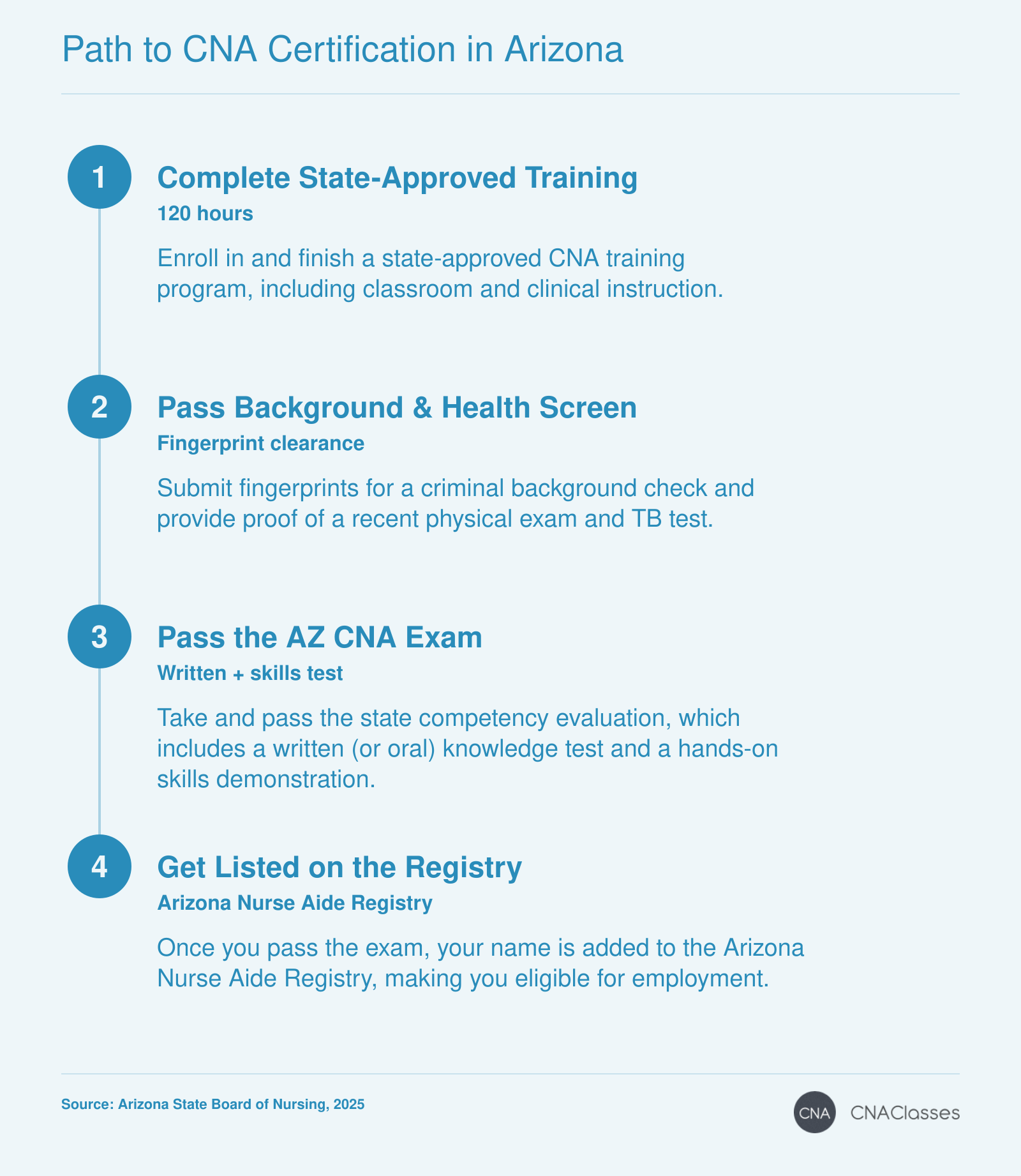
Becoming a Certified Nursing Assistant in Arizona follows a clear four-step process. Each milestone is designed to ensure you have the skills and background to provide safe, competent care. Here's the path from training to registry listing.
Phoenix-area CNA programs range from roughly $1,250 to just under $2,500 in total cost, making them affordable compared to many other healthcare credentials. That range shifts significantly depending on what each school includes in its fees and what you pay separately.
The table below compares six programs using 2026 cost data. The exam fee ($130) reflects the Arizona state certification test charged separately from tuition at all of these schools.
| Program | Tuition | Fees & Books | Exam | Total | |
|---|---|---|---|---|---|
| [[LINK:1 | Star Canyon School of Nursing]] | $950 | $300 | $130 | $1,250 |
| [[LINK:2 | Moore Medical Training Institute]] | $1,050 | $350 | $130 | $1,400 |
| Maricopa Career Institute | $1,475 | Included | $130 | $1,4754 | |
| LifeWork Education | $1,400 | $400 | $130 | $1,8005 | |
| Arizona Technical Training Institute (AZTTI) | $1,400 | $600 | $130 | $2,1306 | |
| [[LINK:3 | Medstar Academy]] | $1,530 | $734 | $130 | $2,497 |
Star Canyon and Moore Medical sit at the affordable end of the market. Medstar Academy has the highest total cost, though its fees and books bundle may cover materials that other schools charge separately or leave to the student.
None of these programs currently accept federal financial aid, so your options center on payment plans and outside sponsorship.
If your employer offers tuition reimbursement or sponsorship, AZTTI explicitly accommodates that path, which can bring your out-of-pocket cost close to zero.6
Even the lowest-cost programs carry expenses that do not always appear in advertised tuition. Budget an additional $100 to $200 for items like scrubs, a stethoscope, and a background check. Some schools bundle these into their fees; others do not, so confirm the full list before you enroll. If you can qualify for an employer-sponsored or grant-funded program, total costs can drop under $500, a scenario covered in the next section on free CNA training options.
Several Phoenix-area employers will train you as a CNA at zero out-of-pocket cost, and state workforce programs can fill the gap when employer sponsorship is not available. Knowing where to look can save you hundreds or even thousands of dollars while launching your healthcare career faster.
The most direct path to free training is through healthcare facilities that cover tuition in exchange for a work commitment after you earn your certification.
Because these programs require a service commitment, ask each employer about the length of the agreement, scheduling expectations, and whether you will be paid during training.
If employer-sponsored training does not fit your situation, public funding may cover your tuition instead. Arizona@Work, operated through the Maricopa Workforce Center, can pay for CNA training when the occupation appears on its in-demand list5. Eligibility is based on income or employment status, so contact your local Arizona@Work office to confirm whether you qualify.
The Maricopa Community College District periodically offers workforce development grants that reduce or eliminate tuition at member colleges such as Phoenix College and GateWay Community College. Check each school's financial aid page for current grant cycles.
High school students have two notable options. Metro Tech High School, at 3839 W Camelback Rd, offers a free Career and Technical Education CNA program for enrolled students3. Phoenix Job Corps, at 518 S 3rd St, provides no-cost CNA training for individuals ages 16 to 24 who meet financial-hardship criteria4.
Before enrolling in any free program, verify that it appears on the Arizona State Board of Nursing's approved nursing assistant program list. This step ensures your training hours count toward certification. You can also search job boards for "free CNA training" listings in Phoenix, as many facilities advertise sponsored slots alongside open positions. When in doubt, call the employer's human resources department directly to ask about upcoming cohort dates and application deadlines.
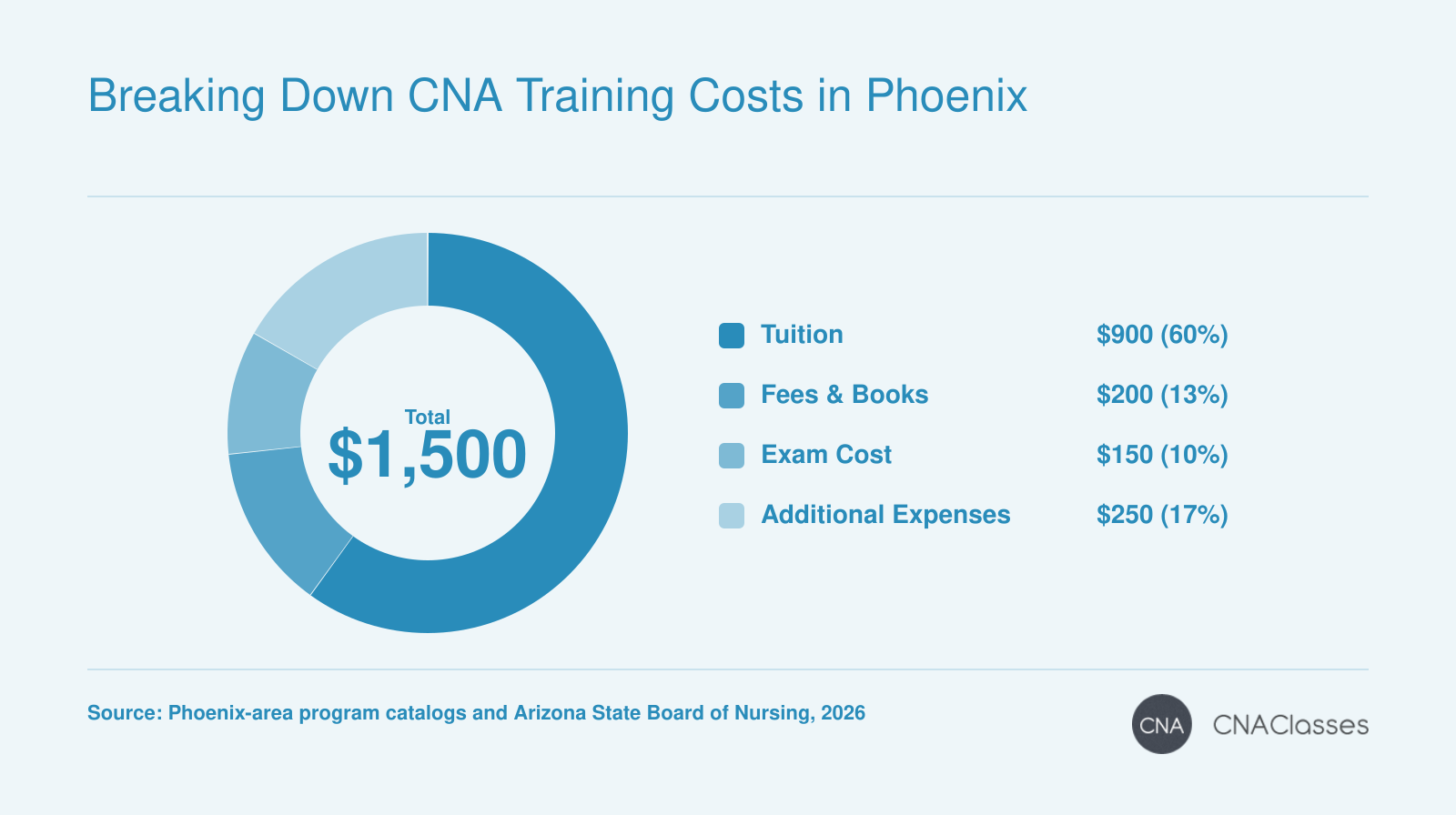
The total cost of CNA training in Phoenix typically ranges from $800 to $2,500, depending on the program type and included materials. Below is a representative breakdown of a mid-range program, showing how each expense contributes to the overall investment.
Below are the top CNA programs serving Phoenix students, ranked by IPEDS completion data, accreditation status, and program fit. The list highlights schools across Arizona offering strong nursing assistant training, with particular attention to those in the Phoenix metro area.
Somerton, AZ
Best for: Rural healthcare career starters
Regional Center for Border Health, located in Somerton, specializes in training for rural and border-region healthcare roles. Its 160-hour Nursing Assistant program exceeds Arizona's minimum requirements, preparing students for certification in just six weeks. The curriculum includes extensive hands-on labs and a clinical externship, with all materials and exam fees included in the $3,400 tuition.
Tucson, AZ · $0 – $5,000/yr
Best for: Stackable credential seekers in Tucson
Pima Community College in Tucson offers a one-semester Nursing Assistant certificate that stacks into its LPN and RN pathways. In-person classes at multiple campuses cover vital signs, infection control, and communication, with clinical rotations in local facilities. As a public institution, it provides affordable in-state tuition and robust transfer options.
Mesa, AZ · $22,000/yr (net price)
Best for: Fast hybrid CNA training in metro Phoenix
Pima Medical Institute-East Valley in Mesa delivers a hybrid or fully campus-based Nursing Assistant certificate in just six weeks. Students gain real-world skills through day-one hands-on training and a clinical externship. The program is ABHES-accredited and approved by the Arizona Board of Nursing, with financial aid options including Pell Grants and scholarships.
Chandler, AZ · $2,000 – $9,000/yr
Chandler-Gilbert Community College, part of the Maricopa system, provides a Fast Track Nurse Assisting Certificate requiring only 2-4.5 credits. Located in Chandler near Phoenix, the program offers part-time study and uses shared Maricopa simulation labs and clinical sites across the county. Applicants need a high school diploma and fingerprint clearance.
Avondale, AZ · $2,000 – $9,000/yr
Estrella Mountain Community College in Avondale offers the NUR158 Nursing Assistant course, approved by the Arizona State Board of Nursing. The campus-based program emphasizes holistic care and therapeutic communication, with clinical experiences in acute and long-term settings. It serves the west Phoenix metro area and is part of the Maricopa Community Colleges district.
Kingman, AZ · ~$6,000/yr (est.)
Mohave Community College in Kingman provides a one-semester Nursing Assistant certificate with flexible 8-week accelerated or 16-week traditional formats. Through WAVE/CTED and AZ@Work partnerships, eligible students may access sponsored training, making it a route for workforce development in northern Arizona.
Coolidge, AZ · $5,000/yr (net price)
Central Arizona College in Coolidge offers a Nursing Assistant program as part of its nursing department. While detailed program outcomes are not widely published, the college's high NCLEX-RN pass rate reflects a supportive nursing education environment. Its low net price makes it an affordable option between Phoenix and Tucson.
Phoenix, AZ · $10,000 – $15,000/yr
GateWay Community College operates multiple Phoenix locations and offers a Nurse Assisting Certificate of Completion aligned with Arizona certification requirements. The program includes simulation labs and clinical placements in Phoenix hospitals and nursing homes. Applicants must attend an info session and obtain a DPS fingerprint card.
Yuma, AZ · $3,000 – $10,000/yr
Arizona Western College in Yuma has been approved by the Arizona State Board of Nursing since 1990. Its Nursing Assistant program emphasizes rural healthcare and workplace readiness, with modern facilities and experienced faculty. Students gain practical clinical experience in a supportive environment focused on rural community needs.
Prescott, AZ · $3,000 – $9,000/yr
Yavapai College in Prescott delivers a 6-credit Nursing Assistant Certificate that combines classroom and clinical training. Admission requires background, health, and drug screenings. While federal financial aid is not available, the program prepares students for state exams and emphasizes diverse populations and legal-ethical care.
Programs that combine affordable tuition with strong exam pass rates and reliable job placement give students the clearest path from the classroom to a rewarding healthcare career.